In this article
The Nuna car-seat lineup in Canada is a sequence of different jobs, not a staircase triggered by birthdays. PIPA, PIPA Lite and PIPA Urbn are removable rear-facing infant carriers. RAVA is a fixed-in-vehicle convertible that can be used rear-facing and then forward-facing. ROYL is a later forward-facing five-point-restraint-to-booster seat. AACE is a dedicated belt-positioning booster. Start with the stage your child is in now, then let the Canadian label and manual decide when that stage ends.
The answer can change with child fit, vehicle fit and installation routine. A lighter carrier may require a base. A baseless design may have lower published child limits. A seat with overlapping weight ranges may still be the wrong stage. This guide uses four checkpoints to keep those trade-offs visible.
Checkpoint 1: identify the restraint job
Transport Canada describes four stages: rear-facing, forward-facing with a built-in five-point restraint, booster use and the vehicle seat belt alone. It advises keeping children rear-facing until they reach the rear-facing seat's weight or height limit, and keeping children in each stage as long as possible. Provincial and territorial rules may add age, height or weight requirements.
That creates the first branch:
- Need a removable infant carrier? Compare PIPA, PIPA Lite and PIPA Urbn.
- Need a seat that stays installed and can begin rear-facing? Compare RAVA against other Canadian convertible seats, not against a booster.
- Child has outgrown rear-facing and still needs an internal five-point restraint? Compare the RAVA's forward-facing mode with ROYL's forward-facing five-point-restraint mode, using every age, weight, height and installation requirement.
- Child is ready for a belt-positioning booster? Compare ROYL booster mode and AACE, then verify belt fit in the actual vehicle.
Do not skip directly from infant carrier to booster because the published weight ranges appear to touch. The restraint type, developmental readiness and manual requirements are part of fit.
The current Canadian lineup at a glance
| Model | Job | Canadian published use range | Routine-defining detail |
|---|---|---|---|
| PIPA | Rear-facing infant carrier | 4-35 lb; less than 32 in; 1 in head clearance | 7.9 lb carrier; base included |
| PIPA Lite | Rear-facing infant carrier | 4-22 lb; less than 32 in; 1 in head clearance | 5.3 lb carrier; vehicle use requires the base |
| PIPA Urbn | Rear-facing infant carrier | 4-22 lb; 15-29 in; at least 1 in of head clearance | 7 lb carrier; no separate base required |
| RAVA | Rear- and forward-facing convertible | Rear: 5-40 lb; Forward: 25-65 lb; 49 in or less | Stays installed; not a stroller carrier |
| ROYL | Forward-facing five-point restraint, then high-back booster | Five-point restraint: age 2+, 30-65 lb; Booster: age 4+, 40-120 lb and 38-57 in | Starts forward-facing; installation method changes use limits |
| AACE | High-back, then backless belt-positioning booster | High-back: age 4+, 40-110 lb and 38-60 in; Backless: age 5+, 50-120 lb and 38-60 in | No internal five-point restraint |
These are screening limits from current Canadian Nuna sources. They are not complete instructions. The exact seat label and manual control, including head position, restraint routing, recline, installation method, vehicle seating position and any additional fit criteria.
Checkpoint 2: choose the infant carrier by the vehicle routine
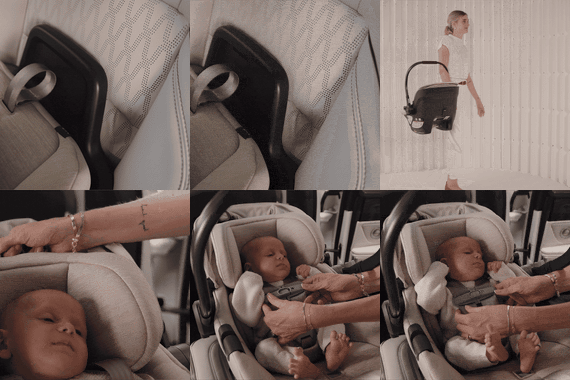
All three PIPA models are removable rear-facing carriers and connect to Nuna strollers, but their vehicle routines differ enough that weight alone should not decide.
PIPA: the broadest published infant range
The PIPA Infant Car Seat has a Canadian use range of 4 to 35 pounds. Its current Canadian manual requires height to be less than 32 inches and the top of the child's head to remain at least 1 inch below the top of the carrier. Nuna lists the carrier at 7.9 pounds and includes the True Lock base. For a household with one main vehicle and room for a permanent base, it is the most straightforward PIPA branch. It also offers the highest published weight limit among the three current Canadian PIPA models.
The limit that matters is whichever is reached first, along with the manual's fit rules. A child can outgrow a seat by height or head position before the weight number is reached.
PIPA Lite: the lightest carry, with a base requirement
The PIPA Lite weighs 5.3 pounds without canopy or insert. That is 2.6 pounds less than the published PIPA carrier weight and can matter on stairs, long corridors or repeated daycare handoffs.
The reversal condition is equally clear: Nuna states that PIPA Lite must be installed in a vehicle with its base. Its child range is 4 to 22 pounds. The Canadian PIPA Lite manual requires height to be less than 32 inches and the top of the child's head to remain at least 1 inch below the top of the restraint. It is a strong routine fit when carrying effort is the biggest problem and every vehicle can support the planned base setup. It is a poor fit when spontaneous use in vehicles without the base is central to the week.
PIPA Urbn: change vehicles without carrying a separate base
The PIPA Urbn uses integrated rigid connectors and can also be installed with the vehicle belt according to the Canadian manual. Nuna lists it at 7 pounds, for infants 4 to 22 pounds and 15 to 29 inches; the top of the child's head must also remain at least 1 inch below the top of the carrier. It attaches directly to TAVO series and TRVL strollers without adaptors.
Urbn is the route to examine when taxis, rideshares or two vehicles make a separate base inconvenient. That does not mean every vehicle position is compatible. Nuna directs users to the vehicle fitting information, and both the car-seat and vehicle manuals remain required.
The infant-carrier decision in one line
Choose PIPA for the broadest published infant envelope, PIPA Lite for the lowest carrier weight when a base is always available, or PIPA Urbn for a no-separate-base routine with lower published child limits. Then verify the actual installation and child fit.
Checkpoint 3: know what changes when the carrier stops moving
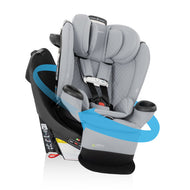
The RAVA Convertible Car Seat is not the next version of PIPA. It performs a different job. It stays in the vehicle and supports rear-facing children from 5 to 40 pounds, then forward-facing children from 25 to 65 pounds, with a maximum stated height of 49 inches in both modes.
Moving from a PIPA carrier to RAVA removes the click-out transfer. Every arrival means unbuckling the child from the fixed seat. In return, a convertible seat can keep a child rear-facing after an infant carrier is outgrown. Transport Canada advises keeping a child rear-facing as long as the child remains within the seat's rear-facing limits.
A family may also choose a convertible from the start if the newborn meets all seat requirements and the vehicle installation works. That does not recreate infant-carrier convenience. Compare the daily sequences:
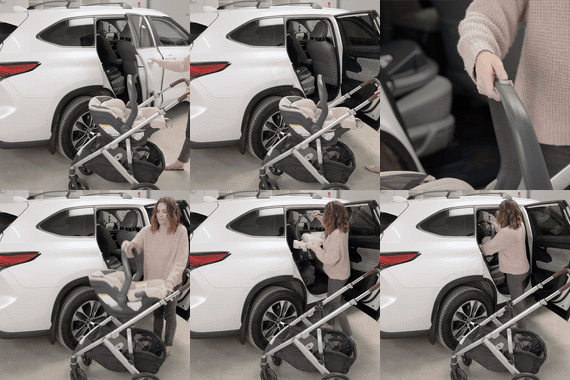
- Carrier route: buckle indoors, click into base, remove carrier at destination, attach to stroller when needed.
- Convertible route: place and buckle the child in the installed seat for every trip, then move the child to a stroller or carrier at the destination.
The choice is about the transfer routine as well as the purchase timeline. Do not claim savings from skipping an infant seat without including any stroller newborn setup or other carrying solution you will actually need.
Checkpoint 4: separate forward-facing restraint use from booster readiness
The ROYL and AACE overlap in published weights, but the internal restraint is different.
ROYL five-point-restraint mode: a later forward-facing stage
ROYL begins as a forward-facing combination seat with a five-point restraint. Nuna Canada specifies at least age two and 30 to 65 pounds when installed with the vehicle belt and tether. When installed with UAS and tether, the stated range is 30 to 40 pounds and 49 inches or less. That installation-method distinction is material: reaching 40 pounds does not necessarily end use of the seat, but it can require changing the installation method according to the manual.
ROYL then converts to a high-back booster for children at least age four, 40 to 120 pounds and 38 to 57 inches. A child must still be ready to sit properly with the vehicle belt for the entire ride.
AACE: a dedicated booster path
AACE has no internal five-point restraint. Its high-back mode is listed for children at least age four, 40 to 110 pounds and 38 to 60 inches. Its backless mode begins at at least age five, 50 to 120 pounds and 38 to 60 inches. Transport Canada says a booster must fit both the child and the vehicle; the lap belt should sit snugly on the hips, and the shoulder belt must remain correctly positioned.
Choose ROYL when the child still needs a forward-facing internal five-point restraint and you want the same shell to become a high-back booster later. Consider AACE when the child is already booster-ready and a dedicated high-back-to-backless path fits the vehicles involved. Do not use the lower edge of a booster weight range as the only readiness test.
Use this transition worksheet
For the seat currently in use, write down the following before shopping:
- Exact model and Canadian model number. Transport Canada warns that seats purchased outside Canada may not comply with Canadian standards, so do not transfer another country's limits or installation instructions to a Canadian model.
- Child's current weight and standing height. Recheck rather than relying on a recent estimate.
- Current mode limits and fit rules. Include the required head clearance, restraint position and any age minimum.
- Vehicle seating position and installation method. Record UAS or seat belt, top-tether availability where required, and whether the vehicle manual permits that position.
- The actual reason for transition. Name the limit or recurring routine problem. "Turning four" or "friends use boosters" is not enough.
If no documented limit has been reached and the seat still fits correctly, the evidence may point to staying in the current stage. Transport Canada specifically cautions against rushing from one stage to the next.
Canada-only checks before purchase
Look for the National Safety Mark on the seat. Transport Canada states that it is proof the seat meets Canadian standards and that it is illegal to import, sell or use a child car seat in Canada without that mark, apart from a narrow exception for certain custom restraints. Do not transfer a US manual, weight range, product name or installation video onto a Canadian seat.
Also check the current recall and safety-notice databases and register the seat with the manufacturer. Registration allows the manufacturer to contact owners when a notice affects a specific product.
For RAVA owners, Nuna Canada currently has a seat-pad and cleaning-kit advisory for listed Canadian model numbers. Nuna states that the US recall does not apply to Canadian seats, while offering a kit and revised pad for specific Canadian RAVA models. This is an ownership check, not a reason to generalize that every RAVA is recalled. Match the exact model number to the advisory.
Vehicle fit can overturn the model choice
No published width or marketing phrase can guarantee that a seat fits your vehicle, provides usable front-passenger space, or installs correctly in a particular seating position. Transport Canada's buying checklist asks whether the child seat fits the car, and its installation guidance requires reading both manuals.
If possible, test the exact Canadian model in the intended vehicle before purchase. Check that the permitted installation can be achieved, that the recline is correct, that adjacent restraints still work independently and that the front passenger can sit safely. For a multi-vehicle household, repeat the check in every vehicle rather than assuming the result transfers.
When another brand may fit better
Nuna's current Canadian line does not make every decision automatic. A different manufacturer may offer a shell shape, infant carrier connection, width, load leg, rotation feature or stage combination that better fits your vehicle and routine. Compare Canadian models under the same dimensions: child fit, vehicle installation, restraint stage, daily transfer and cleaning.
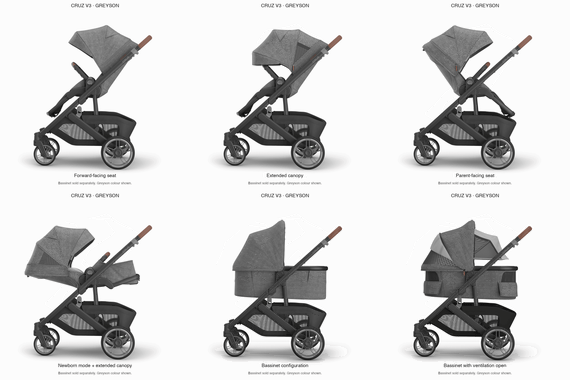
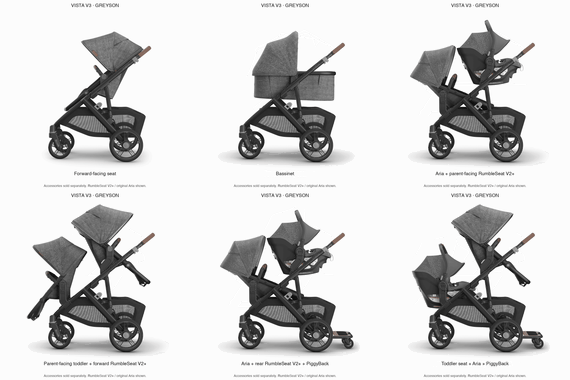
For example, Clek's Canadian Liing is another infant-seat route with its own vehicle and stroller compatibility, while UPPAbaby's current Canadian infant seats connect directly to that brand's Cruz V3. Those ecosystem differences are useful only after the seat fits the child and vehicle. Brand continuity cannot substitute for a correct installation.
The stage path
Use PIPA, PIPA Lite or PIPA Urbn when a removable rear-facing carrier solves the routine. Use RAVA when a fixed convertible seat is the right rear-facing and later forward-facing path. Consider ROYL only after the child has outgrown rear-facing and meets every five-point-restraint-mode requirement. Move to ROYL booster mode or AACE only when the child meets the seat limits, the law and the behavioural and belt-fit demands of booster use.
The most useful Nuna lineup is not a preselected sequence of boxes. It is a set of stage-specific tools. The right next seat is the one that keeps the child in the appropriate stage, installs correctly in the actual vehicle and has a daily routine the caregiver can reproduce every trip.