In this article
Long mixed-surface routes point toward the Nuna MIXX Next when the stroller will carry most of the family's daily load. Stairs, a condo entry, transit transfers, and a smaller folded package make the Nuna TRIV Next the other route to examine. The answer can reverse if your lighter stroller still has to absorb rough routes every day, or if the fuller MIXX Next will be lifted into a vehicle several times per outing.
This is not a choice between a "good" and "better" stroller. It is a choice between two different places to carry the burden. MIXX Next puts more structure into the rolling setup. TRIV Next reduces the structure you have to lift and store. The useful question is which burden appears more often in your week.
The 60-second route decision
| Your recurring route | Start with | Reason to reconsider |
|---|---|---|
| Long walks, groceries, rougher sidewalks, frequent seat recline changes | MIXX Next | You must carry it up stairs or lift it into a high cargo floor daily |
| Elevator, cafe, transit, compact entryway, frequent car loading | TRIV Next | Your normal route is uneven enough that a larger chassis matters more than lift weight |
| Newborn travel system with a Nuna PIPA | Either | Compare the complete fold and loading routine, not only compatibility |
| One stroller expected to handle nearly every local outing | MIXX Next | Your storage and lifting limits are hard constraints |
First checkpoint: what does each stroller ask you to lift?
Nuna Canada lists the MIXX Next at 28.3 lb without its arm bar and insert. Its folded dimensions are 27.5 by 23.6 by 19 inches. The current Canadian TRIV next BMW variant is 18.4 lb without its insert, armbar and canopy, and folds to 22.5 by 24 by 15 inches. Both exclusions matter: these are manufacturer specification weights, not a promise about the exact ready-to-roll configuration in your hallway.
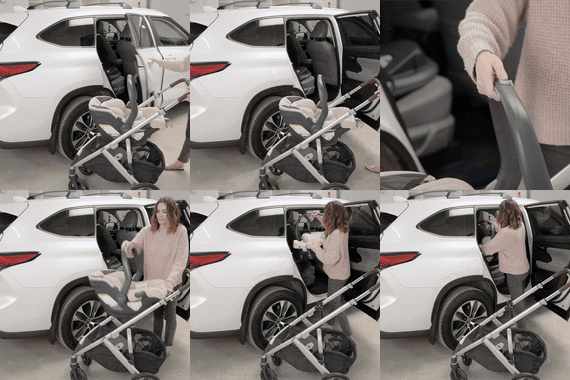
Rehearse each lift with a safe object close to the stroller's published weight. Lift from floor to trunk height, turn, and set it down without leaning it against your clothing. If the MIXX-range lift is already awkward before adding a diaper bag or managing a child, the TRIV Next has solved a real daily problem.
Do not stop at weight. Tape each folded rectangle on the floor using the published length and width, then add clearance for your hands. A stroller can be lighter yet still block a closet door; a heavier stroller can fit neatly because its standing fold works with your storage shape. The TRIV Next manual shows the seat attached during folding and the folded stroller standing on its handle and front wheels. The MIXX Next stands when folded. Your test is therefore about the resulting package, not whether one model technically folds.
Second checkpoint: where should the stroller carry effort?


The MIXX Next uses rear-wheel Free Flex suspension, progressive front suspension, lockable front swivel wheels, and foam-filled tires. The current TRIV next BMW variant uses spring suspension under the seat, all-wheel suspension, large rear wheels and foam-filled rubber tires. Those published systems do not prove that one will feel smoother on every block. They do show that both are designed for more than a bare-bones travel chassis.
The distinction is chassis scale and daily intent. MIXX Next is 23.6 inches wide and 32.7 inches long when open; TRIV Next is 22.5 inches wide and 37 inches long. The TRIV is narrower but longer in the published open dimensions. That is a useful warning against assuming "lighter" means smaller in every direction. Measure your elevator door and trunk opening rather than relying on category names.
For a route with cracked sidewalks, curb cuts, a weekly market basket, and long walking time, the MIXX Next's extra carried mass may be a trade you willingly make for its full-size setup. For a route made of smooth sidewalks interrupted by stairs, narrow doors, a bus, and a cafe, the TRIV Next moves effort away from lifting and storage. Neither conclusion is a laboratory performance claim; it is a route-based inference from the published chassis, fold, and weight specifications.
Third checkpoint: seat and newborn plans
MIXX Next accepts PIPA series infant car seats using its included ring adaptor. MIXX Next has a reversible stroller seat and is listed from birth to 50 lb. Use the current Canadian TRIV Next manual to choose the approved newborn configuration for the exact trip. Follow the current Canadian manual and the child requirements for the exact infant seat you own.
MIXX Next adds a named MIXX series bassinet path, sold separately, alongside its true-flat stroller-seat recline. If a bassinet is central to your newborn plan, that dedicated commercial path makes MIXX Next easier to map. If your early routine will mainly be car-to-stroller transfers with a PIPA, both models provide a supported travel-system path, so the fold-and-carry rehearsal should decide more of the purchase.
A stroller seat or infant car seat is not a substitute for a safe sleep space. Health Canada advises moving a baby who falls asleep in a stroller or car seat to a crib, cradle, or bassinet when you reach your destination. Treat recline and travel-system convenience as transport features, not permission to use the setup as a destination sleep space.
Four route cards
1. The condo elevator and underground parking loop
You leave through an elevator, cross a smooth lobby, and load the stroller into a compact vehicle. TRIV Next has the stronger starting case because the published weight and folded dimensions reduce the handling task. MIXX Next can still win if your trunk fits its fold cleanly and your walks after parking are long, loaded, or uneven.
2. The walk-everywhere neighbourhood
You rarely put the stroller in a car. Groceries, appointments, and park trips happen on foot. MIXX Next has the stronger starting case because the lifting penalty occurs less often, while the fuller setup is used for more minutes. Check that its 23.6-inch width works at your narrowest doorway and that its folded standing position does not consume your entry.
3. The transit transfer day
Your route includes a platform, a bus, and a short walk. TRIV Next's lower published weight can matter more than a larger chassis feature list. But transit is not one situation: if the stroller usually remains open and your system has step-free access, basket use and ride priorities may pull you back toward MIXX Next. Rehearse the exact station or stop, including the point where you must control the stroller and child at once.
4. The one-stroller household with occasional travel
MIXX Next is the more practical starting shortlist when the stroller must cover broad daily duty and travel is occasional. TRIV Next is the better starting shortlist when compact handling is the household's everyday need, not a once-a-year bonus. For air travel, compare both measured folds with the operating carrier's current stroller policy and be prepared for the handling method that carrier requires.
Run this test before choosing
- Write the five most common weekly outings and mark every lift, stair, rough block, narrow door, and storage stop.
- Measure the trunk opening, usable trunk floor, elevator door, and home storage space.
- For a realistic lift rehearsal, use 18.4 lb for the stroller without its insert, armbar and canopy, then add about 2.6 lb if those parts stay attached.
- Decide whether the newborn plan is stroller seat, PIPA travel system, or a separate bassinet path.
- Choose for the route that happens four days a week, then verify that the other model's strongest scenario is not a hard requirement.
Choose around the repeated handoff
MIXX Next is the fuller daily platform; TRIV Next is the easier city handoff. Choose MIXX Next when long, loaded walks and broad everyday use outweigh lifting. Choose TRIV Next when compact storage, stairs, transit, and repeated car loading are the weekly bottlenecks. The decision should be visible on your route map before it is visible in a feature list.
Explore the current Nuna collection, then compare the exact Nuna MIXX Next stroller and Nuna TRIV Next stroller configurations carried by baby enRoute.