In this article
The Canadian Nuna PIPA carries a child from 4–35 lb and can be installed with its base or by an approved carrier-only vehicle-belt method. The Canadian Nuna PIPA lite is much lighter to carry—5.3 lb compared with the PIPA's 7.9 lb published carrier weight—but it ends at 22 lb and must be used with a compatible PIPA-series base in a vehicle. Choose the PIPA for broader child limits and base-free belt-installation flexibility; choose the PIPA lite when reducing repeated carrying effort matters more and a base can stay wherever the child rides.
The names make these seats sound like a standard and lighter version of one product. Their Canadian manuals reveal a more important difference: they create different vehicle plans.
Canadian comparison at a glance

| Decision point | Nuna PIPA (Canada) | Nuna PIPA lite (Canada) |
|---|---|---|
| Published carrier weight | 7.9 lb | 5.3 lb, excluding canopy and infant insert |
| Child-use range | 4–35 lb; less than 81 cm (32 in.); top of head at least 25 mm (1 in.) below carrier top | 4–22 lb; less than 81 cm (32 in.); top of head at least 25 mm (1 in.) below restraint top |
| Regular base use | Base included; rigid UAS or vehicle-belt installation described in the Canadian manual | Must be installed with a compatible PIPA-series base |
| Carrier-only vehicle installation | Approved vehicle-belt method described in the Canadian manual | Not permitted; the carrier must use the base |
| Best first question | Do we need installation flexibility or a higher weight ceiling? | How often and how far will we carry the occupied carrier? |
The maximum height does not promise the same duration because children reach weight, height and seated-fit limits differently. For either model, use the Canadian manual and labels that match the exact seat for its limits, installation methods and required setup.
Run the stair-and-door lift test
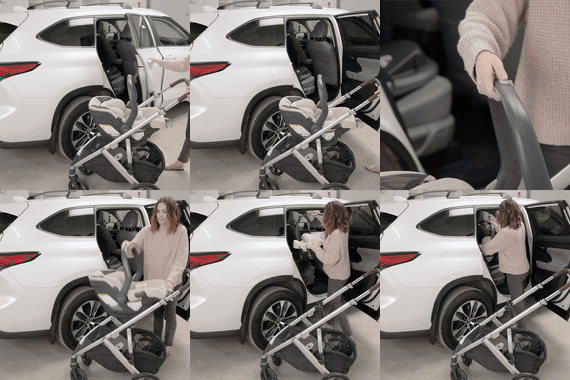
Use the route that creates the most repeated effort instead of a generic load worksheet. Have each regular caregiver rehearse three points with a realistic demonstration load:
- lift from the floor or stroller height;
- carry through the longest stairs, parkade, daycare hallway or front path; and
- set the carrier down and reconnect it at the vehicle.
Record where grip, reach or repetition becomes limiting. The test is complete when each regular caregiver can name whether repeated lifting changes this household's route.
A PIPA lite carrying a 15 lb baby starts around 20.3 lb before excluded components are counted. A PIPA with the same child starts around 22.9 lb. The difference remains 2.6 lb, but whether it matters depends on repetition, reach and distance. Lift both with a realistic demonstration load rather than comparing empty shells on a shelf.
What the PIPA's broader range changes
Because the PIPA's 35 lb maximum is 13 lb higher than the PIPA Lite's 22 lb maximum while both the PIPA manual and PIPA Lite manual specify height less than 81 cm (32 inches), the PIPA can provide more usable time for a child who approaches 22 lb before another fit limit, but not a fixed number of months. For either model, the top of the child's head must remain at least 25 mm (1 in.) below the top named in its manual, and the instructions and labels for the exact seat still apply.
The PIPA also offers two vehicle architectures. The PIPA manual supports two routines: attach the carrier to an installed base, or install the carrier without the base using the approved vehicle-belt method. The second method can matter for an occasional family vehicle or other trip where a correctly installed base is not present.
Base-free does not mean check-free. The caregiver must understand the correct Canadian belt path, recline, handle position, allowed vehicle belt and seating position. If the method cannot be reproduced confidently, it should not be counted as practical flexibility.
What the PIPA lite's base rule changes
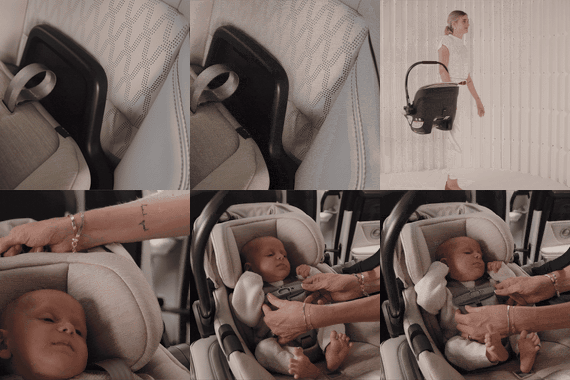
The PIPA lite's published 5.3 lb carrier weight is the clear reason to choose it. A caregiver who lifts the carrier repeatedly may value that reduction every day.
Its Canadian manual is equally clear that the carrier must be installed in a vehicle with the base. The seat alone cannot be secured for a drive. That creates a planning question for every regular vehicle: will a compatible base be installed there before the child needs to travel?
For a one-car household, or a household where the child nearly always rides in one vehicle, the rule may create little friction. Because the PIPA lite must be installed with a base, each vehicle used needs a correctly installed PIPA infant car seat base. Compare complete setups, not only carrier prices.
Four routines, four different answers
One primary car and a walk-up home
A base can remain installed, while the lighter carrier helps on stairs. The PIPA lite has a strong practical case if its lower child maximum and future convertible-seat timing are acceptable.
One primary car and very little carrier use
If the carrier is usually placed directly on a stroller or removed only for short distances, the weight difference may matter less. The PIPA's broader child range and alternate belt-installation option may offer more value.
Two regular family vehicles
Price and install the full system. The PIPA lite needs a compatible base in each vehicle where it will be driven. The PIPA can also use a base in each car, but its approved carrier-only belt method provides an alternative when correctly executed.
Occasional taxis or rentals
The PIPA is the relevant option of these two because its Canadian manual includes carrier-only vehicle-belt installation. Practise that exact method before relying on it. The PIPA lite cannot be used in a vehicle without its base.
Do the three-part trial
1. Carry trial
Use a realistic load. Lift from the floor and vehicle height, walk, turn and operate a door. Every regular caregiver should try it.
2. Installation trial
Use the exact Canadian model in every regular vehicle. Follow both manuals, confirm the approved seating position and installation method, and make sure each caregiver can identify a correct final result.
3. Transition trial
Compare the child's current growth pattern with the 22 lb and 35 lb maximums without predicting an outgrowth date. Decide whether an earlier convertible-seat purchase under the PIPA lite plan creates a problem or simply moves an expected purchase forward.
Price every base and transition
Compare the complete ownership plan
Write two totals, even if the prices are not yet known. The PIPA plan includes the carrier and included base, any second base, and the later convertible seat. The PIPA lite plan includes the carrier and included base, either a routine for moving and correctly reinstalling that base or an additional compatible base for another regular vehicle, and a later convertible seat that may be needed sooner if the child reaches 22 lb before another limit. Stroller adapters belong in either total only when the chosen stroller needs them.
This exercise is not about predicting the cheapest lifetime route. It reveals equipment dependencies. A household may willingly pay for a second PIPA lite base because lower carry weight improves every day. Another may prefer the PIPA because a practised carrier-only belt installation covers occasional vehicles without another permanent component.
Use a base-readiness test
For each regular vehicle, ask who will install the base, who will inspect it after the vehicle seat is moved, and where the matching manual will be kept. Then have the least-frequent caregiver dock and release the carrier and identify the connection check. A base that is available but not correctly installed is not a working part of the plan.
For the PIPA's carrier-only option, run a separate test. The caregiver should be able to select an approved position, route and lock the belt, set the allowed recline and handle position, and confirm the final installation without relying on a photo from another vehicle. If that cannot be done calmly, count the option as unavailable until more instruction or help is obtained.
Finally, interpret weight and installation separately. A lighter carrier is an ergonomic advantage, not a safety ranking. A higher maximum may extend eligibility, not guarantee a better fit. Both seats must be installed and used exactly as their Canadian manuals require.
Choose the PIPA when:
- the 4–35 lb range better matches the planned infant-seat stage;
- an approved carrier-only vehicle-belt method has real value;
- the 7.9 lb empty carrier remains manageable with the growing child;
- the exact seat installs correctly in every intended vehicle.
Choose the PIPA lite when:
- repeated carry weight is the dominant daily problem;
- a compatible base can be installed wherever the child regularly rides;
- the 4–22 lb range and later transition plan are acceptable;
- every caregiver understands that carrier-only vehicle installation is not allowed.
Choose by the vehicle plan
The Nuna PIPA is the more flexible vehicle system and has the higher Canadian weight maximum. The Nuna PIPA lite is the lighter carry, with a stricter base requirement and lower weight maximum. Test both as complete Canadian systems, then compare the wider Nuna collection at baby enRoute only if neither arrangement solves the routine you documented.