In this article
The installation architecture decides this comparison. Canadian Nuna PIPA can dock on an installed base and retains an approved carrier-only vehicle-belt option. Canadian Nuna PIPA urbn instead puts rigid UAS installation in the carrier without a separate base. The urbn must not be used with a base and has a 4-22 lb, 15-29 in. child range, with installation methods set out in its Canadian manual.
Both are portable Nuna infant carriers, but the decisive difference sits under the carrier. One separates the vehicle installation into a base; the other integrates its rigid connectors into the seat.
Installation-mode map
| Vehicle setup | Nuna PIPA (Canada) | Nuna PIPA urbn (Canada) |
|---|---|---|
| Rigid UAS | Rigid connectors are on the included base | pipaFIX rigid connectors are integrated into the carrier |
| Vehicle belt | Base installation or approved carrier-only installation described in the Canadian manual | Approved carrier installation methods described in the Canadian manual |
| Base rule | Designed to dock on its PIPA base for regular use; carrier-only belt method also available | Do not use the carrier with any base |
| Published child range | 4–35 lb; less than 81 cm (32 in.); top of head at least 25 mm (1 in.) below carrier top | 4–22 lb, 15–29 in. |
| Published carrier weight | 7.9 lb | 7 lb, excluding canopy and infant insert |
The PIPA urbn is not a PIPA with an optional built-in base. It is a base-free design with its own approved methods and limits. The standard PIPA base is not an accessory upgrade for the urbn.
How the standard PIPA organizes a drive
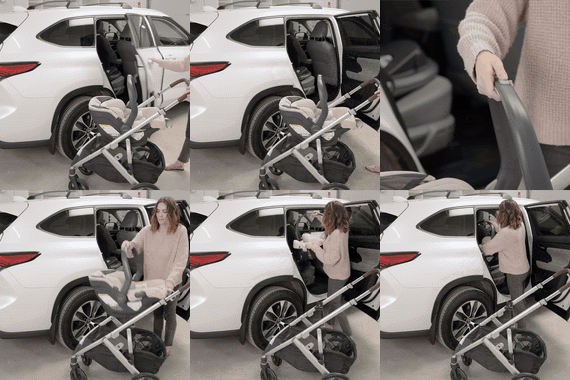
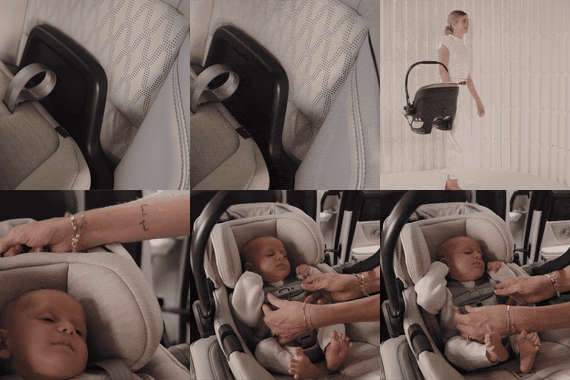
With the PIPA, the base is installed in the vehicle using the approved rigid-UAS or vehicle-belt method. The carrier docks onto that base for each drive. This separates two jobs: the base maintains the regular vehicle installation, while the carrier travels with the child.
That arrangement can be valuable in a primary vehicle. For the PIPA, after the base is correctly installed, attach the carrier to the base, pull to verify the connection, and confirm the required indicators. Another regular vehicle may use its own correctly installed Nuna PIPA infant car seat base.
The current Canadian PIPA manual also describes installing the carrier without the base using a vehicle belt. That creates an occasional-use path when a base is not present, provided the caregiver can reproduce the exact belt route, recline, handle position and vehicle requirements.
How the PIPA urbn organizes a drive
The PIPA urbn's pipaFIX rigid UAS connectors fold out from the carrier and attach directly to suitable vehicle lower anchors. There is no separate base to leave behind. The current Canadian manual also provides approved vehicle-belt installations.
This design can reduce equipment planning when the seat moves between compatible vehicles. The carrier brings its rigid connectors with it, and a documented belt method remains available where appropriate. The caregiver still needs to verify vehicle compatibility and complete every manual check at every installation.
The urbn's no-base rule is absolute: do not place it on a PIPA base. It also has lower child maximums than the standard PIPA: 22 lb and 29 inches rather than 35 lb; the PIPA manual separately requires height less than 81 cm (32 inches) and at least 25 mm (1 inch) of head clearance below the carrier top. Those differences should be part of the purchase decision, not discovered at the first growth check.
Use the vehicle switchboard
List every vehicle expected to carry the child in a typical month.
| Vehicle | Frequency | Approved method you can perform | Equipment that must be present |
|---|---|---|---|
| Primary family vehicle | _____ | _____ | _____ |
| Second caregiver vehicle | _____ | _____ | _____ |
| Grandparent or occasional vehicle | _____ | _____ | _____ |
| Taxi or rental | _____ | _____ | _____ |
For the PIPA, mark where a base will remain installed and where the carrier-only belt method would be used. For the urbn, mark where integrated UAS is compatible and where an approved belt method would be needed. A blank cell is a problem to solve before that vehicle is part of the plan.
What changes in a compact vehicle
Nuna lists both carriers at 17.5 inches wide, 25 inches long and 22 inches high, but identical external dimensions do not create identical installed fit. The connector or belt method, vehicle-seat contour, required recline, front-seat position and loading access still need to be tested.
With the standard PIPA, verify the installed base and the room needed to attach and release the carrier. With the urbn, perform the complete direct-to-vehicle installation and confirm the indicators. For either model, use only a forward-facing vehicle seating position permitted by the vehicle manual, never install rear-facing in front of an active frontal air bag, and meet the model's carrier-contact rules.
Four decision scenarios
One car, predictable daily use
The PIPA base can remain installed, turning most drives into a dock-and-check routine. The PIPA's higher child maximums may add value if the carrier remains comfortable to use as the child grows.
Two or more cars, frequent hand-offs
The urbn can remove the need to place a separate base in every compatible vehicle. Compare that convenience with its lower child limits and the need to complete an installation each time it moves.
Regular car plus occasional taxi
Both models have an approved base-free route in their current Canadian manuals: carrier-only vehicle-belt installation for the PIPA, and integrated UAS or vehicle-belt installation for the PIPA Urbn. The better choice is the method every caregiver can execute correctly under real trip conditions.
Caregiver wants one unchanging installation
A correctly installed PIPA base left in the primary vehicle best matches that preference. The urbn's integrated system is designed for repeat direct installation, which is only useful when that repeat step is welcome and reliable.
Proof checklist before purchase
Run a timed caregiver hand-off
Place the unoccupied carrier beside the vehicle with the manual open. One caregiver completes the approved installation and explains each check aloud. A second caregiver removes it, repeats the installation and identifies the same checks without coaching. Time is recorded only to expose rushed steps, not to turn installation into a race.
For the PIPA, repeat the drill once with the base and once with the carrier-only vehicle-belt method if both will be used. For the urbn, repeat it with integrated UAS and with the approved belt method expected for vehicles where lower anchors are not the chosen route. A method belongs in the household plan only when the people who will use it can perform it correctly.
Map the consequence of a forgotten component
Imagine arriving at each vehicle with only the child and carrier. With the standard PIPA, a missing base is manageable only if an approved carrier-only belt installation is suitable and the caregiver can complete it. With the urbn, the rigid connectors travel with the carrier, but the seating position still needs compatible lower anchors or an approved belt installation.
Now imagine a vehicle change after the child grows past 22 lb or 29 inches. The urbn can no longer be the travel solution once any of its limits is reached, even though the carrier and connectors still function. The standard PIPA may remain eligible within its higher limits, subject to all manual fit rules. This is why vehicle convenience and transition timing should be evaluated together.
Resolve these red flags before buying
- a caregiver expects the urbn to click onto a PIPA base;
- a second vehicle's seating position has not been checked in its owner's manual;
- the plan depends on a belt installation no regular caregiver has practised;
- the setup allows prohibited carrier contact or uses a seating position or vehicle belt that either the child-seat manual or vehicle manual does not permit;
- the child's current measurements are already close to the urbn's maximums.
Complete the vehicle-and-model proof
- Confirm the physical seat is the Canadian model and has the National Safety Mark.
- Match the physical seat to the current Canadian manual in Nuna Canada's model index.
- Install the seat by every method you expect to use, in every regular vehicle.
- Have each caregiver independently identify the correct belt path or connector indicators, recline and final check.
- Compare the child's current measurements with the 22 lb/29 in. urbn limits and the PIPA manual's 35 lb limit, height less than 81 cm (32 in.), and required 25 mm (1 in.) of head clearance below the carrier top.
- For the PIPA, include any additional base in the total plan. For the urbn, remove any assumption that a base can be added later.
Choose by the installation routine
The Nuna PIPA is a base-centred everyday system with an approved carrier-only belt alternative and broader child limits. The Nuna PIPA urbn integrates the rigid installation into a lighter carrier and eliminates the separate base, with lower limits. Map the real vehicles and methods first, then use the Nuna collection at baby enRoute to compare the Canadian products that match that map.