In this article
The Canadian Nuna PIPA is a removable infant carrier for a 4–35 lb child under 32 inches, subject to the head-clearance and fit rules in its manual. The Canadian Nuna RAVA is a convertible seat that starts rear-facing at 5 lb and can later be used forward-facing. The removable PIPA carrier supports approved car-to-compatible-stroller transfers. The RAVA is a convertible seat installed in the vehicle, and a child who meets its 5 lb minimum must still meet the exact harness, insert, recline, installation, and vehicle-manual requirements because the minimum alone does not prove fit.
The useful comparison is not “Which seat lasts longer?” The RAVA does, by design. The real decision is whether a detachable carrier solves enough daily problems to justify an infant-seat stage before the convertible.
Start with the two different systems
| System question | Nuna PIPA (Canada) | Nuna RAVA (Canada) |
|---|---|---|
| Seat type | Rear-facing infant carrier with a base; Canadian manual also permits carrier-only vehicle-belt installation | Convertible seat that remains in the vehicle |
| Published child limits | 4–35 lb; less than 81 cm (32 in.); top of head at least 25 mm (1 in.) below carrier top | Rear-facing 5–40 lb and up to 49 in.; forward-facing 25–65 lb and up to 49 in. |
| Published seat weight | 7.9 lb for the carrier | 27.5 lb |
| Between-drive use | Carrier can be removed and is compatible with Nuna strollers | Child is moved into a stroller, carrier or other destination setup separately |
| Primary value | Portable infant-stage convenience | Longer in-vehicle stage coverage from a single seat |
These limits are not interchangeable with U.S. Nuna pages or with an older manual. For installation and fit, use the label and current Canadian manual that correspond to the exact seat in front of you.
Compare the complete setup, not just the seat price
Write down what each option requires in your real routine.
A PIPA-first setup may include
- the infant carrier;
- the included base in the primary vehicle;
- a second compatible base if another regular vehicle needs one, or practiced use of an approved carrier-only belt installation;
- a compatible stroller and any correct adapter required by that stroller;
- a future rear-facing convertible when the PIPA is outgrown.
A RAVA-from-start setup may include
- the RAVA installed at the correct rear-facing recline;
- a separate stroller, bassinet or baby-carrying plan outside the vehicle;
- more time transferring the child at each arrival;
- an installation plan for every vehicle, because the 27.5 lb seat is not intended to click in and out like an infant carrier.
The RAVA can reduce the number of car-seat purchases, but it does not replace every function of the PIPA. The PIPA can reduce transfer friction, but it does not eliminate the later convertible-seat decision.
Where the PIPA changes the day
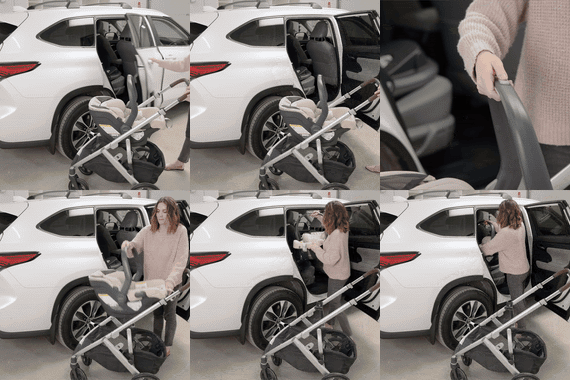
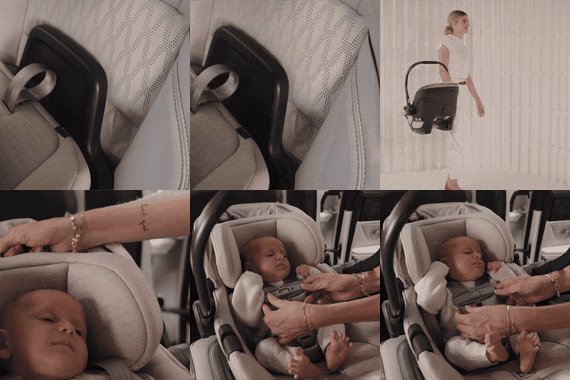
The PIPA's carrier detaches from its base and connects with Nuna strollers. That can simplify a route made of several short stops: the child remains in the carrier while the caregiver moves between the vehicle and a compatible stroller. The value is highest when those transfers happen often and the carrier remains manageable at the child's current weight.
Portability has practical limits. The published 7.9 lb is only the carrier, so the carried load rises as the baby grows. The Canadian manual's instructions still apply when the carrier is used outside the vehicle, including keeping the child fully secured. Plan how the child will be moved into the appropriate destination setup rather than treating portability as unrestricted use.
The PIPA's included base supports rigid UAS or a vehicle-belt installation, and its Canadian manual also describes installing the carrier without the base using a vehicle belt. That can help occasional travel, but every method must satisfy the exact child-seat and vehicle-manual checks.
Where the RAVA simplifies ownership
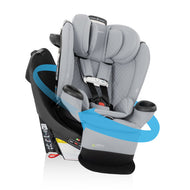
The RAVA starts rear-facing at 5 lb and extends through a 40 lb rear-facing maximum, then has a forward-facing mode from 25–65 lb. Transport Canada recommends keeping a child rear-facing until they reach the seat's rear-facing weight or height limits. A RAVA that fits the newborn, vehicle and caregivers can therefore cover the initial rear-facing stage without a separate infant seat, and continue well beyond it.
The RAVA stays in the vehicle. That makes its 27.5 lb seat weight less important during an ordinary day, but more important if the seat must be moved between cars. A household that alternates vehicles should compare the cost and effort of repeated installation with the cost of a second appropriate seat.
Starting with a convertible also means every arrival includes unbuckling and lifting the baby from the vehicle seat. For some families that is a small step. For a caregiver managing winter layers at the car, a parking garage, multiple children or frequent errands, it can be the deciding inconvenience.
Walk through seven real stops
Choose a representative weekday and mark every time the child crosses one of these boundaries:
- home to vehicle;
- vehicle to stroller;
- stroller to indoor destination;
- destination back to vehicle;
- one vehicle to another caregiver's vehicle;
- vehicle to stairs, elevator or a long walkway;
- vehicle to an approved sleep or play space at home.
For each boundary, write “move child,” “move carrier,” or “reinstall seat.” The PIPA is usually strongest where “move carrier” replaces repeated rebuckling. The RAVA is strongest where the seat can remain installed and the child can be moved comfortably. A routine with many “reinstall seat” entries needs another plan, whichever model you prefer.
Do not skip the newborn-fit check
A published minimum weight is an eligibility boundary, not proof that every newborn will achieve the correct fit. For either seat, the harness position, crotch-buckle setup, approved insert use and recline must match the Canadian manual. Have the exact seat checked with the actual vehicle, and reassess once the baby arrives.
The RAVA also takes more front-to-back cabin space in some rear-facing configurations than a shopper may expect from a web dimension. Vehicle seat contour, recline, front-seat needs and the chosen seating position all influence the installed result. A product page cannot promise front-passenger comfort or three-across compatibility in a particular car.
Count transfers, installations and later purchases
Price the transition, not only the first box
A PIPA-first plan contains a planned hand-off to a rear-facing convertible. Record where the PIPA will be stored or passed on when it is outgrown, when the RAVA trial should happen, and whether a second infant-seat base is part of the budget. A RAVA-from-start plan removes that first car-seat transition but may require a separate bassinet, stroller seat or carrier solution for destinations outside the vehicle.
Neither list is automatically shorter in practice. A RAVA that must move between two cars can create repeated heavy installation work; a PIPA with two correctly installed bases can create a smooth hand-off but adds equipment. Compare the number of installations, transfers and components over a typical month.
Make the final test with all regular occupants
Install the chosen seat in the intended position, then seat the driver, front passenger, neighbouring child and any adult who regularly rides in back. Check that each occupant retains a vehicle-manual-permitted seating position, normal belt routing, buckle access and every required child-seat clearance. For the PIPA, rehearse carrier attachment and removal. For the RAVA, rehearse placing and buckling the child without leaning on the installation.
Start with the PIPA when:
- car-to-stroller transfers happen most days;
- the seat will usually dock into a base that stays installed;
- the caregiver can comfortably manage the carrier plus the growing child;
- you accept that a convertible seat will be a later purchase.
Start with the RAVA when:
- you want one installed seat to cover rear-facing and later forward-facing stages;
- moving the baby separately at each stop works for your day;
- the RAVA provides the correct newborn fit in your specific vehicle;
- the seat can remain in one vehicle most of the time.
Pause when a caregiver cannot complete the manual checks, newborn fit remains uncertain, the chosen position or belt is not allowed by either manual, or the installation cannot be secured as required. Treat comfort separately as a household-use consideration.
Choose the seat architecture
The Nuna PIPA buys a removable infant-stage system; the Nuna RAVA buys longer stage coverage in a seat that remains in the vehicle. Count your daily transfers, test the Canadian model in the actual vehicle and confirm the manual fit before choosing. The Nuna collection at baby enRoute is most useful after that routine check has told you which architecture belongs on the shortlist.