In this article
A Nuna travel system is complete only when four exact pieces agree: the Canadian infant car seat, the stroller model, the required connection hardware and the vehicle installation plan. Start with the stroller that fits your route and the infant seat that fits your child and vehicle. Then choose the connection. Reverse that order only when moving between several vehicles is the hardest part of your week.
The brand name alone does not prove that an adapter is included, that no adapter is needed, that a bassinet fits the frame, or that a carrier can use the intended vehicle installation. This configuration map separates those decisions so a convenient transfer does not hide a poor stroller or car-seat fit.
Build the system through four branches
Follow one branch at each step. Write the exact model name beside your answer.
Branch A: what must the stroller do after the infant seat is outgrown?
- Full-size single, reversible seat and bassinet option: start with MIXX Next.
- Lighter city single with a reversible seat: start with TRIV Next.
- Lowest published carry weight in the current Nuna single lineup and quick fold: start with TRVL LX.
- Tight-space lateral movement plus a reversible seat: start with SWIV.
- Single now, stacked second seat or rider later: start with DEMI Next.
- Two independent world-facing seats side by side: start with TRVL dubl.
- World-facing full-size setup sold as a direct-connect bundle: consider TAVO Next + PIPA.
Branch B: what must the infant seat do in the vehicle?
- Use one main removable base and keep the broadest published PIPA child range: start with PIPA.
- Minimize carrier weight and always use a compatible base: start with PIPA Lite.
- Move among compatible vehicles without carrying a separate base: start with PIPA Urbn.
Branch C: how do those exact products connect?
Use the compatibility map below. If the exact stroller or infant-seat model is missing, stop. Confirm with the current Canadian manuals before ordering a similar-looking adapter.
Current Nuna stroller-to-PIPA map
| Stroller | PIPA series connection | Connection piece | Newborn alternative | Decision consequence |
|---|---|---|---|---|
| MIXX Next | Compatible with PIPA series infant carriers | Ring adapter included with current stroller | MIXX series bassinet or approved stroller-seat mode | Most configuration choice; adapter is another part to manage |
| TRIV Next | Compatible with PIPA series infant carriers | Folding ring adapter included | Use the approved configuration in the exact manual | Reversible stroller seat with a lighter frame than MIXX Next |
| TRVL LX | Compatible with PIPA series infant carriers | No adapter required | Near-flat, carriage-like stroller-seat mode per Nuna guidance | No adapter to store; stroller seat does not reverse |
| TAVO Next | Compatible with PIPA series infant carriers | No adapter required | Flat-reclining world-facing stroller seat per the manual | Direct-connect bundle; no parent-facing stroller seat |
| SWIV | Compatible with PIPA series infant carriers | Ring adapter included | Near-flat stroller-seat recline; follow exact manual | Adds lateral wheel movement and reversible seat |
| DEMI Next | Car-seat modes available | Verify adapter and included parts for exact Canadian SKU | DEMI Next bassinet or approved seat configuration | Connection must be planned with the future passenger layout |
| TRVL dubl | PIPA series carrier on wider seat | No adapter required | Use only the approved seat configuration in the exact manual | One infant carrier plus one stroller seat; check total passenger plan |
This map is for the current Canadian models in the baby enRoute Nuna collection. Product generations and included parts can change. Verify the exact model or SKU in Nuna Canada's manual index before ordering connection hardware; do not infer compatibility from a family name alone.
Choose the stroller side of the system first
A travel system is often sold around the infant carrier, but the stroller usually remains in use longer. Test the stroller in its future seat configuration, not only as a frame carrying the infant seat.
MIXX Next: the broadest configuration branch
The MIXX Next supports a PIPA series infant carrier on its included ring adapter, a separately sold MIXX series bassinet, and a reversible stroller seat. Nuna lists it from birth to 50 pounds and at 28.3 pounds without armbar and insert. The system suits a household that values several newborn and later-seat modes and can accept the heavier lift.
The ring adapter is not a flaw; it creates the connection. But it is a component with its own storage and latching routine. Decide whether it will remain on the stroller, be removed for the seat or bassinet, and fit in the trunk with the chosen configuration.
TRIV Next: reversible city use with a folding adapter
For the current Canadian TRIV next BMW variant, the included PIPA-series ring adapter folds with the stroller. That removes one storage step while preserving a parent-facing or world-facing stroller seat later. Its published 18.4-pound weight excludes the insert, armbar and canopy.
This is the branch for families who want a lighter city frame without giving up seat direction. This remains an adapter-based connection, so include the adapter in the handoff routine.
TRVL LX: direct attachment and frequent lifting
The TRVL LX accepts PIPA series infant seats directly and has a published 14.6-pound weight without canopy and armbar. Its one-hand fold and direct connection reduce the number of pieces during a transfer. The later stroller seat faces the world rather than reversing.
Choose it when lifting and a quick car-to-stroller sequence are the constraints. Do not choose it solely because it is called a travel stroller: folded dimensions still need to pass your trunk and carrier rules, and an airline can set its own cabin policy.
SWIV: connection plus tight-space movement
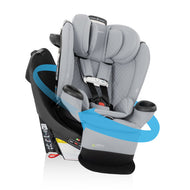
The SWIV includes a PIPA ring adapter and has a reversible seat. Its distinguishing feature is button-activated 360-degree rotation on all four wheels, enabling lateral repositioning. Buy that capability only when elevators, counters or crowded interiors make it useful after the infant-carrier period.
DEMI Next and TRVL dubl: draw the second passenger
With the DEMI Next, infant-carrier position interacts with a future sibling seat, bassinet or rider board. Do not confirm only that the PIPA clicks onto the frame. Draw where each child will ride, whether either seat must face a specific direction, what happens to basket access and which components travel in the car.
With the TRVL dubl, a PIPA series carrier attaches directly to the wider seat. The other world-facing seat remains for a second child. Nuna's current Canadian manual limits each seat occupant to 50 pounds and 45 inches and the combined stroller load to 100 pounds. Because that manual does not state the external dimensions, confirm the current Canadian product measurement before running the doorway and trunk test.
Choose the PIPA by installation, not by stroller compatibility
Because current Nuna strollers broadly accept the PIPA series, the vehicle routine is the better way to separate the carriers.
PIPA: one conventional base plan
The PIPA has a Canadian range of 4 to 35 pounds. Its current Canadian manual requires height to be less than 81 cm (32 inches) and the top of the child's head to remain at least 25 mm (1 inch) below the top of the carrier. Nuna lists the carrier at 7.9 pounds and includes its base. It is the natural starting point when one main vehicle can keep the base installed and the broader published infant range matters.
For two vehicles, an additional PIPA base can reduce reinstallations, but only after the exact carrier and base compatibility is confirmed and each base installs correctly in its vehicle. An extra base is a routine purchase, not an automatic accessory.
PIPA Lite: carry less, commit to the base
The PIPA Lite weighs 5.3 pounds without canopy or insert. Its current Canadian manual specifies 4 to 22 pounds, height less than 81 cm (32 inches), and at least 25 mm (1 inch) between the top of the child's head and the top of the restraint. Nuna states that it must be installed in a vehicle with its base.
It can make a great stroller connection and still be the wrong vehicle system for taxis or unplanned car changes. Count the base requirement before giving the carrier-weight advantage priority.
PIPA Urbn: no separate base, lower published limits
The PIPA Urbn uses integrated rigid connectors and can use the vehicle belt according to the Canadian manual, without a separate base. It weighs 7 pounds and is listed for 4 to 22 pounds and up to 29 inches.
That configuration can simplify taxis, rideshares or alternating vehicles. It also requires checking the approved vehicle fit and accepting that its published height and weight envelope is smaller than PIPA's. Do not convert "baseless" into a claim of universal vehicle compatibility.
Two current bundle paths at baby enRoute
A preconfigured bundle can reduce ordering mistakes, but it does not replace the fit checks.
MIXX Next + PIPA
The MIXX Next + PIPA Travel System combines the 28.3-pound published MIXX stroller, its included ring adapter and the 7.9-pound PIPA carrier with base. It is the fuller configuration path: reversible stroller seat, optional MIXX bassinet and the broadest published PIPA range.
TAVO Next + PIPA
The TAVO Next PIPA Travel System connects the PIPA directly, without an adapter. Nuna lists the TAVO stroller at 23.2 pounds without armbar and canopy, with a world-facing seat and flat-reclining backrest. It is the simpler component path when parent-facing and bassinet modes are not priorities.
Use a routine test to choose: if you will switch among parent-facing seat, bassinet and infant carrier, MIXX earns its added modes. Use TAVO Next when direct PIPA connection and a world-facing stroller seat fit the routine. The winner changes with the configuration you will actually use.
Accessory map: required, optional or separate job
| Item | Classification | Buy when | Stop rule |
|---|---|---|---|
| Stroller-specific PIPA adapter | Adapter-based connections only | Buy one only when the exact stroller does not include connection hardware and the adapter page names its generation | Do not buy by brand name or photo |
| Extra PIPA base | Routine option | A second frequent vehicle can support the exact base installation | Buy only the base named in the carrier manual; Urbn does not use a separate base |
| MIXX or DEMI bassinet | Separate newborn configuration | A flat bassinet mode solves walking or destination use and exact compatibility is confirmed | Similar names do not cross systems |
| Rain cover | Weather accessory | SWIV includes one; verify exact-model compatibility for any other cover | Check compatibility before buying for another stroller or carrier |
| Cup holder or child tray | Convenience accessory | Buy only when the current accessory page names the exact stroller series and it improves a repeated routine | Wait if it interferes with folding, doorways, or loading |
baby enRoute currently lists separate MIXX and DEMI series, TRIV series and TRVL series accessories. Those family names are compatibility boundaries, not styling suggestions. The MIXX Series Bassinet and DEMI Next Bassinet are different products. Confirm model number and manual before treating either as a substitute.
Cross-brand connection: verify both sides
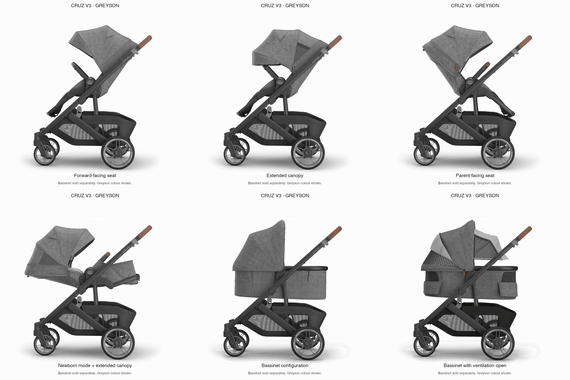
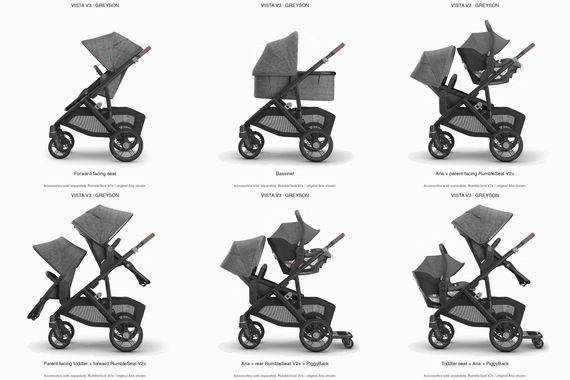
A Nuna PIPA carrier can be part of a non-Nuna stroller system only when current manufacturer documentation supports the exact carrier, adapter and stroller generation. The focused PIPA-to-VISTA/CRUZ adapter guide holds that generation-specific decision so this system map can stay focused on choosing the full route.
UPPAbaby's Canadian Minu V3 page separately lists adapters for selected Nuna infant seats. These are not universal statements about every UPPAbaby frame; verify the exact adapter listing before purchase. Check the adapter page, stroller manual and car-seat manual together. If one side does not name the exact model or generation, hold the purchase.
The six-line configuration card
Before checkout, fill this out and keep it with the manuals:
- Infant seat: exact Canadian model and model number.
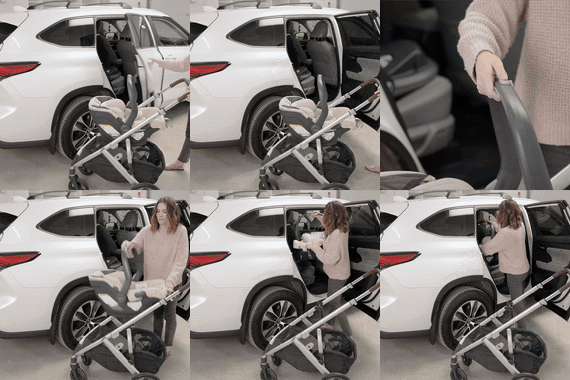
- Vehicle installation: base, integrated rigid connectors or vehicle belt; intended seating position.
- Stroller: exact model and generation.
- Connection: direct, included ring adapter or separately purchased approved adapter.
- Later stroller mode: parent-facing seat, world-facing seat, bassinet, second seat or rider board.
- Storage plan: where carrier, adapter, bassinet and removed seat will go in the vehicle and home.
If any line says "probably compatible," the configuration is not ready. Replace the assumption with a current Canadian manual or official compatibility page.
Safety boundaries that remain after compatibility is confirmed
A correct click onto a stroller does not prove the infant carrier is correctly installed in a vehicle. Read the child-restraint manual and vehicle manual for every installation. Look for the National Safety Mark on a Canadian seat and follow the child limits and fit criteria on that exact product.
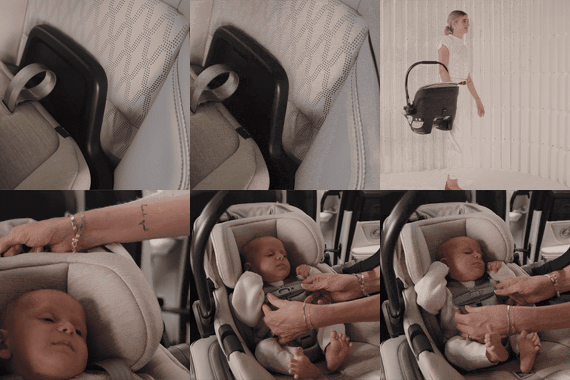
A travel system also does not make the car seat a routine sleep space. Health Canada advises moving a sleeping baby from a car seat or stroller to a crib, cradle or bassinet when the destination is reached. A separate stroller bassinet must itself be marketed and used as an approved bassinet according to its instructions; a near-flat stroller seat or infant carrier should not be renamed as one.
Build the system
Lead with MIXX Next when you want four named stroller configurations, TRVL LX when lift and direct PIPA connection matter most, SWIV when lateral movement solves a space constraint, or DEMI Next when a second passenger is likely. Use TAVO Next when a direct-connect, world-facing bundle fits the routine.
Then choose PIPA for its broader published infant range, PIPA Lite for its lower carrier weight with a mandatory base, or PIPA Urbn for a no-separate-base vehicle plan with lower published limits. Add only the exact connection and accessories those choices require.
The finished system should be boringly specific. You should be able to name every model, connection, limit and storage location. That is what turns a set of matching products into a travel system that works.