In this article
The short answer: Nuna makes the most sense as an ecosystem when you want an infant car seat to move between the vehicle and one or more compatible strollers, while choosing separate home products only for the jobs you actually need. It makes less sense to buy the logo first and solve fit later. A stroller still has to fit your trunk, building and walking route; a car seat has to fit your child, vehicle and installation plan; and a high chair or playard should earn its own place at home.
This guide maps the current Nuna range sold by baby enRoute into four lanes: strolling, car travel, travel-system connections and home routines. Use it to decide where staying within one brand removes friction - and where there is no benefit to matching.
Start with the bottleneck, not the bundle
Before comparing finishes or packages, name the hardest part of your week. Is it lifting a stroller into a compact trunk? Getting through a condo doorway? Moving a sleeping infant from car to stroller? Carrying a seat up stairs? Planning for a second child? Or creating a dining and play setup at home?
The answer points to the product family that should lead your decision:
- Route problem: choose the stroller first, using real folded dimensions, width, weight and passenger layout.
- Vehicle problem: choose the car seat first, using the Canadian manual, child limits, vehicle manual and a trial installation where available.
- Transfer problem: map the exact infant seat-to-stroller connection before buying a bundle or adapter.
- Home problem: evaluate the high chair, playard or seat as an independent tool. Matching a stroller does not make it a better fit for your room.
That order matters because the Nuna name does not erase physical constraints. A side-by-side double and a 21-inch-wide compact single solve different problems. A 5.3-pound infant carrier that requires its base in a vehicle and a 7-pound model with integrated rigid connectors create different car-change routines. The useful question is not "Which Nuna product is most premium?" It is "Which setup removes the most repeated friction without creating a new fit problem?"
Lane one: choose the stroller by the route it must survive
The current Nuna collection at baby enRoute covers full-size singles, compact city strollers, a growing-family tandem and a side-by-side double. They are not a straight upgrade ladder.
MIXX Next: the full-size all-round route
The MIXX Next is the broadest single-stroller choice when you want a reversible seat, a bassinet option and a PIPA travel-system connection in one frame. Nuna Canada lists it from birth to 50 pounds, with a 28.3-pound stated stroller weight that excludes the armbar and insert. Its folded footprint is 27.5 by 23.6 by 19 inches. That makes it a stronger candidate for frequent neighbourhood walking and mixed daily use than for a household whose decisive test is carrying the stroller up several flights every day.
TRIV Next and TRVL LX: two different ways to go lighter
The TRIV Next keeps a reversible seat and includes a folding ring adapter for PIPA series infant seats. Nuna lists an 18.4-pound weight excluding the armbar and insert. It is the more natural branch for a city family that still wants the child facing either direction.
The TRVL LX is lighter at a stated 14.6 pounds excluding the canopy and armbar, folds to 14.25 by 21 by 27 inches and accepts Nuna PIPA series car seats directly without an adapter. Its stroller seat faces forward rather than reversing. Choose between these two by testing the task: parent-facing flexibility points toward TRIV Next; frequent lifting, quick folding and direct infant-seat attachment point toward TRVL LX.
SWIV: when lateral movement is the point
The SWIV has button-activated 360-degree rotation on all four wheels, a reversible seat and an included PIPA ring adapter. That side-to-side movement can be useful around crowded counters, elevators or tight restaurant layouts. It is not automatically better on every route. If your usual walk is long and open, test its 19.2-pound stated frame and fold against the simpler choices instead of paying for a movement system you rarely use.
DEMI Next and TRVL dubl: capacity decisions, not style decisions
The DEMI Next with Rider Board starts as a single and can convert for a second seated child with the separately sold sibling seat. The included rider board creates another option for a child who can stand reliably. Its 24-inch width keeps passengers in a stacked layout, but the eventual double configuration changes basket access, sight lines and how you load the frame.
The TRVL dubl places two seats side by side. Nuna's current Canadian manual limits each seat to 50 pounds and 45 inches, with a combined maximum of 100 pounds. Nuna Canada's current TRVL dubl page publishes a 30.5-inch width, a 25.2-pound stroller weight and a 19.75 by 30.5 by 27.75-inch fold; measure the stroller at your front door, elevator, vehicle and common destinations. Choose DEMI when single-to-double flexibility is the real need; choose TRVL dubl when two independent side-by-side seats are worth the wider format.
Lane two: follow the car-seat stage, then choose the routine
Nuna's Canadian car-seat line covers three functional stages: rear-facing infant carriers, a rear- and forward-facing convertible seat, and forward-facing-to-booster or dedicated booster options. These stages overlap by weight, but that does not make them interchangeable.
Transport Canada advises keeping a child rear-facing until the child reaches the rear-facing seat's height or weight limit, and keeping each child in each stage as long as possible. Provincial and territorial rules can add minimum requirements. Use the child measurements, the exact Canadian seat label and manual, and the vehicle manual together; age alone is not a fit test.
PIPA, PIPA Lite and PIPA Urbn: three infant-carrier routines
- PIPA is the conventional broad-range choice: its current Canadian manual specifies 4 to 35 pounds, height less than 81 cm (32 inches), and at least 25 mm (1 inch) between the top of the child's head and the top of the carrier. Nuna includes the base and lists the carrier at 7.9 pounds.
- PIPA Lite reduces the stated carrier weight to 5.3 pounds, excluding canopy and insert, but must be installed in a vehicle with its base. Its current Canadian manual specifies 4 to 22 pounds, height less than 81 cm (32 inches), and at least 25 mm (1 inch) between the top of the child's head and the top of the restraint.
- PIPA Urbn weighs 7 pounds and is designed for installation without a separate base, using integrated rigid connectors where compatible or the vehicle belt according to its manual. Its Canadian limits are 4 to 22 pounds and up to 29 inches.
That creates a clean trade-off. PIPA carries the widest published infant range of the three. PIPA Lite prioritizes the lightest carrier but ties every vehicle trip to a compatible base installation. PIPA Urbn prioritizes changing vehicles without carrying a separate base, but has the shortest stated height and weight envelope. None of those facts can predict when an individual child will outgrow a seat.
RAVA, ROYL and AACE: the later stages are not one ladder with fixed birthdays
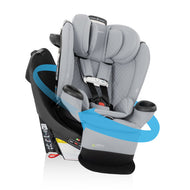
The RAVA is a fixed-in-vehicle convertible seat. Nuna Canada specifies rear-facing use from 5 to 40 pounds and forward-facing use from 25 to 65 pounds, with a 49-inch height limit in either mode. It stays installed in the vehicle rather than serving as a stroller carrier.
The ROYL begins later: it is a forward-facing combination seat with an internal five-point restraint, then a high-back booster. Nuna specifies at least age two and 30 to 65 pounds for five-point-restraint mode, with installation-method limits in the manual; high-back booster mode begins at at least age four and 40 pounds. The AACE is a dedicated belt-positioning booster that converts from high-back to backless. It is not a replacement for an internal-restraint stage before the child is ready.
The stop rule is simple: do not buy the next seat because a birthday arrived or because two ranges overlap. Move only after the current mode is outgrown or another manual-based requirement changes the fit.
Lane three: use the travel system for transfers, not routine sleep
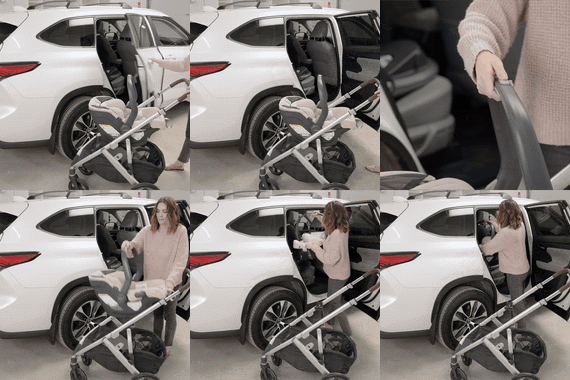
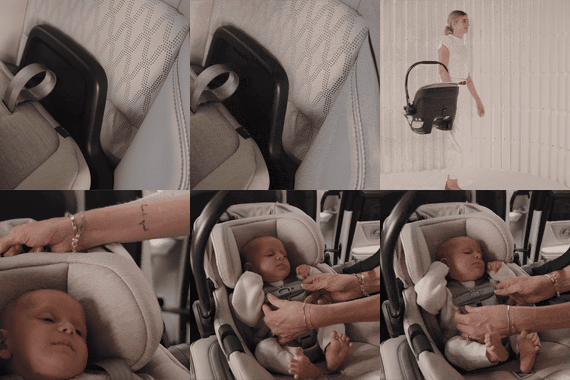
A travel system lets an infant carrier attach to a stroller. It is useful when a short transfer would otherwise require unbuckling and rebuckling the baby. It does not turn a car seat into a general sleep space. Health Canada advises moving a sleeping baby from a car seat or stroller to a crib, cradle or bassinet when the destination is reached.
Within the Nuna range, the connection can be direct or adapter-based:
- MIXX Next and TRIV Next use included ring adapters.
- TRVL LX and TAVO Next accept PIPA series infant seats directly, without an adapter.
- SWIV includes a PIPA ring adapter.
- TRVL dubl accepts a PIPA series carrier on its wider seat; confirm the exact connection and passenger limits in both manuals.
For a preconfigured option, baby enRoute lists the MIXX Next + PIPA Travel System and the TAVO Next PIPA Travel System. A bundle can simplify ordering, but it should come after the stroller and infant-seat branches pass their own tests. The Nuna travel-system configuration map shows how the stroller, seat, connection and accessories fit together.
Lane four: home products are independent decisions

Nuna's home line can coordinate visually with the travel gear, but there is no functional reason to buy every item from one brand.
- The BRYN belongs in a dining routine. Measure its floor position, table clearance and the path to the sink; then consider tray and seat-pad cleanup.
- The LEAF grow is a motor-free swaying seat with a harnessed infant stage and a later chair stage. It is not a sleep product. If a baby falls asleep in a seated or semi-reclined product, Health Canada advises moving them to an appropriate sleep space.
- The SENA aire is a playard with a bassinet attachment. Nuna Canada states that only the bassinet is for sleeping or napping, not the playard itself. Health Canada likewise distinguishes playard bassinet attachments from the playard and advises following the attachment's developmental and weight limits.
Those boundaries are more important than colour matching. Decide which recurring home job you need to solve, then check the exact manual and room footprint.
A five-stop Nuna ecosystem check
- Map the week. List the three routes or rooms where the gear will be used most.
- Measure the hard limits. Record trunk opening, cargo floor, doorway and storage dimensions. For a car seat, record child height and weight and inspect the intended vehicle seating position.
- Choose the lead product. Let the hardest route choose the stroller, or the hardest vehicle fit choose the car seat.
- Verify every connection. Write down the exact stroller, infant seat, adapter and generation. Do not infer compatibility from the Nuna name alone.
- Delete decorative add-ons. Keep an accessory or home product only if it removes a repeated task or meets a measured need.
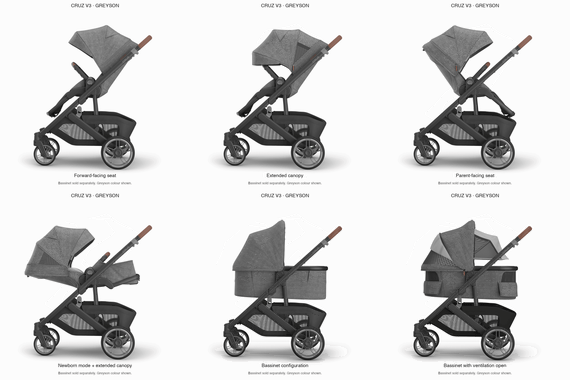
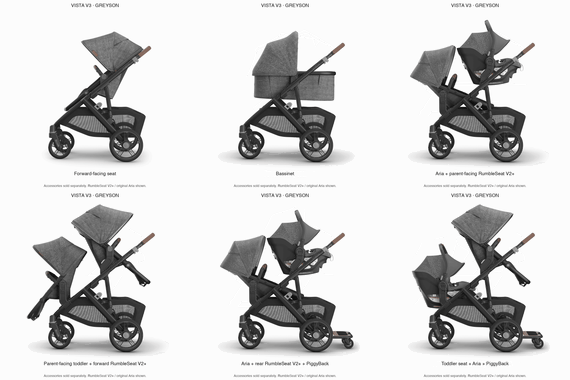
Nuna is a coherent ecosystem, but it is not an obligation to stay within one brand. If no Nuna stroller passes your lift-and-storage test, or no Nuna seat produces an acceptable manual-compliant installation in your vehicle, widen the shortlist. For context, UPPAbaby's Canadian Cruz V3 connects directly to its Mesa and Aria infant seats, while its Minu V3 uses adapters for selected Nuna seats. A different connection pattern may fit a different household better.
Start with the household bottleneck
Build around the product that carries the greatest daily constraint. Choose a Nuna stroller first when walking, folding or passenger capacity drives the week. Choose the car seat first when child and vehicle fit are the harder problem. Add a travel-system connection only after both products work independently. Treat BRYN, LEAF grow and SENA aire as separate home decisions with their own use boundaries.
The result may be an all-Nuna setup, a partial ecosystem or one Nuna product surrounded by other brands. All three can be sensible. The strongest setup is the one whose connections are documented, whose dimensions have been tested and whose next stage is triggered by fit rather than a shopping calendar.