In this article
Start with the family route, not the logo. A PIPA-centred system, strong single-stroller choices at several sizes, or a compact stroller that accepts a PIPA without an adapter points toward Nuna. A large basket, native UPPAbaby infant-seat connection, or the VISTA V3 path from one child to two or three points toward UPPAbaby. Because the answer can reverse at the model level, use the ecosystem result to choose the next exact-model comparison.
Start with the route, not the brand reputation
Nuna and UPPAbaby are not two single strollers. In Canada, each is a connected group of full-size, compact and expanding products. A fair comparison therefore starts with the routine you are buying for. A family that walks to groceries needs a different answer from a family lifting a stroller into a small trunk twice a day. A family expecting a second child soon should not use the same scorecard as a family that expects to remain a one-seat household.
Use this route map:
- One child, daily full-size use: compare Nuna MIXX next with UPPAbaby CRUZ V3.
- One child now, two seated children later: compare Nuna DEMI next with UPPAbaby VISTA V3.
- Compact city or travel priority: compare Nuna TRVL lx or TRIV next with UPPAbaby MINU V3.
- Two children in a compact side-by-side: compare Nuna TRVL dubl with UPPAbaby MINU Duo.
This article maps those paths. It does not pretend that a feature on one Nuna model belongs to every Nuna stroller, or that every UPPAbaby uses the VISTA configuration.
Route 1: one child and everyday errands
The Nuna MIXX next is the Nuna system to inspect when a reversible seat, included ring adapter for PIPA-series infant car seats, bassinet option and a fold that stands are central to everyday use. Nuna Canada lists it from birth to 50 lb and publishes a 28.3 lb stroller weight excluding the arm bar and insert. Its seat can face the parent or the world, and it folds with the seat in either direction.
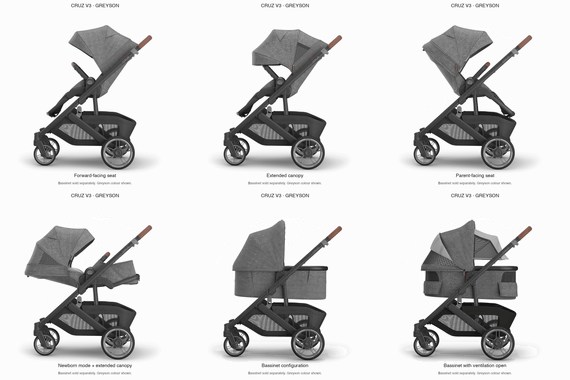
UPPAbaby describes the CRUZ V3 as a single, full-size stroller. It also has a reversible seat and from-birth use, and UPPAbaby includes an infant insert with the current CRUZ V3 seat. Its published frame-and-seat weight is 26.5 lb, its width is 22.5 inches, and its basket limit is 30 lb. That gives CRUZ V3 a defined win for a household that routinely walks home with a substantial grocery load or wants a narrower published chassis.
MIXX next can still be the stronger route for a family already committed to a Nuna PIPA because its PIPA-series ring adapter is included. Do not treat either outcome as universal. Measure the trunk opening and write down the heaviest normal basket load before choosing.
Route 2: a second child is part of the plan


Nuna DEMI next and UPPAbaby VISTA V3 solve growth differently. The current Nuna Canada DEMI next configuration includes a rider board. Nuna's sibling seat is sold separately and duplicates the main seat's birth-to-50-lb published use; it can connect in upper or lower positions. Nuna also offers a DEMI next bassinet, and the official materials show stacked twin and bassinet-plus-seat arrangements.
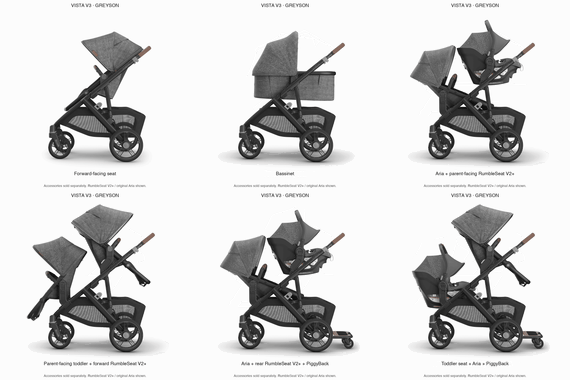
VISTA V3 starts as a single stroller and can add a RumbleSeat and PiggyBack accessories. With those accessories, UPPAbaby says the VISTA V3 can accommodate up to three children. Its main toddler seat is rated to 50 lb, while actual lower-seat limits and allowed positions must be checked against the specific current accessory instructions before purchase.
The ecosystem choice here is spatial. DEMI next keeps the second seat close within a stacked frame and offers two 50-lb sibling/main seats, while VISTA V3 presents a broader, explicitly documented path to three riders. VISTA wins when a ride-along third child is a likely scenario. DEMI can win when two equal published seat limits and the included rider board in the current Nuna stroller package matter more. In either system, list every required seat, bassinet and adapter rather than comparing base stroller prices alone.
Route 3: compact travel is the centre of the decision
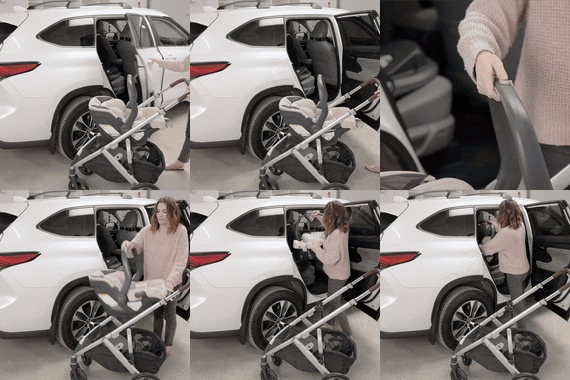
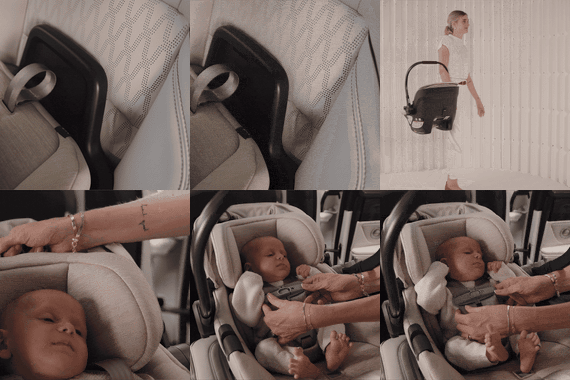
The compact ecosystems diverge most clearly at the car seat. Nuna's TRVL lx accepts Nuna PIPA-series infant car seats directly, with no adapter, and includes a carry bag. Nuna publishes a 14.6 lb weight without canopy and armbar; those parts add about 2.4 lb. The stroller seat has a near-flat recline that converts to carriage mode, and the frame stands when folded.
UPPAbaby MINU V3 publishes a 16.7 lb true weight and a smaller folded envelope of 10 by 18 by 21.5 inches. Its seat supports a from-birth carriage mode, and adapters can connect UPPAbaby Aria or Mesa plus selected Nuna, CYBEX and Maxi-Cosi infant seats. UPPAbaby describes the fold as IATA-compatible, but airlines control cabin acceptance, so the folded measurement and the operating carrier's current policy still decide the trip.
MINU V3 wins when the smallest published fold in this pair and a 20-lb basket matter most. TRVL lx wins when direct PIPA attachment and the included carry bag remove steps from repeated car-to-stroller transfers. MINU V3 uses adapters for selected Maxi-Cosi, Nuna, and Cybex infant seats.
Newborn setups: count parts before making a promise
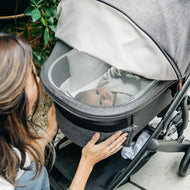
“From birth” can mean a stroller seat, a carriage mode, a bassinet, an infant insert or an infant car seat. Those are different experiences and different purchase lists. MIXX next supports a true-flat seat recline and separate MIXX-series bassinet or PIPA carrier. TRVL lx converts its seat to carriage mode and accepts PIPA carriers directly. DEMI next can use its stroller seat, separate bassinet or PIPA pairing according to the current instructions.
UPPAbaby CRUZ V3 uses its lay-flat reversible seat and included infant insert from birth. MINU V3 has a carriage mode in the seat. VISTA V3 requires the Infant SnugSeat or bassinet accessory for birth use in its toddler seat pathway, while UPPAbaby publishes the seat alone from three months. The correct question is not “which brand works from birth?” It is “which exact newborn configuration will we use, and which pieces are included?”
Run the ecosystem worksheet
- Write the number and ages of likely riders for the next three years.
- Record your infant car-seat model, or mark it undecided.
- Measure the trunk opening, storage closet and narrowest regular doorway.
- List the normal basket load: diaper bag only, groceries, or daycare gear.
- Build the complete configuration list for newborn, toddler and second-child stages.
- Check each adapter, seat and bassinet against the current Canadian product page and manual.
If the answers point to several Nuna models, browse the Nuna collection and compare the exact product pages. If they point to UPPAbaby, use UPPAbaby Canada's current model and accessory pages to confirm the configuration. The useful winner is the ecosystem with fewer compromises in your repeated week, not the one with the longest feature list.
Route-level shortlist
Choose Nuna for a PIPA-centred system, a broad choice of compact-to-full-size stroller formats, and configurations such as direct car-seat attachment on TRVL lx or two 50-lb seats on DEMI next. Choose UPPAbaby for CRUZ V3's large published basket, MINU V3's very compact fold, or VISTA V3's documented path to a third rider. If your shortlist still spans both brands, stop comparing ecosystems and move to the exact model pair that matches your route. That is where the meaningful trade-offs become measurable.
Ownership beyond the first configuration
An ecosystem choice also determines which parts remain useful when the routine changes. Write down the accessories that would move to another stroller in the same brand, and which are tied to one frame. PIPA-series infant car seats can connect across several current Nuna strollers, but the connection method differs: direct on TRVL lx and through an included ring adapter on MIXX next or TRIV next. MINU V3 uses adapters for Mesa and Aria infant seats.
Cleaning and repair should be model-level checks, not assumptions about the logo. Confirm which fabrics remove, which parts the manufacturer lists for replacement, the warranty terms that apply in Canada, and where the stroller can be serviced. These factors can break a close score, but they do not override an incompatible passenger plan.
A final counterexample test
Try to disprove your preferred brand. If you prefer Nuna, ask whether CRUZ V3's 30-lb basket or MINU V3's smaller fold would remove a weekly problem. If you prefer UPPAbaby, ask whether direct PIPA attachment or DEMI next's duplicate 50-lb seat limits would remove more steps. A preference that survives the strongest competitor scenario is ready to become a model shortlist.