In this article
For one infant seat shared between two cars, an extra PIPA base is a supported option only for the current PIPA and PIPA Lite. PIPA urbn is a separate infant seat that does not use a base. Choose between them by mapping who transports the child, how often the carrier moves, which installation each vehicle supports and whether one seat or two seats are actually needed.
Two-car planning changes here: PIPA urbn is another complete restraint, not a replacement base. Buying it for the second car means buying and managing another complete restraint with its own fit, limits, harness and expiry history.
First decide whether the carrier travels
There are three different two-car systems:
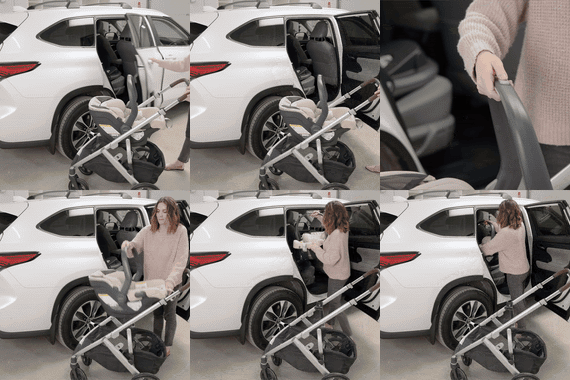
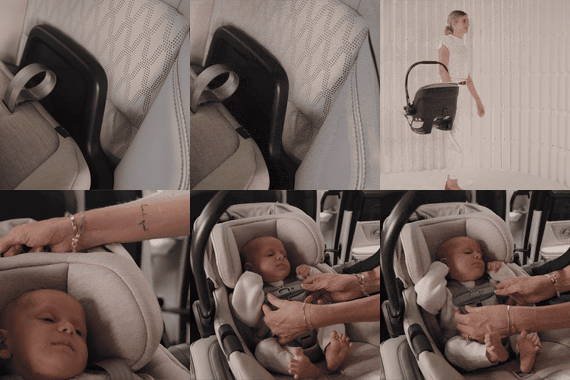
- One PIPA carrier, two installed bases: the carrier moves with the child and clicks onto the base in either car.
- One PIPA carrier, one base: the primary car keeps the base; the second car uses the PIPA's documented carrier-only vehicle-belt installation.
- Two complete infant seats: each car has its own restraint, such as a PIPA-system seat in one car and a PIPA urbn in the other. The child is transferred between seats.
PIPA Lite removes option two because its Canadian manual requires the base for vehicle installation. PIPA urbn does not participate in options one or two because it cannot be installed on a base.
Exact equipment map
| Current Canadian seat | Works with current PIPA base? | Second-car paths | Child-use limits published by Nuna Canada |
|---|---|---|---|
| PIPA | Yes | A correctly installed PIPA base or the documented carrier-only vehicle-belt installation | 4–35 lb, less than 32 in, with at least 1 in of head clearance below the carrier top |
| PIPA Lite | Base required for vehicle use | Vehicle installation requires the base | 4–22 lb; less than 81 cm (32 in.); top of head at least 25 mm (1 in.) below restraint top |
| PIPA urbn | No | A separate urbn remains in the second car or moves between cars using its documented integrated-UAS or vehicle-belt installation | 4-22 lb, up to 29 in, subject to all manual fit limits |
The different limits matter in a mixed-seat household. A child may outgrow one seat before the other, so the second-car plan needs its own transition date.
Path one: an extra PIPA base

The current Nuna PIPA infant car seat base is listed by Nuna Canada for rear-facing use with PIPA and PIPA Lite. One base in each regular vehicle can make the handoff predictable: the carrier travels with the child while each vehicle keeps a verified installation.
This path is especially coherent when daycare pickup alternates between caregivers but the same infant carrier arrives with the child. It also keeps the harness fit and carrier history in one seat.
Each base still needs a separate installation. Vehicle A may support rigid UAS in the chosen position while Vehicle B requires the base's documented vehicle-belt method. Read both vehicle manuals, complete every indicator and movement check, and do not assume matching cars have identical rear-seat conditions. The Canadian PIPA base-versus-baseless guide separates the permitted methods by exact PIPA model.
An extra base does not help if the carrier is frequently left with the other caregiver or if a driver may arrive without it. In that routine, two bases can still produce one unusable car.
Path two: PIPA base in one car, carrier-only in the other
The current Canadian PIPA manual includes carrier-only installation with allowed vehicle belts. This can reduce the second-car hardware when the second vehicle is occasional and the caregiver can perform the belt installation confidently.
Test that method in the second car before choosing it. Confirm the belt type, routing, locking, buckle position, recline and movement at the belt path. Time the complete installation without rushing. If it is difficult to achieve consistently, the theoretical flexibility is not solving the household problem.
This is not an option for PIPA Lite. Its Canadian manual says it must be installed in a vehicle with the base. Do not copy the PIPA's blue belt-path instructions onto the Lite carrier.
Path three: a separate PIPA urbn
PIPA urbn has integrated rigid UAS connectors and documented vehicle-belt methods, so it can create a base-free second-car setup where the vehicle and caregiver support one of those installations. Nuna's manual also says not to attempt to use it with a base.
This path changes the handoff. The child moves between two complete seats, which means both harnesses need current adjustment, both seats need registration and history records, and both caregivers must monitor model-specific limits. A cover, insert or canopy component belongs to its own seat unless Nuna identifies it as interchangeable.
A second complete seat can be useful when each vehicle independently handles pickup. It can be wasteful when the carrier always travels with the child and an extra base would provide the same operational result with fewer harnesses to manage.
Mixed-seat households need two fit checks
If one car has PIPA and the other has PIPA urbn, fit the child independently in each carrier. Harness height, insert use and permitted handle position follow that seat's manual. Do not copy a buckle, insert or harness setting from one carrier to the other.
Put a simple identification card in each vehicle with the seat model, current child fit check, caregiver who knows the installation and the next expected outgrowth trigger. The card is a reminder, not a substitute for the manual, but it can prevent a backup pickup from assuming both seats operate alike.
Use a two-car friction diary
For one week, record the answer to five questions for every child trip:
- Which car departed and which car returned?
- Which adult had the infant carrier at pickup time?
- Did the child need to stay in the carrier for a stroller handoff?
- Was there time and space for a fresh installation?
- Did either vehicle need the rear seating position for another passenger or child restraint?
The diary often reveals the answer. If one carrier reliably follows the child, two bases may be the cleanest system. If each car must be ready without exchanging equipment, two complete seats may be more resilient. If the second car is rare and its belt installation is easy and repeatable, the PIPA carrier-only path may be enough.
Compare the whole two-car routine, not just shelf price
Check current prices on the live baby enRoute product pages, then compare the full period of use:
- equipment required in each car;
- time to install or attach on an ordinary pickup;
- who must carry the infant carrier;
- whether a stroller adapter or direct stroller connection is needed;
- the earlier outgrowth point if two different seats are used;
- storage after outgrowth and the ability to preserve each seat's history.
Do not use a transient sale price or assumed stock status as the deciding evidence. The current baby enRoute catalogue can establish the listed products, but product availability should be read from the live page at purchase time.
Check the second-car installation before buying
- Confirm the exact seat and, if used, exact base model.
- Choose an allowed rear-facing seating position using the restraint and vehicle manuals.
- Select one permitted installation method and complete its routing, locking, recline and indicator steps.
- Check movement where the restraint manual directs, not at the canopy or handle.
- Attach and remove the empty carrier several times if a base is used.
- Complete the child's harness fit in every separate seat.
- Teach the backup caregiver the same checks and leave the manual accessible.
If the plan relies on an unknown base, a borrowed insert, an unreadable label or a method from another PIPA model, stop and identify the equipment first.
Decision summary
Choose an extra PIPA base when you use PIPA or PIPA Lite, the same carrier reliably travels with the child, and both cars can keep a correct base installation.
Use PIPA carrier-only in the second car when the second vehicle is occasional, its belt system supports the Canadian PIPA manual, and the caregiver can repeat the installation correctly. This does not apply to PIPA Lite.
Consider a separate PIPA urbn when each car needs an independent seat and the second vehicle supports an urbn installation. Treat it as a separate seat with different limits, not as an accessory for the first PIPA.
Rework the plan when neither car consistently has the carrier or required base, or when the intended seating position cannot pass the manual checks. Operational simplicity begins with the real pickup pattern.