In this article
In Canada, “PIPA base or baseless?” has three different answers. The current Nuna PIPA can be installed on its base or installed carrier-only with a vehicle belt. The current PIPA Lite must be installed in a vehicle with its PIPA base. The PIPA urbn does not use a base at all; its Canadian manual provides installation with the integrated rigid UAS connectors and with specified vehicle-belt methods.
Start from the installation method, not the convenience label: choosing a baseless routine first and a seat second can lead you to the wrong model. Start with the exact model name on the seat and Canadian manual, then decide which installation method is useful in the vehicles you actually use.
The Canadian model-by-model answer
| Current Canadian model | Base installation | Carrier-only or base-free options | Best question to ask |
|---|---|---|---|
| Nuna PIPA | Yes. Its manual covers the PIPA base with rigid UAS or a vehicle belt. | Yes. The carrier can be secured without the base using an allowed lap-and-shoulder belt or lap belt. | Will you use the base most days but need a documented belt option for occasional vehicles? |
| Nuna PIPA Lite | Required for vehicle use. | No carrier-only vehicle installation is permitted by the Canadian manual. | Can every vehicle and aircraft plan accommodate bringing and correctly installing the base? |
| Nuna PIPA urbn | No. The manual says not to use this seat with a base. | Yes. The manual covers integrated rigid UAS and specified vehicle-belt installations. | Do the vehicles you use support one of the urbn's documented installation methods and fit checks? |
These are not interchangeable instructions. A demonstration for one PIPA model is not permission to use the same belt path, base, or connector sequence with another. Use the manual that matches the exact model shown on your restraint.
If the remaining choice is between lower carry weight and base-free vehicle hardware, compare the PIPA Lite-versus-PIPA Urbn model-choice guide after confirming which installation methods each model allows.
Identify the seat before discussing the method
Look underneath the carrier for its model label and Canadian National Safety Mark, then match that model to Nuna Canada's current manuals page. Do the same for a separate base. Colour names and fabric collections are not model identifiers, and “PIPA” in a marketplace title may describe the product family rather than the exact seat.
This check is especially important with borrowed or second-hand equipment. Confirm the manufacture and do-not-use-after labels, registration and recall status, crash history, missing or damaged parts, and any modification or non-approved repair. If the exact model cannot be identified from a readable label, do not select an installation method until the model and matching manual are confirmed.
What a base changes in daily use
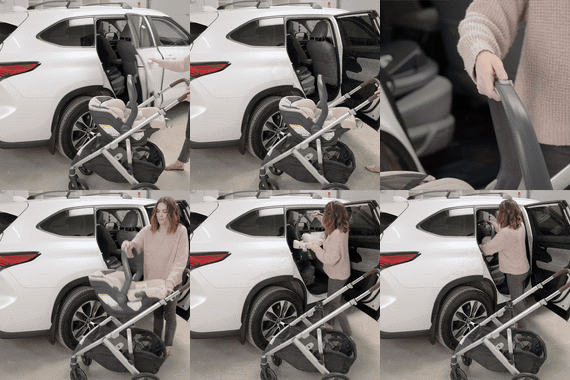
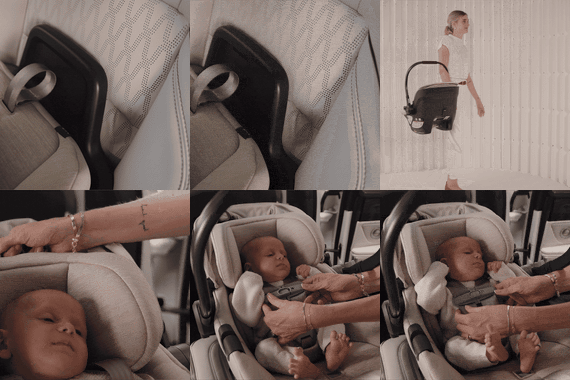
A correctly installed base can make a repeated commute simpler: the base stays in the vehicle, while the carrier is attached and removed at each trip. For the current PIPA and PIPA Lite, the Canadian PIPA base is the matching base listed by Nuna. The base manual describes rear-facing use with those two seats; it is not a universal PIPA-series dock and is not for the PIPA urbn.
That convenience does not remove the installation work. The base still has to suit the vehicle seating position, be installed by an allowed method, show the required indicators, and pass the movement and recline checks in the manual. A second vehicle also needs its own complete installation check. Moving a base between cars may be possible, but it turns each move into another installation rather than a quick carrier handoff.
For a household with one predictable vehicle, that fixed-base routine may be exactly the point. For a household that rotates among a family car, a grandparent's vehicle and taxis, the value depends on how often the base can remain installed and how often another documented method is needed.
What “baseless” means for each seat
PIPA: a carrier-only belt installation
The current Canadian PIPA manual for the CF035 Canadian model family includes carrier-only installation with a vehicle lap-and-shoulder belt and with a lap belt. This can be useful when bringing the carrier into an occasional vehicle without moving the base. It is still a full car-seat installation: the belt must follow the illustrated path, the carrier must have the specified recline, and movement at the belt path must stay within the manual's limit.
Do not translate “the PIPA can be installed without its base” into a claim of universal vehicle compatibility. Belt geometry, buckle position, available seating positions and the vehicle manufacturer's restrictions still matter. Practise in each planned vehicle before the day you need the option.
PIPA Lite: the base is part of the vehicle plan
The Canadian PIPA Lite manual is explicit that the seat must be installed in a vehicle with the base. There is no carrier-only shortcut for an occasional ride. That also changes flight planning: the manual's aircraft instructions use the base, so the base must be part of that trip plan and the airline must permit the approved restraint in the booked seat.
This does not make the PIPA Lite a poor choice. It makes it a specific choice for families whose vehicle routine can support the base. If ad-hoc vehicles are central to your week, resolve that routine before buying rather than assuming “PIPA series” means one shared installation menu.
PIPA urbn: base-free is the design, not a missing accessory
The Canadian PIPA urbn manual says not to attempt installation with a base. Its integrated rigid UAS connectors are built into the carrier, and the manual also provides vehicle-belt installation methods. That can reduce the number of separate pieces in a multi-vehicle routine, but it does not eliminate the need to check the seating position, permitted method, angle, indicators, belt path and final movement every time.
The urbn also has different child-use limits from the current PIPA. Treat it as a separate infant seat with a different operating envelope, not as a PIPA plus an integrated version of the removable base.
Run the same-trip test before choosing
Picture one ordinary week and assign an installation method to every ride:
- Primary car: name the exact seating position and whether a base will remain installed.
- Second regular car: decide whether it needs another compatible base, a documented carrier-only belt installation, or a separate base-free seat.
- Occasional car or taxi: confirm that the selected model allows the method you expect to use. Then check the vehicle when available.
- Air travel: read the aircraft section for that exact Canadian model and confirm the airline's current restraint and seat rules before booking.
- Stroller handoff: separately verify the stroller and required adapter.
If any row depends on “we will figure it out at pickup,” the plan is not finished. A calm practice installation with the child absent is more useful than a feature comparison conducted only on product pages.
Installation checks that do not change with the marketing label
- Confirm the exact restraint model, Canadian certification markings and manual.
- Read both the child-restraint manual and the vehicle owner's manual for the intended seating position.
- Use only the installation method or combination permitted by the exact restraint or base manual, and do not combine UAS with a vehicle belt unless that manual expressly allows it.
- Check recline and every required visual indicator.
- Test movement at the belt path or connector path exactly where the manual directs.
- Recheck harness height, fit, routing and chest-clip position for the child.
Transport Canada advises caregivers to read the child-seat and vehicle instructions and follow the instructions for the specific child-seat model. A local child-passenger-safety technician can help you learn the installation, but the matching manuals remain the authority for your specific products.
When to stop and verify
Pause before travel if the exact PIPA or base model cannot be matched to its manual, a required indicator or recline check fails, movement exceeds the manual's limit, or the vehicle manual disallows the planned position. Also stop if a US review is the only support for a Canadian setup: names and instructions can differ by market and generation.
The useful conclusion is not that a base is always easier or that baseless is always more flexible. It is that the current Canadian PIPA, PIPA Lite and PIPA urbn solve different transportation routines. The right model is the one whose documented installation methods cover your real vehicles without improvisation, including the least convenient ride of the week.