In this article
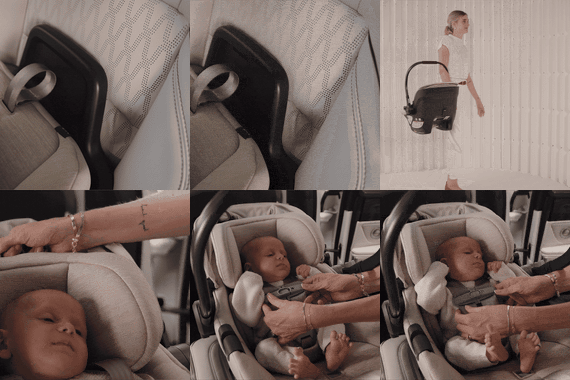
Start with the job that repeats: the Nuna PIPA lite publishes the lower 5.3 lb carrier weight and requires a base in every vehicle used. For a week built around vehicle changes, the Nuna PIPA urbn removes a separate base from the plan: its rigid UAS connectors are built into the carrier, and its Canadian manual also permits vehicle-belt installation. The trade-off is a heavier carrier and a lower standing-height limit than the PIPA lite.
This is not simply a contest between two lightweight infant seats. The Canadian PIPA lite and PIPA urbn organize the vehicle-installation job differently. The more useful question is which job you repeat most often: carrying the seat away from the car, or installing it in another car.
The Canadian specifications that shape the decision
| Decision point | Nuna PIPA lite (Canada) | Nuna PIPA urbn (Canada) |
|---|---|---|
| Published carrier weight | 5.3 lb, excluding canopy and infant insert | 7 lb, excluding canopy and infant insert |
| Child-use range | Rear-facing, 4–22 lb; less than 81 cm (32 in.); top of head at least 25 mm (1 in.) below restraint top | Rear-facing, 4–22 lb, 15–29 in., with at least 1 in. of head clearance |
| Vehicle installation: PIPA Lite vs PIPA Urbn | Must be used with its PIPA-series base | Integrated rigid UAS or a vehicle-belt method described in the Canadian manual; do not use it with a base |
| Best first filter | How long and how often will you carry the carrier? | How often will you move the seat between vehicles? |
The published weights do not include the baby, canopy or insert. For a realistic carry comparison, add the child's current weight and anything that stays attached to the carrier. A two-pound difference between empty carriers remains a two-pound difference after the child is added, but the total carried load is what your stairs, hallway and daily route will actually reveal.
A five-minute route scorecard
Score each statement from 0 (“almost never”) to 3 (“most days”). The higher total in a column identifies the kind of friction worth reducing. It is not a safety score, and it does not replace a vehicle-fit check.
| Your routine | Points toward PIPA lite | Points toward PIPA urbn |
|---|---|---|
| I carry the occupied carrier up stairs or through a long parkade. | Add your score | — |
| The carrier often travels on a Nuna stroller after leaving the car. | Add your score | Add your score |
| The seat regularly moves between two or more vehicles. | — | Add your score |
| I use taxis or family vehicles where a dedicated base may not be present. | — | Add your score |
| I can install and leave a compatible base in every regular vehicle. | Add your score | — |
| Minimizing the equipment stored in a second vehicle is a priority. | — | Add your score |
A close score is useful information. It means the purchase should be decided by an in-person installation and carry test, not by another round of specification comparison.
When the PIPA lite earns its name
The PIPA lite's 5.3 lb published carrier weight is its clearest advantage. It can matter when the carrier is lifted repeatedly, held while opening doors, or carried between a parking space and a home. Families who can leave the included base installed in one primary vehicle may experience the base requirement as a non-issue: the carrier docks for each drive, then leaves the base behind.
That advantage depends on the full route. If a second caregiver regularly takes the child in another car, the second vehicle also needs an appropriate base installation before the PIPA lite can be used there. A lighter carrier does not remove that equipment and setup requirement.
The PIPA Lite manual requires height less than 81 cm (32 inches) and at least 25 mm (1 inch) between the top of the child's head and the top of the restraint, while PIPA Urbn publishes a 29-inch height limit. That does not predict exactly when an individual child will outgrow either seat. For each model, stay within its weight and height limits and follow all fit instructions in the exact Canadian manual.
When the PIPA urbn reduces vehicle-change friction
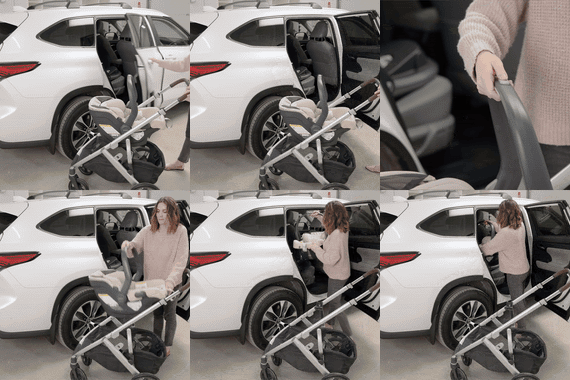
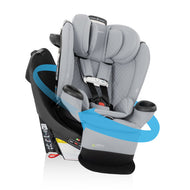
The PIPA urbn places rigid UAS connectors directly on the carrier. With the PIPA urbn in an allowed vehicle seating position, no separate base is used. Its Canadian manual also illustrates approved lap-and-shoulder-belt and lap-belt installations, which gives caregivers another documented route when the rigid connectors are not the method being used.
That flexibility is not permission to improvise. The vehicle seating position, connector or belt path, recline, carrier contact and final tightness all need to meet the Canadian PIPA urbn manual and the vehicle owner's manual. The urbn must not be placed on a PIPA base.
The urbn weighs 7 lb before the excluded canopy and insert are counted. It is still designed as a portable infant carrier, but the lite is the more direct choice when every pound carried away from the vehicle is the dominant concern.
Run three scenarios before choosing
One car, one regular driver, many stairs
A permanently installed base reduces the PIPA lite's main inconvenience, while the lower empty-carrier weight helps on the part of the route that happens on foot. Confirm the base fits the chosen seating position and that every regular driver can operate the carrier release.
Two family cars with frequent hand-offs
The comparison is between one urbn moving with the child and a PIPA lite setup that needs a compatible base wherever it will be driven. Price both complete arrangements, then perform the approved installation in both vehicles. If each vehicle can keep a base installed, the lite remains a practical contender; if not, the urbn's integrated design may remove repeated equipment planning.
Occasional taxi or rental-car use
The urbn offers approved base-free installation methods, but travel does not shorten the installation checklist. A caregiver still needs the Canadian manual, enough time to select a suitable seating position, and confidence using the exact approved method. If that cannot be done reliably, convenience on paper is not enough.
The showroom test that settles a close result
Account for the friction that specifications omit
Carry weight is experienced away from the vehicle; the repeated installation task happens at the vehicle. Walk through a rainy or winter hand-off in your head. Will the caregiver be holding another child's hand, carrying bags, finding lower anchors in an unfamiliar seat or storing a base? The best specification is the one that removes a repeated step without creating an installation step the household cannot perform reliably.
Also separate “many vehicles” from “many installations.” A PIPA lite can work smoothly across two regular cars when both keep correctly installed bases. A PIPA urbn can be the simpler one-car choice when the household does not want a base occupying the seating position between trips. Count the actual installations per week, not the number of keys on the hook.
Before assigning value to stroller compatibility, test the complete combination. Both product families connect with Nuna strollers, but the stroller model, adapter requirement, carrier attachment and loading space still matter. A lighter carrier that is awkward to load, or an integrated seat that does not fit the intended vehicle position, has not solved the route.
- Carry the real load. Ask whether a floor model can be weighted to approximate your child's expected weight. Lift it from low and waist height, walk, turn and operate a door.
- Use every regular vehicle. With permission and qualified help where available, test the approved installation in the exact seating position you expect to use.
- Rehearse the hand-off. Have each regular caregiver identify the correct indicators, release points and belt or connector checks from the manual.
- Measure the complete purchase. Include any additional compatible base needed for the PIPA lite setup; do not assume the PIPA urbn can share one.
- Check the transition horizon. Compare your child's current measurements with both seats' Canadian limits and fit rules without treating the maximums as a promised duration.
Choose the trade-off you will repeat
At 5.3 lb and requiring its base in a vehicle, the PIPA lite minimizes carrier weight; at 7 lb and designed for baseless installation, the PIPA urbn minimizes separate installation equipment. For a base-stable, carry-heavy routine, start with the Nuna PIPA lite. For a multi-vehicle routine, start with the Nuna PIPA urbn. Then let a Canadian-manual installation in the real vehicle, not the name of the seat, make the final call.
Confirm installation methods and two-vehicle equipment from the current Canadian manuals for the exact PIPA models. Return to the wider Nuna collection at baby enRoute only after the model-choice job is settled.