In this article
A Canada-first Nuna travel plan starts with the exact PIPA model, then checks each transport operator. The current PIPA can use its documented carrier-only vehicle-belt installation. PIPA Lite requires its base for vehicle and aircraft use. PIPA urbn has no base and uses its documented integrated-UAS or vehicle-belt methods. Airlines, taxis, rideshare services and transit agencies add separate rules that can change by trip.
A smaller packing list is not automatically the simplest safe trip. Leaving a required base behind or relying on an unconfirmed airline or taxi rule can create a problem at the curb. Plan each travel segment before deciding what to carry.
Build a departure board, not one universal checklist
| Trip segment | Authority to check | Nuna question | Proof to keep |
|---|---|---|---|
| Aircraft cabin | Transport Canada acceptance rules, airline policy and crew direction | Does the exact Canadian restraint manual permit aircraft use, and what pieces does it require? | Readable certification labels, manual aircraft pages and the airline confirmation |
| Checked or gate-checked stroller | Airline baggage policy for the booked flight | Can the stroller be folded and protected within the airline's current process? | Current dimensions, booking notes and baggage rules |
| Taxi or rideshare | Province or territory law, service type and vehicle | Which documented vehicle-installation method will you use in that exact seating position? | Matching seat manual and a practised installation plan |
| Bus, rail or ferry | Local transit agency | Can the stroller board, park and move without obstructing doors or priority space? | Current local stroller rules and a fold/carry fallback |
A green answer in one row does not carry into the next. An aircraft-approved child restraint does not establish a taxi installation, and a cabin-sized stroller on one airline cannot be assumed to receive the same handling on another.
Flying: start with a booked seat and the exact manual
Transport Canada's current child-restraint advisory circular explains that an aircraft child restraint is secured to the aircraft seat with its safety belt, identifies acceptable design standards, and describes label and seating considerations. It recommends an approved restraint appropriate to the child's size. The airline still controls acceptance and seating on the actual flight.
For the current Canadian Nuna models:
- PIPA: its Canadian manual certifies the restraint for motor vehicles and aircraft and provides aircraft installation with or without the base. Confirm the airline's current seating rules and which method fits the aircraft seat.
- PIPA Lite: its Canadian manual requires the base for vehicle use and shows aircraft use with the base. A carrier-only flight plan is not supported.
- PIPA urbn: its Canadian manual certifies it for aircraft use and shows installation with the aircraft lap belt. Its integrated rigid UAS connectors are not the aircraft attachment method.
When booking, tell the airline you intend to use a Canadian child restraint in a purchased seat. Ask about permitted seat locations, aircraft-seat width, rear-facing placement, boarding order and whether the base or carrier changes the fit. Transport Canada notes that child restraints should not be placed in an exit row and describes window-seat placement as the recommended location, subject to the operator's cabin plan.
Bring the manual or an offline copy and make sure the certification and model labels remain readable. Cabin crew may need to verify them. A US label guide or product review does not replace the labels on a Canadian restraint.
Stroller handling is an airline policy question
Air Canada's current children-and-travel page distinguishes small gate-check-eligible strollers from larger strollers handled at the baggage counter. Check the operating carrier's current page for every segment, not only the airline that sold the ticket.
Measure the folded stroller at home with the accessories that will remain attached. Remove loose cup holders, trays and adapters when required, secure them in a labelled bag, and use a travel bag only as instructed. A compact stroller such as Nuna TRVL lx can simplify the carry sequence, but the model name alone does not guarantee cabin acceptance.
Photograph the stroller before handoff and place contact details inside the bag.
Choose one of three airport movement plans
Stroller to the gate: this can carry the child and cabin items through the terminal, but it requires a clear gate-check handoff. Know which accessories must be removed, who will fold the stroller, and who will hold the child during that fold.
Stroller checked at the counter: this reduces equipment at security and boarding but creates a longer child-carry segment. Use a suitable baby carrier if desired, keep the child restraint available for the aircraft seat, and confirm how you will move through connections and baggage claim.
Compact stroller presented for cabin acceptance: measure the fully folded stroller and compare it with the operating carrier's current allowance. Even a compact model may be gate-checked because of aircraft type, space or policy. Pack it so an unexpected handoff does not separate essential loose pieces.
For a connecting itinerary, repeat the policy check for every operating carrier. A codeshare can place different baggage and child-restraint procedures inside one reservation.
Taxis and rideshare: law, policy and installation are separate
Child-restraint requirements can vary by province or territory; in British Columbia, ordinary taxis are exempt from the child-restraint division but taxis operating only under a transportation-network-services authorization are not. Current British Columbia regulations, for example, distinguish a taxi from a vehicle operating only under a transportation-network-services authorization. Ontario publishes its own taxi exemptions and exceptions. Verify the current rule where the ride occurs and identify whether the booked service is a taxi, rideshare or another passenger vehicle.
A legal exemption does not make an unrestrained ride equivalent to using an appropriate restraint. Build the trip around a documented seat installation whenever possible. Neither the driver nor an app listing can authorize a method that the Nuna or vehicle manual does not allow.
How each PIPA model changes the curbside plan
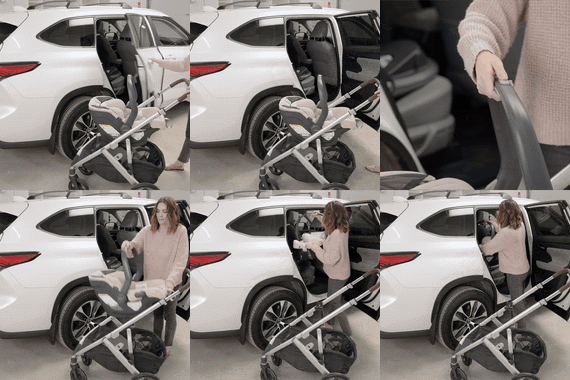
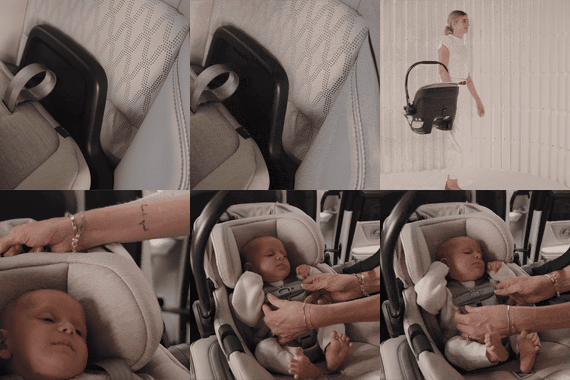
PIPA: the carrier-only belt path can avoid transporting the base when the exact vehicle belt and seating position support the manual's method. Practise routing, locking, recline and the final movement check before the trip.
PIPA Lite: the base is required. Confirm there is time and a suitable seating position to install it correctly at every pickup. If the itinerary depends on rapid vehicle changes without the base, the plan and seat are mismatched.
PIPA urbn: use the integrated rigid UAS only where suitable lower anchors and vehicle instructions support it, or use one of the vehicle-belt methods in the Canadian urbn manual. Do not use a PIPA base with PIPA urbn; confirm that the intended vehicle has a seating position allowed by the Canadian urbn manual.
At pickup, use only a seating position and installation method permitted by the exact Nuna and vehicle manuals. If you cannot complete every required check, cancel or change vehicles; an unsupported installation is not a workaround.
Pre-book the curbside conversation
When a car service accepts notes or calls, ask for a rear seating position with a working seat belt and enough time for the caregiver to install the restraint. If planning to use rigid UAS, ask whether the intended rear position exposes lower anchors, but treat the vehicle manual and the anchors themselves as the final check.
Tell the driver that departure must wait until the installation is complete. The caregiver, not the driver, should be able to perform and verify the restraint's documented method. Keep another transport option available if the arriving vehicle cannot support it.
Transit: local operating rules shape the stroller choice
Transit agencies set their own stroller dimensions and boarding rules. In Metro Vancouver, current TransLink guidance limits strollers to 61 by 122 cm, says they must not obstruct aisles or doors, and tells caregivers to hold the stroller with brakes on before the bus departs. Operators may ask a stroller user to vacate the accessibility area for priority customers.
That local example should prompt questions, not a Canada-wide assumption:
- What is the agency's maximum stroller size?
- Must the stroller be folded during crowded periods or on a particular vehicle?
- Where may it stand, and who has priority for that space?
- Can the caregiver safely hold the child while folding and carrying the stroller?
- Are elevators operating at the transfer stations?
For a bus-heavy route, test the stroller at full outing load. On TransLink, hold the stroller with its brakes on and keep aisles and doors clear; elsewhere, follow the agency's current rules. If a fold may be required, plan who will hold the child and carry the folded stroller before boarding.
Make transfers work with one caregiver
A route that works with two adults may fail when one person must manage the child, stroller, infant seat and luggage. Rehearse the hardest transfer alone in a controlled setting. Keep the fare card and phone reachable without releasing the stroller, consolidate bags into the stroller basket within its limits, and avoid attachments that widen the stroller at doors.
Check elevator outages before leaving and identify an accessible alternate station. If the planned route requires a transfer the caregiver cannot complete with the child and gear, change the route.
A before-travel rehearsal
- Lay out the restraint, required base, stroller, adapters and protective bags.
- Confirm the child remains within every current seat limit and complete the harness fit.
- Install the restraint using the method planned for each vehicle segment.
- Attach the carrier to the stroller with the exact documented connection, then remove it and fold the stroller.
- Measure and weigh travel items as the airline requires.
- Save current airline, provincial and transit pages for offline access.
- Assign each adult a handoff: child, restraint, stroller and bags.
If one person cannot perform the full sequence safely, reduce the luggage or change the connection plan. The most useful travel system is the one the travelling caregiver can install, release, carry and verify without guesswork.