In this article
The honest answer is not yet. UPPAbaby currently describes the Kona as a 22 lb stroller with a one-hand fold that works while the seat is attached in either direction, but it does not publish exact folded length, width, or height. The current UPPAbaby manuals index also has no Kona manual with additional measurements. Those features can make the stroller easier to handle. They do not prove it will pass through your trunk opening or sit inside your usable cargo space.
If trunk fit is a hard constraint, treat the missing dimensions as a stop sign, not an invitation to estimate from photos. Measure your vehicle now and save the numbers, but do not approve the fit without official Kona dimensions or a physical test using the actual folded stroller. If the clearance is close, finish with a physical fit check.
Trunk fit is a three-dimensional problem
Vehicle cargo figures often describe volume. A stroller has a fixed shape. A large cargo volume can still have a narrow hatch, a steep rear window, wheel-well intrusions, or a raised lip that blocks the route in. The smallest point along that route decides the fit.
Start by separating three questions:
- Can the folded stroller pass through the opening? Measure the narrowest clear width and the lowest clear height, not the outer edges of the hatch.
- Can it settle inside? Measure usable floor depth and the height available where the stroller will actually rest.
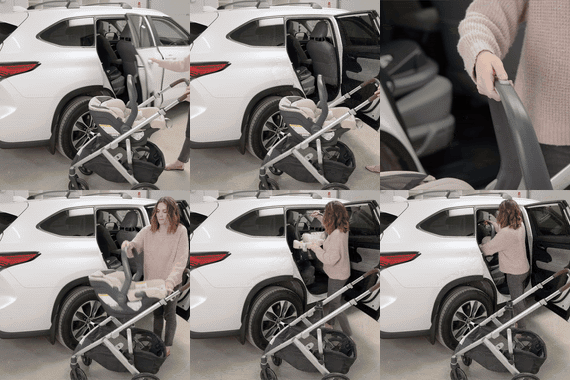
- Can you lift and rotate it into place? Door frames, bumper depth, a high load lip, and a sloping hatch can remove the turning room suggested by simple measurements.
The Kona's published 22 lb weight helps describe the stroller itself, and UPPAbaby says it can fold with the seat attached whether the seat faces the parent or the street. The current Kona product page supports those facts. Neither fact gives the folded geometry, and 22 lb is not the weight of the stroller plus everything you may leave in its basket.
Your measure-before-buy worksheet
Empty the part of the trunk you expect to use. Keep permanent items, such as a cargo cover or emergency kit, in place if they will remain there on ordinary trips. Use a rigid tape measure where possible, and record the smallest clear measurement rather than an optimistic edge-to-edge number.
| Vehicle measurement | Where to measure | Why it matters |
|---|---|---|
| Narrowest opening width | Between trim, hinges, latch housings, or other fixed intrusions | A stroller wider than this point cannot enter straight through. |
| Lowest opening height | From the top of the load lip to the lowest part of the hatch opening | The roofline or hatch trim may block a tall folded package. |
| Usable floor depth | From the closed hatch line to the rear seatbacks | The hatch needs room to close without pressing on the stroller. |
| Usable interior width | At floor level and again above the wheel wells | The narrowest internal level may decide whether the stroller lies flat or must turn. |
| Interior height at rest | At the position where the thickest part of the stroller would sit | A sloped rear window can reduce height quickly near the hatch. |
| Lift-over height | Ground to the top of the load lip | This reveals the lifting task, even when the stroller fits once inside. |
| Reserved cargo zone | The space left after groceries, pet gear, or luggage that normally travels with you | A technical fit is not useful if it consumes space your routine requires. |
Photograph the tape in place for the opening width, opening height, and floor depth. A saved image is easier to use in a store than a number whose measurement points you no longer remember.
Build the paper footprint only from official numbers
If UPPAbaby publishes Kona's exact folded dimensions, transfer the stated length and width to flattened cardboard, builder's paper, or taped newspaper. Label the orientation and write the official folded height on the template. This is a planning aid, not proof: a flat rectangle cannot reproduce wheel shape, handlebar protrusions, or the rotation required to enter the hatch.
Lay the template on the cargo floor in every plausible orientation. Close the hatch gently only if nothing is near the glass or trim. Check what remains for a diaper bag, groceries, or another item your household routinely carries. Then hold a tape or lightweight box at the published height to see where the sloped hatch begins to interfere.
Run the opening test before the floor test
A common mistake is measuring the cargo floor and skipping the route into it. If you obtain official folded dimensions, rehearse the path with an empty box or existing item that is close to those measurements. The box should pass the narrowest hatch point without being forced. Make sure your hands have space to control it and that you can rotate it without striking the glass.
The one-hand fold may simplify the sequence beside the vehicle, especially because the Kona seat can remain attached in either direction. Still, 'one-hand fold' does not mean one-handed lifting, loading, or hatch closing. Plan to use both hands for a controlled lift unless current instructions for the exact stroller explicitly permit another method.
Set a clearance margin that matches your routine
There is no universal clearance number because trunks, trim, stroller shapes, and loading habits differ. Instead, classify the result:
- Clear pass: The official folded package is smaller than the opening and usable cargo box in every relevant direction, with visible room for hands and the closed hatch.
- Orientation-dependent: It fits only diagonally, on its side, or after removing a component that current Kona instructions explicitly permit you to remove. Confirm the complete sequence with the actual stroller.
- Close call: One dimension is near a vehicle limit, or a sloped hatch makes the result unclear. A paper test is insufficient. Require a physical test.
- No fit: A published dimension exceeds the narrowest unavoidable opening or usable interior measurement. Do not assume fabric compression or wheel movement will rescue the fit.
Remember that a fit with an empty trunk is not automatically a routine fit. Rebuild one normal outing: stroller, diaper bag, reusable shopping bags, winter gear, pet equipment, or luggage. If the stroller pushes essential cargo into the passenger area, you have learned something important even though the hatch closes.
Questions to settle during a physical fit check
- Does the folded stroller enter without scraping trim or contacting glass?
- Can the hatch close freely without pressure on the stroller?
- Can the stroller be lifted over the cargo lip by the person who will load it most often?
- Does the required orientation leave the brake, fold controls, or fabric vulnerable to other cargo?
- Can the stroller be removed without unloading the entire trunk?
- Is there still room for the items carried on a typical grocery run or family visit?
For a closer look at Kona's weight, basket, and fold, see the Kona specification guide. Households navigating shared elevators and transit can also use the Kona city-fit guide to map constraints beyond the vehicle.
Your trunk-fit verdict
The Kona may become a strong trunk candidate, but '22 lb,' 'slim,' and 'one-hand fold' are not measurements. Record the opening, cargo box, lift-over height, and space your real routine needs. Do not approve the fit without official folded dimensions or a test using the actual stroller. That pause is more useful than a confident guess.
Browse the UPPAbaby collection to compare stroller options currently available from baby enRoute.