In this article
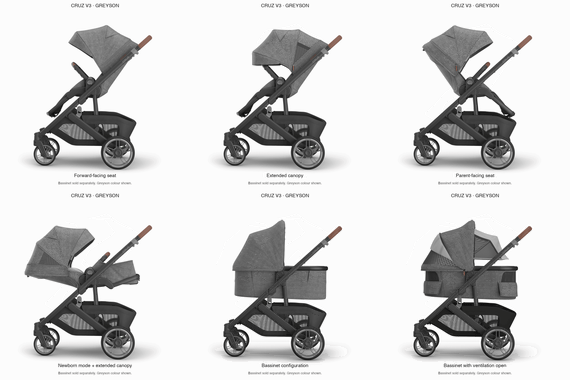
Skip UPPAbaby Kona if your routine is controlled by overhead-bin travel, multi-child seating, regular running, or a space that requires exact dimensions today. None of those conditions makes Kona a poor stroller. Each points to a different product job than the mid-size, one-child everyday role Kona is designed to fill.
Kona's confirmed strengths are clear: a 22-lb frame, 30-lb basket, reversible seat with four one-hand recline positions, and one-hand fold with the seat attached in either direction. The honest way to evaluate a new model is to look for a stop rule before looking for another reason to buy it.

Red flag 1: your calendar is built around cabin-focused travel
Kona's 22-lb frame and one-hand fold may be useful in hotels, car travel, or any trip where an everyday stroller travels with you. That does not make it an overhead-bin stroller. UPPAbaby has not published Kona's folded dimensions or described it as overhead-friendly.
If frequent flights are the hardest use case, start with the UPPAbaby Minu V3. UPPAbaby's official Minu V3 page positions it as a travel stroller with an overhead-friendly one-hand fold and lists a true weight of 16.7 lb. That is 5.3 lb less than Kona's published 22 lb.
The smaller number does not decide everything. An airline's acceptance, route, aircraft, and baggage policy can change, so confirm the current rules with every carrier on your itinerary. The stop rule is simple: if cabin placement is mandatory, do not choose a stroller without the measurements and policy match needed to support it.
Better-fit route: Choose Kona only if destination usefulness and daily capacity matter more than a cabin-focused package. Choose the travel-first lane if every departure starts with an overhead requirement.
Red flag 2: another seated child is part of the plan
Kona is presented as a versatile single stroller with a reversible seat and from-birth configurations. Its public page does not describe a second seat or conversion into a double. A ride-along option, even if one is later confirmed, would not be equivalent to a second stroller seat.
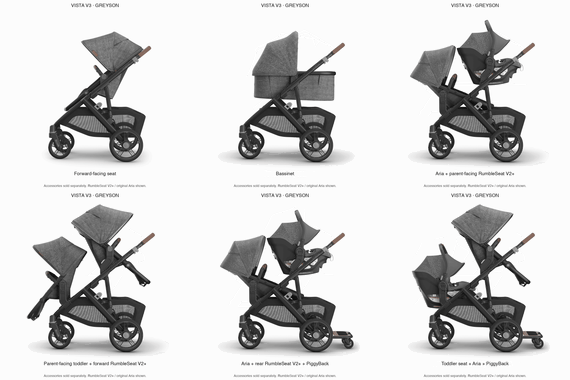
If your decision depends on carrying two seated children on one frame, begin with the UPPAbaby Vista V3. The official Vista V3 page says it can accommodate up to three children with added RumbleSeat and PiggyBack accessories. It also publishes the frame-and-seat weight and exact folded and unfolded dimensions, which lets you test the cost of that expansion against your space.
Do not buy for an abstract future if it makes the present routine unnecessarily difficult. Use a timeline. If another seated-child configuration is a likely weekly need during the stroller's service life, expansion deserves priority. If it is remote or unlikely, Kona's simpler single-stroller role may be the more relevant job.
Better-fit route: Choose an expandable chassis when seated-child capacity is a real plan with a time horizon. Keep Kona in consideration when one main seat is the actual requirement.

Red flag 3: you plan to run with the stroller
Do not infer jogging suitability from general language about movement, agility, or city use. Kona's official page does not designate it as a jogging stroller.
The UPPAbaby Ridge V2 owns a different job. UPPAbaby's official Ridge V2 page calls it a performance jogger engineered for walking, running, trail, and all-terrain use, with a swivel-locking front wheel, suspension, wrist strap, and disc hand brake. Follow its official instructions and age guidance before jogging.
That purpose-built equipment comes with a different portability profile. Ridge V2 is not the answer for someone who simply encounters an occasional park path. It is the better-fit route when running is a planned, repeated activity and the stroller must be selected around it.
Better-fit route: Choose a jogging stroller for jogging. Choose Kona for everyday movement only when running is not part of the stroller's job description.
Red flag 4: your storage, lift, or boot has a hard maximum
Kona's current product page says slim footprint and gives a 22-lb weight. It does not publish the exact folded width, depth, or height, nor exact unfolded dimensions. If your stroller bay, elevator, or vehicle opening has only a few centimetres of tolerance, a category description cannot close the decision.
Measure the usable space, including hinges, wheel wells, hatch slope, shelves, and anything that stays in place. Then require an official product measurement smaller than that space with a practical margin for loading. A visual estimate from photography is not a measurement.
This red flag does not always point to more or less stroller. It points to more evidence. Minu V3 and Vista V3 both publish dimensions, but they serve different routines. Pick the job first, then compare its official numbers with your limit.
Better-fit route: Keep Kona as an unresolved candidate when its current feature mix is right but fit evidence is missing. Choose a measured alternative when the purchase timeline requires a decision and that model's actual job also fits.
After a stop rule fires, compare the right evidence
Do not restart with a generic best-stroller list. Carry the failed requirement into the next comparison. For cabin-focused travel, compare published folded dimensions, carry method, stroller weight, and the operating carrier's current policy. For simultaneous riders, diagram the exact seats, boards, adapters, child limits, and months of overlap. For running, compare only manufacturer-designated jogging models and use their current instructions. For a hard storage limit, reject any option whose official dimensions are absent or exceed the measured opening.
This keeps the alternative honest. Minu V3, Vista V3, and Ridge V2 solve different stop rules; none is a universal upgrade from Kona. The replacement should fix the recurring failure without adding a larger daily burden than the household can manage. Record that stop rule so a later promotion does not restart the same unsuitable comparison.
Two concerns that do not automatically disqualify Kona
You carry a substantial everyday load
That concern may support Kona rather than eliminate it. Its basket is rated to 30 lb. The remaining question is volume and access, because a weight limit does not show whether your particular bags fit the opening.
You want a from-birth path
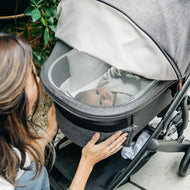
Kona's official page describes a near-flat from-birth position plus direct, adapter-free attachment for an UPPAbaby Bassinet or UPPAbaby infant car seat. That supports shortlist formation, but do not use an exact newborn setup unless current written UPPAbaby instructions explicitly authorize it.
Use one sentence to decide whether to keep Kona
Complete this sentence: Our stroller must ______ every week, and we would buy another product if it could not.
If the blank is "fit an overhead plan," "seat another child," "support running," or "fit a measured space today," Kona should not lead the shortlist. If it is "handle daily errands with real cargo while staying easier to fold, lift, and manoeuvre than a larger system," Kona's mid-size balance is relevant.
For a fuller weekly test, use our earlier guide to decide whether Kona can be your only stroller. You can also compare currently available models in the UPPAbaby collection.
Bottom line: The reason to skip Kona should be a job mismatch, not fear of a new model. A clear stop rule protects the budget and makes the alternative easier to choose.