In this article
UPPAbaby Kona could be an only stroller for a one-child household when the hardest weekly outing still fits a 22-lb, slim-footprint, reversible-seat stroller with a 30-lb basket. The answer becomes less convincing when your week depends on jogging, airline-cabin travel, expansion for another seated child, or a folded space that must meet exact measurements that UPPAbaby has not yet published.
The easiest outing is a poor test. A short, dry walk with an empty basket is an incomplete stroller test. Test Kona against the day when the vehicle is full, the weather changes, groceries join the diaper bag, or one caregiver has to manage every transition alone.
The seven-day friction check
Use your next normal week as a paper rehearsal. You do not need a Kona in hand. Record what the stroller must do, how often it must do it, and which failure would force a second stroller purchase. A one-time exception is not decisive; a recurring failure that appears every week is.
Use the pass, caution, and stop outcomes as household decision rules, not manufacturer guarantees.
Day 1: start with the route you walk, not the route in a campaign photo
Map the actual surface from your door to your most common destination. Note smooth pavement, broken sidewalks, gravel shortcuts, steep grades, curb transitions, and winter-maintenance gaps. Kona is described as agile and suited to tight city spaces, but the current public page does not publish wheel measurements or detailed terrain guidance.
If your normal route is maintained urban pavement, Kona's everyday feature set may align well. If your routine is running, repeated trail use, or rough unmaintained terrain, choose equipment officially designed for that job rather than assuming a mid-size city stroller can cover it.
Day 2: load the outing you dislike carrying
A 30-lb basket rating is meaningful for an only stroller because there is no second, larger stroller to take over on cargo-heavy days. Write down what actually rides beneath the seat: diaper bag, rain cover, caregiver layer, lunch, library books, and groceries.
Separate weight from shape. A basket can remain under its limit and still be awkward if a bulky bag blocks access. Kona's rating gives you a ceiling, not the basket's exact usable geometry. If a weekly grocery run is the deciding route, inspect the opening and access around your preferred seat position before committing.
Day 3: count every lift
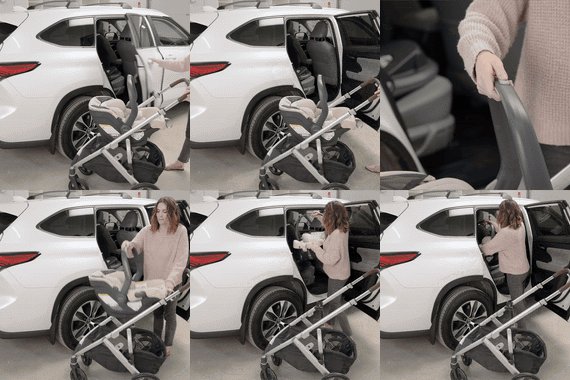
At 22 lb, Kona can still demand repeated or awkward lifting. Count how many times the stroller moves between floor, stairs, storage, and vehicle in one outing. A four-transfer day tells you more than one showroom lift.
The one-hand fold is designed to work with the seat attached in either direction. That can remove a reorientation step. It does not establish the folded package's dimensions or balance. If your boot is tightly packed, trace the usable floor and hatch-opening space and do not approve the fit without official dimensions or a physical fit test.
Day 4: rehearse the home exit
For a condo or apartment, the stroller must pass more than a doorway. Follow the full route: storage location, unit door, hallway corner, elevator call, elevator turn, lobby door, and any steps. Mark every place where you lift, reverse, or move an obstacle.
UPPAbaby calls Kona's footprint slim and specifically references elevators and doorways. Because exact dimensions are not public, that is a design intention, not proof of fit in your building. A hard-width constraint remains unresolved.
Day 5: build the longest ordinary day
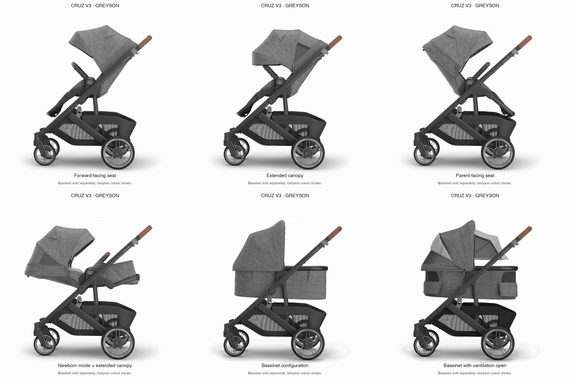
An only stroller must cover the outing that starts after breakfast and ends near dinner. Kona's reversible seat, four recline positions, extendable UPF 50+ canopy with ventilation, adjustable handlebar, and large basket all support day-long flexibility on paper.
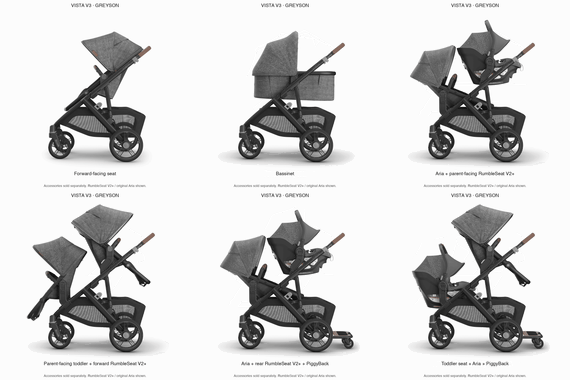
Now look for the capacity you cannot improvise. Do you need another seated-child position? Does a caregiver require a published handlebar range? Do you need a specific accessory included rather than sold separately? The current Canada-scoped Kona page lists the stroller, Toddler Seat Rain Shield, Toddler Seat Bug Shield, and 3-Year Warranty under What's Included, but it does not publish a numeric handlebar range or a multi-child expansion path. Put each unanswered hard requirement on hold.
Day 6: separate travel from air-cabin travel
A stroller can be convenient for car trips, hotels, and destination walking without being a travel-first cabin stroller. Kona's 22-lb weight and one-hand fold may help general travel transitions. UPPAbaby does not currently publish Kona as overhead-bin compatible, and exact folded dimensions are absent.
If overhead-bin travel is central, that is not a detail to revisit after purchase. It is a lane-changing requirement. If the stroller will travel in a car or be checked according to the carrier's current rules, your test is different: lifting, protection, destination usefulness, and vehicle fit may matter more than cabin dimensions.
Day 7: decide with pass, caution, and stop
- Pass: the requirement is directly answered by a published Kona fact and works within your household limit.
- Caution: the feature appears aligned, but fit depends on an unpublished measurement or an in-person check.
- Stop: the routine needs a different product job, such as jogging, cabin-focused travel, or multi-child expansion.
Kona remains a credible only-stroller candidate if most days pass and the cautions are occasional, verifiable details. It is a weak only-stroller choice if one recurring day stops the plan. Buying a single compromise that soon requires a second stroller does not simplify the household.
Turn the week into a one-page decision record
Choose only three requirements that would force another stroller purchase. For each one, record the weekly frequency, the evidence available today, and the cost of being wrong. This prevents a long feature list from hiding the one recurring mismatch that matters.
| Requirement | What counts as evidence | Decision |
|---|---|---|
| A measured home or vehicle space | Official dimensions tested against your usable opening, not a photo or the phrase slim footprint | Hold until measured |
| A cargo-heavy weekly route | Your normal load fits the basket opening and remains within the 30-lb limit | Inspect before choosing |
| A specialized job | The manufacturer identifies the stroller for that job, such as running or overhead-focused travel | Change product lane |
Now write the fallback in plain language: borrow for one annual trip, check the stroller for flights, use delivery for the largest grocery run, or buy a second stroller. A fallback used once a year may be reasonable. A fallback used twice a week means Kona is not functioning as the only stroller.
Who is most likely to make one Kona work?
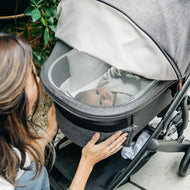
The strongest fit is a one-child household with maintained urban routes, regular car or elevator transitions, a meaningful but not shape-specific cargo load, and no requirement for jogging or airline-cabin placement. Direct attachment for an UPPAbaby infant car seat or Bassinet may simplify the early configuration only when current written UPPAbaby instructions explicitly name the exact component pairing.
For a broader view of why Kona sits in a middle lane, read where UPPAbaby Kona fits in Canada. Kona remains on UPPAbaby's waitlist. Compare currently available stroller roles in the UPPAbaby collection.
Verdict: Kona can plausibly be your only stroller when your hardest weekly route is still an everyday single-child route. Do not let an easy outing decide. The repeated caution or stop condition is the honest answer.