In this article
UPPAbaby Kona makes the most sense for a household that wants one everyday stroller to feel easier in tight spaces without giving up a reversible seat, substantial storage, or a direct UPPAbaby travel-system connection. It is not simply a lighter Cruz or a larger Minu. UPPAbaby describes Kona as a new mid-size category, which is useful only if that middle position matches the way you actually leave home.
The important question for a Canadian buyer is not whether mid-size sounds appealing. It is whether your routine repeatedly asks for more capacity than a travel stroller and less bulk than a conventional full-size stroller. UPPAbaby currently offers a Kona waitlist rather than a standard purchase option. Use that status for shortlist planning, and confirm Canadian price and availability before buying.
The three-lane route map
Picture stroller shopping as three lanes. Start with the job, then consider the model.
| Lane | The routine it serves | The compromise you accept | Your first test |
|---|---|---|---|
| Travel-first compact | Frequent flights, small car boots, stairs, and carrying the stroller for meaningful distances | Less cargo room or fewer everyday-stroller features may be reasonable | Can one adult carry the folded stroller plus the child's essential bag? |
| Mid-size Kona | Daily errands, elevators, car transfers, narrow storage spaces, and one-child outings with real cargo | It will not automatically replace a true cabin-focused travel stroller or an expandable family system | Does 22 lb fit your lifting limit, and is a 30-lb basket useful in your normal week? |
| Full-size or expandable | Longer neighbourhood walks, larger loads, sibling plans, and routines where carrying the stroller is rare | More frame to park, turn, lift, and store | Does the stroller fit the home and vehicle without reorganizing every departure? |
This is a route map, not a ranking. A compact is not automatically more practical because it weighs less, and a full-size stroller is not automatically more capable for your household. The winner is the lane with the fewest repeated points of friction.
Why Kona occupies a real middle lane
UPPAbaby's launch announcement explicitly places Kona between full-size performance and compact convenience. The current official Kona page gives that positioning some concrete shape: a 22-lb frame, a basket rated to 30 lb, a reversible seat with four one-hand recline positions, and a one-hand fold with the seat attached in either direction.
Those features pull in different directions in a useful way. The published 22-lb frame and slim-footprint positioning address movement and storage. The reversible seat, large stated basket capacity, and from-birth paths address the jobs that often push families toward a fuller everyday stroller.
The fold detail deserves attention. A reversible seat can create an extra step on some stroller routines if the seat must be turned or removed before folding. Kona's official page says it folds with the seat attached whether the seat faces the parent or the world. That does not reveal the folded dimensions. For a routine that changes seat direction, keeping the seat attached can remove a repositioning step before folding.
Four routines that make Kona interesting
1. The elevator-to-errand loop
Your stroller leaves a closet, turns through a hallway, enters an elevator, crosses a lobby, and handles a grocery or pharmacy stop. In that routine, centimetres matter, but so do the number of times you reposition the frame and the amount you can carry home.
Kona's slim-footprint positioning and 30-lb basket rating speak directly to this loop. The missing piece is the exact width and folded footprint. Because UPPAbaby does not currently publish those dimensions, record your narrowest doorway and storage bay as requirements; do not treat those household measurements as proof that Kona fits.
2. The car-to-stroller transition
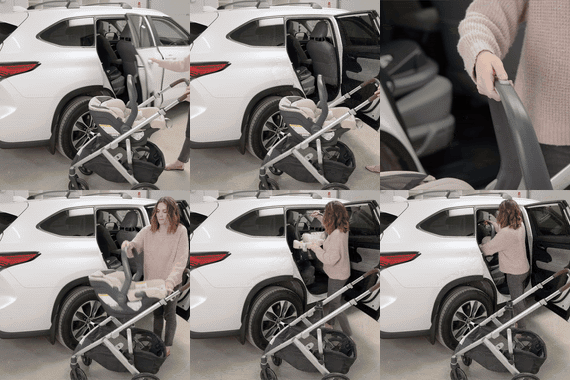
A stroller that lives in a vehicle must be manageable at the boot and useful after it is unfolded. At 22 lb, Kona gives you a real number to compare with your lifting comfort. The one-hand fold may reduce steps when the other hand is occupied, but a product-page promise cannot tell you whether the folded shape works in your specific vehicle.
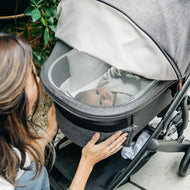
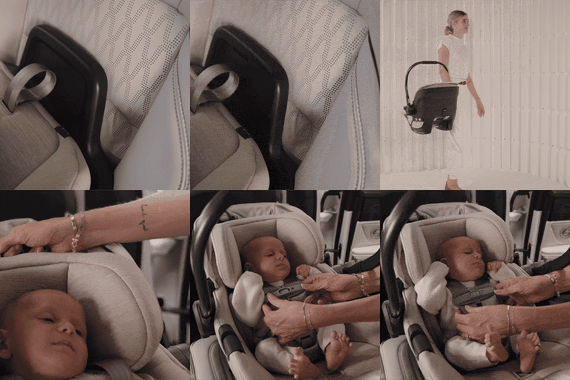
UPPAbaby says its Bassinet and UPPAbaby infant car seats attach directly to Kona without adapters. That simplifies the parts list for families already choosing within the UPPAbaby ecosystem. UPPAbaby limits that no-adapter statement to its own infant car seats. The current page does not resolve the exact component generation or setup, so require written UPPAbaby documentation that names the pairing before use.
3. The all-day single-child outing
A light stroller can stop feeling convenient when coats, groceries, a diaper bag, and weather layers have nowhere sensible to go. Kona's 30-lb basket rating is unusually central to its mid-size pitch. Treat the number as a load limit, not as a promise that every bulky item will fit through the basket opening.
Make a list of the five things that regularly ride below the seat. If volume, shape, and access matter more than total weight, wait to inspect the basket opening and seat-recline interaction in person or in complete official imagery.
4. The changing-seat day
Some families value parent-facing contact early and forward-facing exploration later. Kona's seat reverses and has four one-hand recline positions. Its canopy is listed as extendable with UPF 50+ coverage, a peek-a-boo window, and ventilation, while the handlebar adjusts for different pushers.
These are meaningful everyday features, but they do not answer personal fit. A tall and a short caregiver should each check reach, wrist position, brake access, and stride clearance before treating an adjustable handlebar as universally comfortable.
What Kona does not yet prove
A new category label can create false certainty. UPPAbaby lists Kona from birth with a maximum weight of 50 lb and a maximum height of 40 in. Those limits define the published range, but they do not predict individual comfort or household fit. The current Canada-scoped Kona page lists the Kona stroller, Toddler Seat Rain Shield, Toddler Seat Bug Shield, and 3-Year Warranty under What's Included. Several other Kona purchase-changing details remain unresolved:
- exact unfolded width, length, and height;
- exact folded dimensions and whether the folded stroller stands independently;
- wheel specifications and detailed terrain guidance;
- a public Kona manual with operating and care instructions.
These are not minor omissions for every buyer. Width can decide an elevator or doorway. Folded depth can decide a car boot. A manual can settle use and compatibility questions that marketing copy cannot. If one of those details is a hard constraint, waiting is the rational move.
Use the reversal test before joining the shortlist
Ask what would make you reject Kona even if you liked it. This keeps launch interest from turning into a decision before the evidence exists.
- Write your non-negotiable: a maximum carry weight, exact storage bay, sibling capacity, jogging use, or airline cabin goal.
- Match it to published evidence: 22 lb and 30 lb are usable facts; an unpublished folded measurement is not.
- Choose the lane: travel-first compact, mid-size everyday, or full-size/expandable.
- Identify the reversal: name the missing measurement or real-world fit check that could change your answer.
If your non-negotiable is frequent overhead-bin travel, start in the compact lane. If you expect one chassis to expand for another seated child, start with an expandable system. If the recurring problem is manoeuvring and storing a daily stroller without losing a reversible seat and serious basket capacity, Kona belongs on the shortlist.
Where to go next
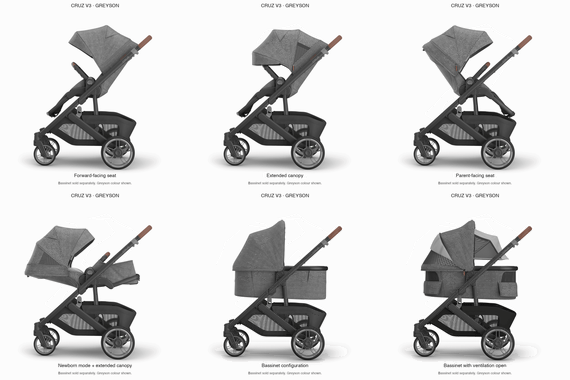
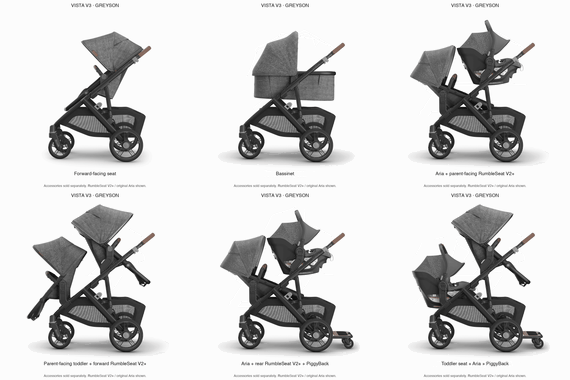
For the broader compact-versus-full-size decision, our Cruz V3 versus Minu V3 guide helps clarify which end of the spectrum already fits you. Kona remains on UPPAbaby's waitlist. Use the baby enRoute UPPAbaby collection as a practical starting point for comparing other stroller options in the brand.
Bottom line: Kona is promising when the middle is the point, not when it is merely a compromise. Put it on your shortlist if daily capacity and a reversible seat matter, but carrying, turning, and storage friction keep pushing you away from a larger stroller. Hold the decision if exact dimensions, expansion, jogging, or airline-cabin fit are hard requirements.