In this article
One Kona is the simpler system. A Cruz V3 plus Minu V3 is the more specialized system. Choose Kona when one 22 lb stroller with a 30 lb basket can cover most days and you want fewer storage, accessory, and handoff decisions. Consider two strollers when you repeatedly want Cruz V3's full-size everyday package on local days and Minu V3's 16.7 lb travel-first portability on departure days.
Price alone cannot decide this ownership question because accessories, resale, storage, and actual use all change household value. Start with a behavioural break-even: how many weekly compromise events does one setup remove, and how many new friction events does it create?

What each setup is built to do
| Ownership question | One Kona | Cruz V3 plus Minu V3 |
|---|---|---|
| Number of strollers to store and track | One | Two |
| Everyday stroller weight | 22 lb | Cruz V3: 26.5 lb frame and seat |
| Travel stroller weight | The same 22 lb stroller | Minu V3: 16.7 lb |
| Published basket limit | 30 lb | Cruz V3: no numeric limit on current page; Minu V3: 20 lb |
| Specialization | One lighter everyday compromise | Separate full-size single and travel-first compact |
| Setup risk | One stroller may not optimize the hardest travel or full-size use case | The wrong stroller, accessory, or packed gear may be in the wrong place |
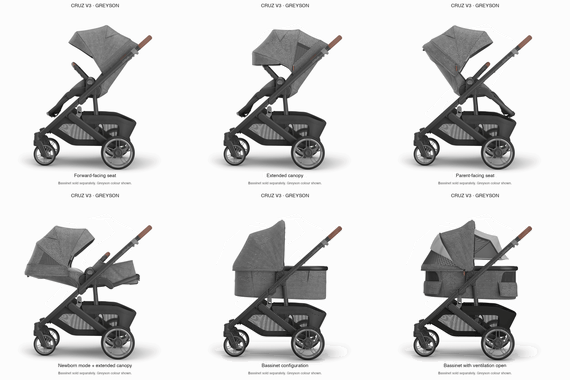
The Kona page supports its 22 lb weight, 30 lb basket, reversible seat, and one-hand fold with the seat attached in either direction. The Cruz V3 page publishes a 26.5 lb frame-and-seat weight but does not publish a numeric basket limit. The Minu V3 page publishes a 16.7 lb weight, 20 lb basket, integrated carry strap, and overhead-friendly compact fold.
Keep a four-week friction diary
Do not start by listing features. For four representative weeks, record moments when the stroller makes the outing harder. Include ordinary days and at least one realistic travel or long-outing day if those are part of your life.
| Date and route | Stroller job | Friction event | Would specialization solve it? | Would a second stroller add a new problem? |
|---|---|---|---|---|
| Example: daycare plus groceries | Everyday cargo | Basket too limited or stroller awkward to lift | Full-size or lighter everyday setup may help | Storage and handoff still apply |
| Example: airport departure | Fold, carry, pack | Repeated carrying or tight luggage space | Travel-first compact may help | Carrier acceptance still must be checked |
| Example: weekend handoff | Another caregiver uses stroller | Needed gear is attached to the other stroller | No | Yes, duplicated packing may be required |
Use plain categories: carry, cargo, fold, storage, handoff, accessory, cleaning, and wrong-location. A feature counts only when it prevents a recorded event.

Count compromise events, not outings
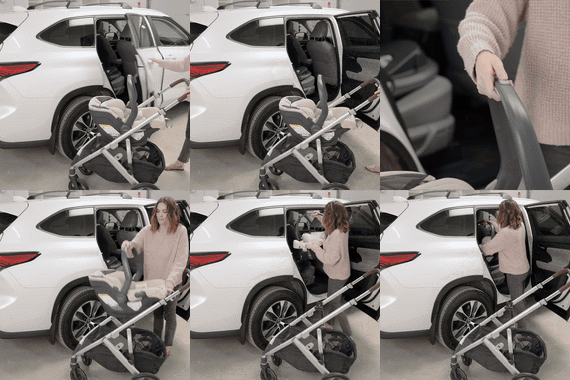
One outing can contain several compromise events. A travel day might require a vehicle lift, terminal carry, small storage space, and airline handoff. A grocery walk might create none if Kona's 30 lb basket and everyday format fit the load.
At the end of four weeks, total three columns:
- Kona compromise events: moments when a travel-first or fuller-size tool would materially improve the task.
- Two-stroller switching events: moments when you would need to choose, move, repack, or retrieve the other stroller.
- Two-stroller ownership events: storage conflicts, duplicated or misplaced accessories, extra cleaning, and caregiver confusion.
If the first total is clearly larger and divides into two stable jobs, the Cruz plus Minu setup has a practical case. If the switching and ownership totals meet or exceed it, one Kona is likely the more efficient system.
When one Kona is the stronger plan
Your routine is mixed but not extreme
Kona's position is useful when most days need some portability, some cargo, and everyday seat flexibility, but few days demand the lightest travel carry or a more substantial full-size stroller.
Those differences describe a middle tool. They do not prove ride feel, trunk fit, or household comfort. Use the friction diary to determine whether the middle actually covers your peaks.
Storage is already contested
Two folded strollers need two parking positions, even when one is compact. Mark the floor or wall areas you can genuinely dedicate without blocking doors, utilities, bicycles, or the daily route out of the home. Do not rely on a folded-size figure that the current Kona page does not publish.
If a second stroller would live in a vehicle, include the loss of cargo flexibility and the chance that the vehicle is elsewhere when the stroller is needed.
Caregivers need one predictable setup
One stroller means one fold, one storage location, and one default set of everyday gear. That can matter in households with daycare handoffs, grandparents, or alternating vehicles. Simplicity is not glamorous, but repeated handoff accuracy is a real ownership benefit.
When Cruz V3 plus Minu V3 can earn its space
Local and travel days are genuinely different
The two-stroller strategy is strongest when local days repeatedly benefit from Cruz V3's full-size single-stroller package and travel days repeatedly benefit from Minu V3's lower weight, compact fold, and carry strap. If both jobs happen often, each stroller avoids compromising the other.
Do not treat an annual flight as frequent travel automatically. Count the full set of departures, including rail trips, walk-up stays, rental vehicles, and compact storage situations. Then compare those with the number of ordinary weeks the second stroller would sit unused.
The handoff between tools is easy
Specialization works when both strollers can be stored accessibly and the right one can be selected without a packing project. A two-stroller household may need a small shared packing list so essential rain gear, comfort items, or approved accessories do not remain attached to the stroller that stayed home.
Before buying accessories twice, verify current compatibility for each exact model. Some accessories may be model-specific, and compatibility should come from the current product or accessory instructions, not visual similarity.
You can name each stroller's weekly job
Finish these two sentences:
- Cruz V3 comes out every week for ______.
- Minu V3 comes out every week for ______.
If either blank remains vague, the portfolio may be aspirational rather than useful. One versatile stroller is often easier to own than two products waiting for hypothetical scenarios.
Run the parking-space and handoff rehearsal
Set aside two real stroller parking positions for one week using household objects or floor markers. Rehearse the route from each position to the door and vehicle. Then create two packing lists: what always stays with the everyday stroller, and what must move to the travel stroller.
Record every time the arrangement blocks something, requires moving another item, or leaves a needed item in the wrong place. This rehearsal does not simulate stroller performance. It tests the ownership system, which is the question this guide is designed to answer.
Do not let shared brand compatibility become an assumption
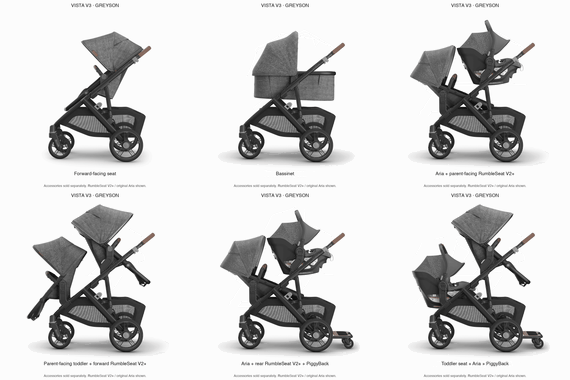
Kona and Cruz V3 publish direct adapter-free attachment for UPPAbaby infant car seats and the Bassinet. Minu V3 uses the appropriate adapters for compatible infant car seats. That difference affects how many parts move between setups.
Build an accessory ledger with four columns: exact item name, model compatibility, usual storage location, and whether a second copy is truly required. Check current manufacturer instructions before use. Do not assume a part fits all three strollers because the logo matches.
The non-financial break-even
A second stroller has crossed the behavioural break-even when all four statements are true:
- the specialized travel job recurs, rather than appearing only in a possible future;
- the specialized everyday job also recurs;
- the household can store and access both strollers without repeated obstruction;
- switching gear and briefing caregivers creates fewer problems than the specialization removes.
If any statement fails, keep one Kona as the leading plan and identify the exact outing that challenges it. The Kona versus Cruz V3 guide and Kona versus Minu V3 guide can isolate which side of the compromise is under pressure. The broader UPPAbaby stroller route map checks whether another model owns the real job.
Choose the ownership system
Choose one Kona when one stroller needs to be ready in one place, most routines fall between full-size and travel extremes, and a second product would multiply storage and handoff work.
Choose Cruz V3 plus Minu V3 when local full-size use and travel-first portability are both recurring, clearly different jobs, and your household can switch between two complete setups without regular packing failures.
Review the current Cruz V3 and Minu V3 product pages, or browse the UPPAbaby collection at baby enRoute. A current Kona price comparison is not possible because the Canada-scoped product page does not show a purchase price; let the friction diary decide whether specialization is worth the added storage and handoff.