In this article
Choose the job before the model. Minu V3 is the travel-first exit. Kona is the lighter everyday city exit. Cruz V3 is the full-size single-stroller exit. Vista V3 is the growing-family system exit. Ridge V2 is the running and all-terrain exit.
These five UPPAbaby strollers are not steps on a simple ranked quality ladder. Each removes a different kind of friction and accepts a different compromise. Start with the task that cannot fail in your household, then compare weight and capacity only within the branch that can perform it.

The five-exit route map
| If this job is non-negotiable | Start here | Trade-off to accept |
|---|---|---|
| Frequent carrying, compact travel transitions, overhead-friendly design | Minu V3 | 20 lb basket limit and an adapter-based infant-car-seat route |
| Everyday city movement with lower weight and substantial cargo | Kona | Single-stroller focus and no promise of overhead cabin acceptance |
| One full-size reversible seat with a more substantial everyday chassis | Cruz V3 | 26.5 lb frame-and-seat weight |
| Approved configurations for more than one child | Vista V3 | 27.6 lb frame-and-seat weight and configuration planning |
| Running, trails, hills, and sustained all-terrain routes | Ridge V2 | 29.2 lb weight and a 20 lb basket limit |
If one row clearly describes the task, take that exit. If two rows compete, count how often each task occurs during a normal month. The model serving the more frequent non-negotiable should lead.
Exit 1: Minu V3 for travel-first portability
Take this exit when the folded stroller regularly becomes something you carry. UPPAbaby publishes a 16.7 lb true weight, a one-hand overhead-friendly compact fold, and an integrated carry strap for the Minu V3. Its basket limit is 20 lb.
This route suits frequent flights, trains, rental vehicles, walk-up accommodation, or any routine where the stroller changes modes several times in one outing. Overhead-friendly and IATA-compatible manufacturer language is not a guarantee of cabin acceptance. Verify the operating carrier's current baggage rules for each trip.
Leave this exit if your normal cargo repeatedly approaches the basket limit, you want a reversible seat, or the stroller spends far more time open and loaded than folded and carried. For the exact everyday-versus-travel decision, use the Kona versus Minu V3 comparison.

Exit 2: Kona for lighter everyday city use
Take this exit when one stroller must move through narrow daily spaces, carry a substantial load, and remain reasonably light for vehicle or home transitions. The Kona weighs 22 lb and has a 30 lb basket limit, reversible seat, adjustable handlebar, and a one-hand fold with the seat attached in either direction.
Kona sits between travel-first and traditional full-size priorities. It is heavier than Minu V3 but lighter than Cruz V3, Vista V3, and Ridge V2 using the current manufacturer-published figures.
Leave this exit if you need a true multi-child seating system or a stroller designed for running. To compare strollers you can buy now, browse the UPPAbaby collection.
Exit 3: Cruz V3 for a full-size single
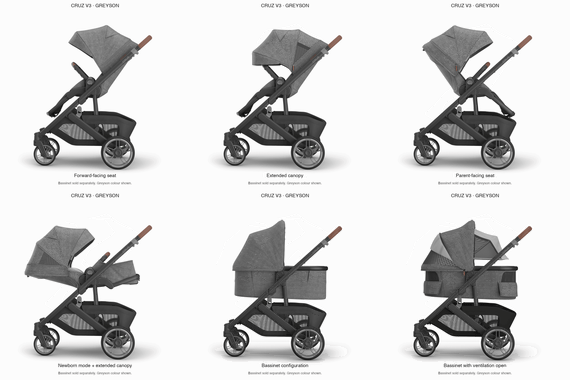
Take this exit when a full-size reversible seat and everyday ride package matter more than minimizing lift weight. The Cruz V3 publishes a 26.5 lb frame-and-seat weight, a reversible seat, and direct adapter-free attachment for the Bassinet, Mesa, and Aria; its current product page does not publish a numeric basket limit. UPPAbaby also publishes the ability to carry a second rider using the PiggyBack accessory.
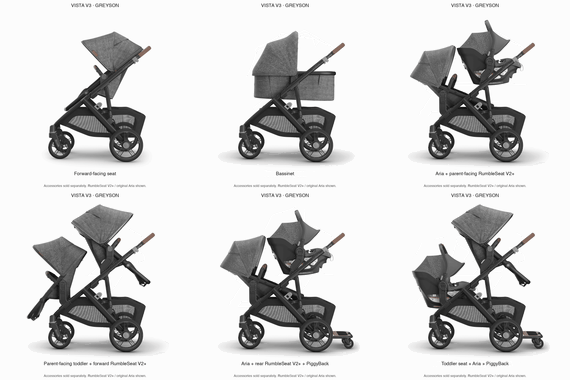
Cruz V3 is not the same expansion proposition as Vista V3. It remains a single-seat stroller with a ride-along option, while Vista publishes RumbleSeat and PiggyBack configurations for up to three children. That distinction matters more than the 1.1 lb published weight difference between Cruz V3 and Vista V3.
Leave this exit if repeated carrying makes 26.5 lb burdensome, or if simultaneous seated positions are a defined requirement. The Kona versus Cruz V3 comparison isolates the lighter-mid-size versus full-size-single choice.
Exit 4: Vista V3 for multi-child expansion
Take this exit when more than one riding position is a realistic, recurring job. UPPAbaby says the Vista V3 can accommodate up to three children with RumbleSeat and PiggyBack accessories. Its frame and seat weigh 27.6 lb, and its basket limit is 30 lb.
Do not choose this branch from family-size uncertainty alone. Map the period when two children would need transport at the same time, the type of position each child needs, and the weekly frequency. Then verify the exact approved accessories, positions, and limits in the current UPPAbaby instructions.
Leave this exit if the second-rider need is remote or rare and lower daily weight would be used at every lift. The Kona versus Vista V3 comparison includes a 36-month capacity map for that decision.
Exit 5: Ridge V2 for running and sustained rough terrain
Take this exit when the stroller's job includes running, recurring trails, steep routes, or sustained uneven ground. The Ridge V2 weighs 29.2 lb and adds a disc hand brake, wrist strap, never-flat tires, suspension, and a swivel-locking front wheel. Its covered basket has a 20 lb limit.
Running is a stop rule, not a lifestyle adjective. Kona, Cruz V3, Minu V3, and Vista V3 are not presented as jogging strollers. Ridge V2 is. Anyone considering that use should follow the current Ridge V2 manual for the exact child and setup; this guide does not determine readiness.
Leave this exit if the hardest regular route is still a city walk and the all-terrain equipment would mostly travel from closet to vehicle. The Kona versus Ridge V2 comparison uses a terrain ladder to test the boundary.
Now compare the numbers inside the right branch
| Model | Published stroller or frame-and-seat weight | Basket limit | Decision shorthand |
|---|---|---|---|
| Minu V3 | 16.7 lb | 20 lb | Carry it often |
| Kona | 22 lb | 30 lb | Push it daily in the city |
| Cruz V3 | 26.5 lb | Cruz V3: no numeric basket limit on current page | Choose a full-size single |
| Vista V3 | 27.6 lb | 30 lb | Configure for family capacity |
| Ridge V2 | 29.2 lb | 20 lb | Equip for performance terrain |
Published weights are useful only when compared on the same decision. The lightest stroller cannot perform every job. The highest basket limit does not prove the easiest packing experience. A one-pound difference may be irrelevant beside a required second seat, while a five-pound difference may dominate a third-floor walk-up.
Use three tie-breakers
1. Count transitions
For seven days, count vehicle lifts, stairs, folds, narrow turns, and storage moves. High transition frequency moves Minu V3 and Kona forward. Low transition frequency gives the larger frames more room to justify their specialized benefits.
2. Build the normal load
Set out the gear for a real outing, including Canadian seasonal layers. Compare the 20 lb and 30 lb basket limits without treating either as a target. Notice bulk and access as well as weight, and keep each test within the published basket limit.
3. Name the future configuration
If future capacity drives the purchase, write down the exact child positions and accessories you expect. Vista V3's expansion is meaningful when the configuration is real. Cruz V3's PiggyBack option is meaningful when a standing rider fits the routine. A vague desire to keep options open is not a configuration.
Five households, five different answers
- Frequent-flyer family with light cargo: Minu V3, subject to carrier verification.
- Condo family walking for errands: Kona when 30 lb basket capacity and lower daily weight matter together.
- One-child household wanting a full-size everyday stroller: Cruz V3 when its more substantial package is worth the extra weight.
- Family with a defined simultaneous-rider period: Vista V3 after verifying the exact multi-child configuration.
- Runner or regular trail user: Ridge V2, with all manufacturer jogging instructions preserved.
A household can have more than one identity. When that happens, decide whether one stroller can absorb the secondary job or whether two specialized strollers would remove more friction. The answer should follow frequency, storage space, and transitions rather than aspiration.
Build the UPPAbaby shortlist
Browse the UPPAbaby collection at baby enRoute to compare the current commercial range. Exact product pages are available for the Cruz V3, Minu V3, Vista V3, and Ridge V2. Use those four current product pages to compare established options against Kona's published middle-lane brief.
Final route
Minu V3 solves frequent departure and carrying friction. Kona solves the lighter everyday city compromise. Cruz V3 solves the full-size single-stroller brief. Vista V3 solves defined multi-child expansion. Ridge V2 solves running and sustained rough terrain. Pick the exit your routine cannot do without, then accept its stated trade-off with open eyes.