In this article
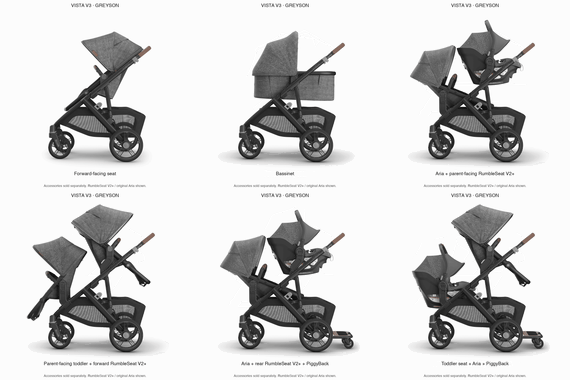
The deciding question is not how many children you may have someday. It is whether one stroller will realistically need to transport more than one child at the same time. The UPPAbaby Kona is the lighter choice for a single-seat routine. The Vista V3 is the growing-family system, with manufacturer-published configurations for up to three children using the RumbleSeat and PiggyBack accessories.
That distinction should control the decision before colour, basket size, or a small convenience feature enters the conversation. Buying expansion you never use creates daily bulk. Buying a single stroller when simultaneous rides are likely can create a larger replacement decision later.

What the current specifications establish
| Decision dimension | UPPAbaby Kona | UPPAbaby Vista V3 |
|---|---|---|
| Published weight | 22 lb | 27.6 lb for frame and seat |
| Basket limit | 30 lb | 30 lb |
| Family capacity | Streamlined single stroller | Can accommodate up to three children with RumbleSeat and PiggyBack accessories |
| Seat and fold | Reversible seat; one-hand fold with seat attached in either direction | Reversible full-size seat; one-step standing fold with or without the seat attached |
| Infant-system connection | Direct adapter-free UPPAbaby infant-car-seat and Bassinet attachment | Direct adapter-free Bassinet, Mesa, and Aria attachment |
The current Kona product page supports its 22 lb weight, 30 lb basket, reversible seat, and adapter-free UPPAbaby infant-system connections. The Vista V3 product page publishes the 27.6 lb frame-and-seat weight, 30 lb basket limit, and expansion capability. Exact multi-child configurations require the appropriate approved accessories and must follow the current UPPAbaby instructions.
Map the next 36 months without predicting your family
A family-horizon map is a planning tool, not a forecast. Use what is known, mark what is possible, and avoid treating a hypothetical sibling timeline as a commitment.
Months 0 to 12: identify the daily rider
Ask who will use the stroller on an ordinary Tuesday. If the answer is one child and there is no current need for a second position, Kona's 5.6 lb lower published weight is a daily advantage you can use immediately. Both models publish a 30 lb basket limit, so choosing the Vista solely for basket capacity does not create a higher weight allowance.
If an older child already needs frequent stroller support, do not postpone that reality to the future column. Define whether that child needs a seat, can use a ride-along board, or will usually walk. The Vista's expansion system becomes relevant only when the required configuration matches the children and routine.
Months 12 to 24: locate the overlap window
The key period is when two children might both need transport during the same outing. Consider distance, nap timing, daycare logistics, transit transfers, and the ability of an older child to walk the entire route. A ten-minute neighbourhood trip and a full day out are different capacity problems.
If the overlap is frequent and two stroller positions are non-negotiable, the Vista V3 has the clearer route. If the overlap is occasional and a second child would usually walk or use another approved solution, a lighter single stroller may still be the better daily tool. Do not count a configuration until you have verified the exact seat, accessory, weight limit, and permitted position in the current manufacturer instructions.
Months 24 to 36: count what remains in use
Expansion has value only while the additional position solves a recurring trip. Estimate when the older child's stamina and schedule may reduce simultaneous use, while acknowledging that this is uncertain. Then compare that likely period with the years in which you will lift, steer, store, and fold the stroller as a single.
This prevents two opposite mistakes: carrying a larger system every day for a short or unlikely overlap, or underestimating a long period in which two children genuinely need transport together.
Run the family-capacity map
| Question | If yes | If no or unknown |
|---|---|---|
| Do two children currently need stroller transport on the same outing? | Start with Vista V3 configuration planning. | Continue to the next question. |
| Is simultaneous stroller use likely several times a week within the next 36 months? | Map the exact Vista seats and accessories. | Preserve Kona's lower daily weight as a live option. |
| Would replacing a single stroller during the overlap be especially disruptive? | Give Vista's expansion more decision weight. | Compare today's routine before buying future capacity. |
| Are narrow city transitions and repeated vehicle lifts the hardest daily tasks? | Kona's 22 lb published weight and slim-footprint brief gain importance. | Vista's higher weight may be an acceptable trade for expansion. |
A yes in the first row can decide the purchase. A vague maybe in the second row should not. Write down the route, frequency, and second-rider need that makes the answer concrete.
Weight matters every day; capacity matters on overlap days
Kona is 22 lb. Vista V3 is 27.6 lb with frame and seat. The 5.6 lb difference is paid at every lift, stair, and storage transition. Vista's expansion value is paid back only on outings when the added child capacity is actually used.
That does not mean lighter is automatically better. A stroller that cannot carry the riders your routine requires is the wrong tool, regardless of weight. It means the comparison needs two counts:
- How many times per week will you lift or store the stroller?
- How many times per week will you use a second or third riding position?
If the first count is high and the second is zero or speculative, Kona has a strong practical case. If the second count is high or tied to an unavoidable care routine, Vista V3's expansion can outweigh the extra 5.6 lb.
Do not use the basket as a tiebreaker
Both models publish a 30 lb basket limit. That removes a common shortcut from the comparison. You still need to inspect basket shape, access in the intended configuration, and the bulk of your normal gear, but the official weight limit does not favour one model.
For the Vista, remember that a multi-child configuration can change how a family loads and accesses the stroller. Verify the exact planned setup rather than assuming the single-seat display represents every configuration. For Kona, the everyday-capacity story combines a 22 lb frame and a 30 lb basket in a single-stroller package.
Newborn routes are similar in one useful way
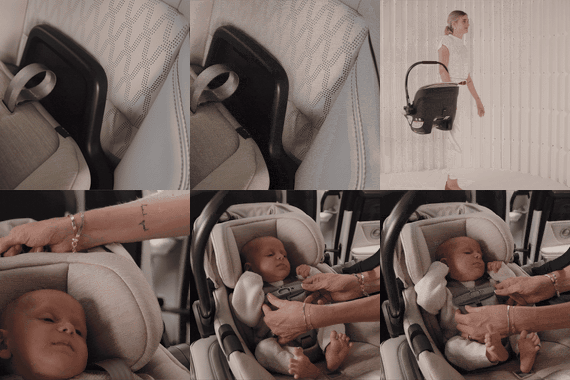
Both stroller pages publish direct, adapter-free connections for UPPAbaby infant car seats and a Bassinet. Kona also publishes near-flat positioning. Vista V3 states that its Toddler Seat is suitable from three months without accessories, or from birth with the Infant SnugSeat or Bassinet accessory.
This is configuration information, not individualized newborn-use advice. Before use, follow the current instructions for the exact stroller, seat, accessory, and child. For this purchase decision, the useful distinction is that infant-system compatibility does not require choosing the Vista solely to obtain a direct UPPAbaby connection.
Choose the system you can explain in one sentence
Choose Kona when: one stroller seat matches the foreseeable routine, lower lift weight matters repeatedly, and you do not want to carry expansion capacity for an undefined possibility.
Choose Vista V3 when: a credible 36-month map includes frequent simultaneous transport for two children, or a current family routine already requires an approved multi-child configuration.
Pause when: the decision depends on an unspecified future, an accessory you have not verified, or a child-capacity assumption that is not in the current manufacturer instructions.
For a broader test of whether a streamlined single can cover the whole routine, read Can the UPPAbaby Kona Be Your Only Stroller? If the real shortlist is between two established full-size choices, the Cruz V3 versus Vista V3 guide isolates single-stroller and expansion priorities.
You can review the current Vista V3 product page and browse the UPPAbaby collection at baby enRoute. Use the collection to compare Vista V3 and other current UPPAbaby options while deciding whether Kona's single-rider brief or Vista's expansion fits your 36-month map.
Choose for the next 36 months
Kona is the more efficient choice when your plan is genuinely one rider at a time. Vista V3 is the more capable system when multi-child transport is a defined job, not merely a possibility. Build the 36-month map, circle the overlap months, and choose the stroller that solves the recurring requirement with the fewest years of unused compromise.