In this article
You have two good options. If you've bought your child their own seat on the plane, you can use their car seat on board, as long as it has the right label and fits the aircraft seat. Or you can check the car seat for free and use it when you land. Both Air Canada and WestJet accept Canadian car seats with the National Safety Mark, and neither allows booster seats on board. For a baby under 2, Transport Canada highly recommends an approved car seat over holding them on your lap.
Check the label first
A car seat bought in Canada carries the National Safety Mark, a maple leaf symbol with "CMVSS 213" (child seats) or "213.1" (infant seats). Both airlines accept it. A seat bought in the US needs a sticker with the words "This restraint is certified for use in motor vehicles and aircraft" in red. Transport Canada says the label must also show the date the seat was made, so don't peel off or cover any stickers.
Take a photo of the labels before you leave home. If the crew asks about your seat, you can show them quickly. While you're at it, check the expiry date: our guide to car seat expiry in Canada shows where to find it. If you're flying with a seat that was bought in the US, read using a US car seat in Canada before you drive with it back home.
Air Canada and WestJet side by side
| Air Canada | WestJet | |
|---|---|---|
| Seat for your child | A car seat is accepted on board only if you've bought a seat for your child | Your child needs their own seat; call WestJet so the booking is set up for a car seat |
| Where it can go | Must fit between the armrests and be held by the aircraft seat belt. Not allowed in Signature Class, except by arrangement with reservations | Not in Business. Not in some seats, such as over-wing exit rows and bulkheads. Rear-facing seats usually go by the window. Someone 12 or older sits beside the child |
| Booster seats | Not allowed on board. A combination seat is fine only with its harness on | Not allowed on board, including combination seats used without the harness |
| Checking it | One car seat or booster per child up to age 11, free, on top of your bag allowance. Nothing else packed inside | Car seats can be checked at no charge, on top of your bag allowance |
| CARES harness | Accepted for children 10 to 20 kg and 100 cm or shorter | Accepted |
This is a summary of each airline's car seat page as we read it in October 2026. Airlines update their rules, so check the page again before you go. If a partner airline operates your flight, check that airline's rules too.
Using the car seat on board
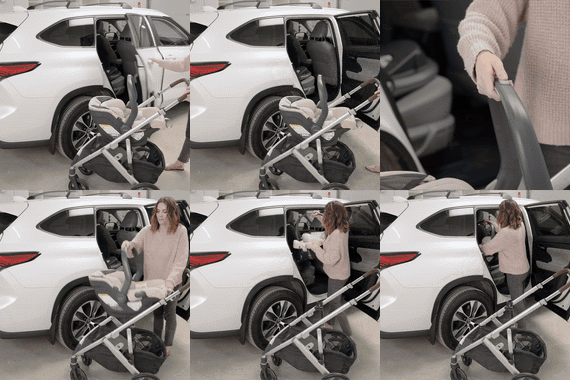
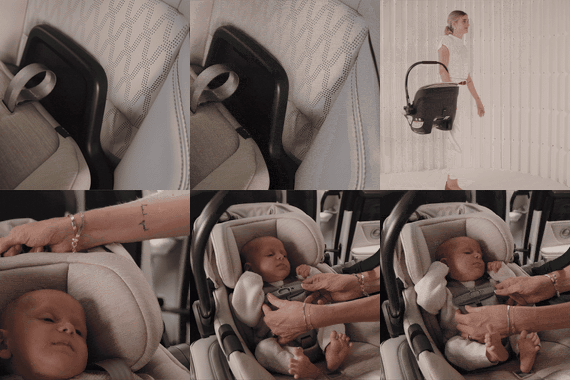
An infant car seat is often the simplest to use on a plane, if its manual allows installing the carrier without the base. The carrier goes on the aircraft seat and the lap belt goes through the belt path the manual shows for that. WestJet says a seat can be used with or without its base, as long as it's labelled and secured properly. Leave the base at home, or check it.
Convertible seats take more planning. They're wider and heavier, and Transport Canada notes that a tether strap can't be used on an aircraft. Before you book, find the section on aircraft use in your manual. Some manuals list which modes are allowed on a plane and which belt path to use. Then measure the seat at its widest point at the bottom. Air Canada says it has to fit between the armrests.
On the day:
- Board early if you can. Installing a car seat in a narrow aisle is easier with no one waiting behind you.
- Route the aircraft belt through the correct belt path, buckle it, then press the seat down and pull the belt tight.
- Harness your child the same way you would in the car: snug at the collarbone, chest clip at armpit level. Our car seat terms guide explains harness height and the chest clip.
- Keep your child harnessed during taxi, takeoff and landing, and whenever the seat belt sign is on. WestJet's page says this, and it's good practice on any airline.
Why the booster stays in the bag
A booster raises your child so a car's lap and shoulder belt fits them. Aircraft seats only have a lap belt, so a booster can't do its job on a plane. Transport Canada says boosters aren't approved for use on aircraft, and both airlines ban them on board. Check it, or pack it in your carry-on to use in the car when you land. A combination seat can be used on board only with its harness in place.
Some older children fly with a CARES harness, a belt-and-strap system made for aircraft seats. Both airlines accept it. It's only for the plane, so you'll still need the right car seat or booster for the drive at the other end.
Checking the car seat instead
If you'd rather not carry it on, both airlines check car seats for free on top of your bag allowance. Air Canada asks that nothing else goes inside the seat's bag. A padded bag keeps the straps together and the fabric clean. The UPPAbaby travel bag for Mesa and Aria seats ($149.99, price in CAD when we wrote this) fits those infant seats, and our guide to car seat travel bags covers what a bag can and can't protect.
When you pick the seat up, open the bag and look it over before your first drive. Check the shell for cracks, make sure the harness adjusts, and confirm all the parts are there. If anything looks wrong, or you're not sure, contact the car seat maker before you use it.
Neither airline's page promises that a car seat can be checked at the gate. If you want to keep it until boarding, ask at the check-in counter. Strollers are a separate allowance. Our guide to travel strollers for a flight explains the size limits.
Before you fly
- Book a seat for your child if you want to use the car seat on board. With WestJet, call to set up the booking for a car seat.
- Photograph the labels and check the expiry date.
- Read the aircraft section of the manual and practise the install without the base at home.
- Measure the seat's width, and compare it with your aircraft if the airline lists seat widths.
- Check your airline's car seat page again the week you fly.
Flying with Nuna gear? Our Nuna travel planning guide covers Nuna's own manuals and travel accessories.
Want help before your trip?
We offer car seat installation and check-ups by appointment at our Richmond and Burnaby stores, free for seats bought from us and $50 for other seats. Our guide to what happens at a car seat check explains what to bring. You can browse infant car seats, car seat accessories and lightweight travel strollers online, and call ahead to ask which seats we have on display.
Neo W. is a BCAA-certified Child Passenger Safety Educator at baby enRoute (BCAA CPS Educator II Course).