In this article
Car seat manuals, websites and videos use Canadian, US and European names for the same parts, which is why the terms get confusing. In Canada, the lower anchors are called UAS (in the US, LATCH; in Europe, ISOFIX). The tether strap is the strap from the top of a forward-facing seat to an anchor in your vehicle, and in Canada it must always be used when your child rides forward-facing in a harness. Load legs and anti-rebound bars are extra supports that some seats and bases add. Here's the full glossary.
Same part, different name
| Canada | US | Europe | What it is |
|---|---|---|---|
| UAS (Universal Anchorage System) | LATCH | ISOFIX | Lower anchor bars in the vehicle seat, and the connectors that clip onto them |
| Tether strap | Top tether | Top tether | Strap from the top of the car seat to a tether anchor in the vehicle |
| National Safety Mark | FMVSS certification label | ECE R44 or R129 label | Shows which country's standard the seat is certified to |
Many brands sell in several countries, so a Canadian product page or manual may still say "LATCH" or "ISOFIX". What matters is that the seat itself has the National Safety Mark. Our guide to US car seats in Canada explains why.
Installation terms
UAS (lower anchors)
Vehicles made after 2002 have UAS: two metal bars tucked between the seat cushion and seat back, near the seat belt buckle. The car seat or base connects to them with either straps and hooks (flexible connectors) or hard arms that click on (rigid connectors). Transport Canada recommends using UAS where your seating position has it.
UAS weight limit: lower anchors have a maximum weight. Check it in both your vehicle manual and your car seat manual. Once your child is over it, install the seat with the seat belt instead, plus the tether if forward-facing.
Seat belt installation and lock-offs
Most car seats can also be installed with the vehicle seat belt. Use UAS or the seat belt, not both, unless your manual says otherwise. Many seats have a lock-off, a built-in clamp that holds the seat belt tight.
Tether strap and tether anchor
The tether strap runs from the top of the car seat to a tether anchor, which may be on the back shelf, the back of the vehicle seat, the floor or the ceiling, depending on the vehicle. In Canada, a forward-facing seat with a harness must always use the tether, together with either UAS or the seat belt. US rules are different, so videos made for US seats may not show it. Some seats also allow or require the tether when rear-facing; your manual will say.
Load leg
A load leg (also called a stability leg) is a support that runs from the base or seat down to the vehicle floor. Manufacturers add it to reduce how much the seat moves forward in a crash. Check your vehicle manual before using one over an in-floor storage compartment, and your car seat manual for how to adjust it.
Anti-rebound bar
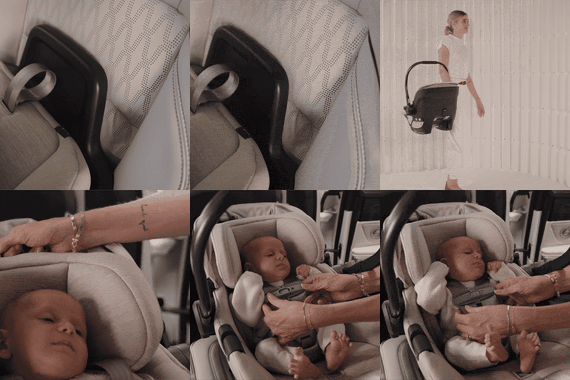
An anti-rebound bar sits at the foot end of a rear-facing seat or base and presses against the vehicle seat back. It's designed to limit how far the seat moves back toward the vehicle seat after the first impact. Some bases combine both: the Cybex Cloud G Pro infant seat ($699.95) comes with an anti-rebound load leg base.
Recline or level indicator
A bubble, ball or line on a rear-facing seat or base that shows when the seat is at the right angle. Recheck it if you move the seat to another vehicle or position.
Harness terms
- Five-point harness: two shoulder straps, two hip straps and a crotch strap that buckle together.
- Harness height: for rear-facing, the shoulder straps should come out at or below your child's shoulders. For forward-facing, they're usually at or above the shoulders; follow your manual.
- Snug harness: you should fit no more than one finger between the strap and your child's collarbone.
- Chest clip: the clip that holds the shoulder straps together. It goes at armpit level.
Types of seat
| Term | What it means |
|---|---|
| Infant seat | Rear-facing only, with a handle so you can carry it. Usually clicks into a base that stays in the car. |
| Convertible seat | Rear-facing first, then turns forward-facing. Stays in the car. |
| All-in-one (3-in-1) | Rear-facing, forward-facing with a harness, then a booster. |
| Combination seat | Forward-facing with a harness, then a booster. Also called harness-to-booster. |
| High-back booster | Raises your child so the vehicle's lap and shoulder belt fits, with a back and guide for the shoulder belt. |
| Backless booster | A booster cushion without a back, for older children. |
Each stage has its own height and weight limits, set in the manual, and provinces set the minimum rules for moving between them.
Labels to know
- National Safety Mark: shows the seat is certified for use in Canada. A seat without it isn't legal to use here.
- Date of manufacture and model number: what you need to check recalls, and to choose a similar seat if you ever need a replacement after a crash.
- Expiry or useful-life date: set by the manufacturer. Our guide to car seat expiry shows where to find it.
Thinking about a second-hand seat? Our guide to buying a used car seat covers what you can and can't check.
Want someone to walk you through your seat?
You can browse our car seats online. We also offer car seat installation and check-ups by appointment at our Richmond and Burnaby stores, free for seats bought from us and $50 for other seats. Call ahead to book, and to ask which seats we have on display.
Neo W. is a BCAA-certified Child Passenger Safety Educator at baby enRoute (BCAA CPS Educator II Course).