In this article
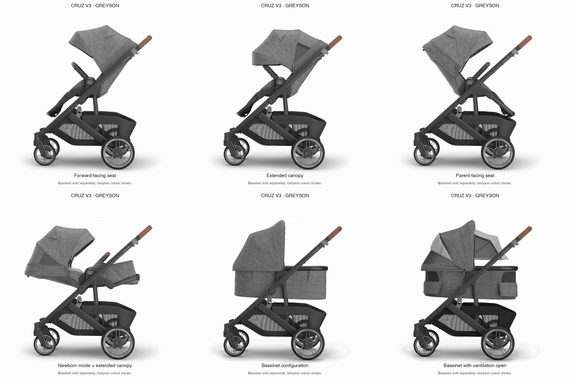
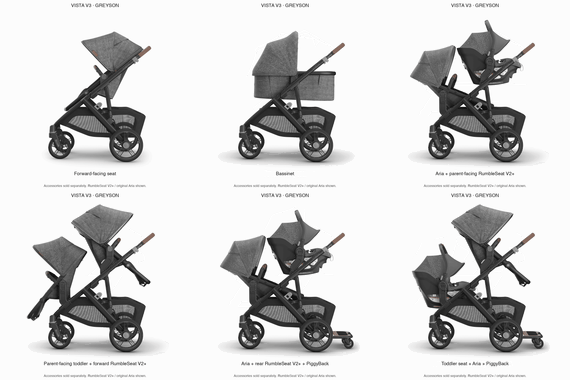
Nuna's current Canadian PIPA family connects across Nuna's current stroller range, but the connection is not the same on every stroller. MIXX next, TRIV next and SWIV use a ring adapter; TAVO next and TRVL models provide direct attachment; TRVL dubl accepts the carrier only on its wider seat; DEMI next uses its supplied infant-carrier adapters and a configuration chart.
Compatibility answers only the first question; it does not answer “what do I need?” A stroller can support the seat while requiring a specific adapter, position, direction or removal step. Build the connection map before the shopping list.
Four questions define the connection
- What is the exact stroller model?
- What is the exact Canadian PIPA model?
- Is the connection direct, on a ring adapter, or on another supplied adapter?
- Are there position, direction or folding restrictions?
The map below covers the current Nuna strollers and Canadian PIPA, PIPA Lite and PIPA urbn models identified on the product and manual pages cited below. Always keep the manual supplied with your own products because Nuna may revise parts and instructions.
Current Nuna stroller connection map
| Current stroller | Current PIPA-family connection | Adapter status | Position or handling note |
|---|---|---|---|
| MIXX next | PIPA series on the MIXX ring adapter | Ring adapter included with the current stroller | Remove the infant carrier before folding; follow the ring-adapter lock checks. |
| TRIV next | PIPA series on the TRIV ring adapter | Ring adapter included with the current stroller | Use only the PIPA-series ring adapter specified in the Canadian manual. |
| SWIV | PIPA series on the supplied ring adapter | Ring adapter included with the current stroller | The carrier faces the stroller pusher; remove the carrier before folding. |
| TAVO next | PIPA series attaches directly | No separate car-seat adapter required | Use the stroller's documented direct-attachment procedure. |
| TRVL lx | PIPA series attaches directly over the armbar with the integrated carrier lock | No separate adapter required | Remove the infant carrier before folding. |
| TRVL dubl | PIPA series use is limited to the wider seat | Use the connection documented in the Canadian manual | Remove the infant carrier before folding |
| DEMI next | PIPA-series travel-system configurations use the stroller's supplied car-seat post or ring adapters as shown in the configuration guide | Current stroller includes infant-carrier adapters | Choose the exact upper/lower and single/double configuration before assembly. |
“PIPA series” here means the current Canadian PIPA, PIPA Lite and PIPA urbn where Nuna provides the series-level stroller statement. It does not change each seat's different vehicle-installation methods or child-use limits.
Ring-adapter strollers: MIXX next, TRIV next and SWIV

A ring adapter creates a continuous support frame between the stroller and carrier. On current MIXX next, TRIV next and SWIV packages, Nuna identifies the appropriate ring adapter as included. Before buying another car-seat adapter for a new current stroller, check its exact package: MIXX next, TRIV next, SWIV, and DEMI next include relevant carrier hardware, while TAVO next, TRVL lx, and TRVL dubl use documented direct connections.
Included does not mean pre-installed. Identify the ring for that stroller, follow its orientation marks, lock it to the frame and then attach the empty carrier. A MIXX ring, TRIV ring and a cross-brand ring adapter should not be treated as one interchangeable accessory simply because they share a shape.
The current MIXX next page specifies PIPA-series use with the included ring adapter. The SWIV page likewise lists an included ring adapter, and the Canadian SWIV manual directs the infant carrier to face the pusher. The current TRIV next manual identifies its ring adapter for Nuna PIPA-series infant restraints.
Direct-attachment strollers: TAVO next and TRVL

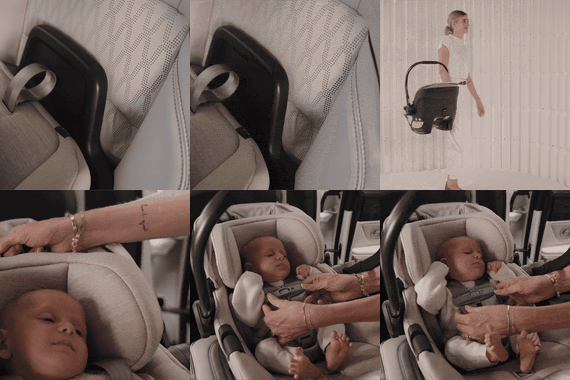
TAVO next is designed for direct PIPA-series attachment without a separate adapter. On TAVO next, recline the stroller seat, position the carrier over the armbar, close the integrated carrier lock, pull up to confirm it is locked, and remove it before folding.
TRVL lx also uses a direct connection. Its Canadian manual shows the PIPA-series carrier positioned over the armbar and secured by the integrated carrier lock. The carrier comes off before the stroller is folded.
TRVL dubl adds a seat-position rule. Its Canadian manual permits a PIPA-series infant carrier on the wider seat, using the integrated lock. The narrower seat is not an alternate car-seat position. This matters when assigning children to the stroller: decide the infant's side first, then verify that the other child fits the remaining seat and that the full setup stays within the manual.
DEMI next: compatibility is configuration-specific
DEMI next is built for several single and sibling arrangements, so a one-line “yes” is not enough. The current Canadian manual includes car-seat post adapters and a ring adapter among the stroller parts and diagrams infant-carrier configurations. The position and adapter depend on whether the stroller is being used as a single, with a sibling seat, or with another infant product.
Lay out the exact configuration before attaching anything. Identify each occupant, upper or lower position, direction and adapter. Use only a configuration shown in the current manual. If the carrier or adapter does not click into place in an approved DEMI next configuration, stop and recheck the exact manual rather than forcing the connection.
Why PIPA urbn still needs the stroller map
PIPA urbn has integrated rigid UAS connectors for vehicle installation, but those are not stroller connectors. On TAVO and TRVL it can use the documented direct stroller attachment. On supported ring-adapter strollers, it uses the stroller's PIPA-series adapter. The vehicle feature neither adds nor removes the stroller hardware named by Nuna.
This distinction prevents a common shopping error: buying a separate vehicle base for PIPA urbn or assuming it never needs a stroller adapter. PIPA urbn's Canadian manual says not to use a vehicle base; Nuna Canada separately states that it attaches to TAVO series and TRVL without adapters, while other compatible Nuna strollers require their exact approved PIPA-series adapter instructions.
The handoff and fold test
Test the travel system without a child before the first outing:
- Apply the brake and install the documented adapter, if required.
- Attach the empty carrier in the permitted direction and position.
- Confirm each lock indicator and pull up on the carrier as instructed.
- Check that the handlebar, canopy and any second seat move through their allowed ranges without conflict.
- Remove the carrier and practise holding it securely while operating the stroller release.
- Fold the stroller only in the state allowed by its manual. The infant carrier must be removed first.
The goal is a repeatable handoff, not simply achieving one click in a showroom. Every caregiver should be able to identify the lock, release and stop condition.
Do you need to buy an adapter?
- Usually no separate adapter purchase: current TAVO next, TRVL lx and TRVL dubl use direct attachment.
- Check the box before buying another: current MIXX next, TRIV next and SWIV list their ring adapter as included.
- Check every configuration component: current DEMI next includes infant-carrier adapters, but multi-seat arrangements require the exact manual diagram.
- For used or mixed-generation gear, match the stroller, carrier, and adapter model numbers to their own manuals before relying on a current product page's included-parts list.
For a current purchase, the Nuna collection can show the stroller and PIPA models baby enRoute lists. Stock status and included parts should still be confirmed on the live product page and packaging; catalogue presence is not proof that every colour or component is available immediately.