In this article
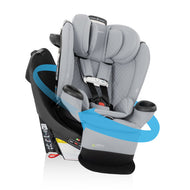
Short answer: the CYBEX Callisto G 360 is a premium-priced all-in-one seat whose clearest practical feature is 360-degree rotation. It is not an automatic winner: at 35 lb and 19.5 in. wide, it deserves an in-vehicle fit check before purchase. Choose it for a compatible vehicle and a routine that will use the rotation, not for an unsupported promise of smoother loading or greater safety.
Check current Callisto G 360 colours and availability.
Start with the price question, not the feature list
CYBEX Canada's official page listed the Callisto G 360 at CAD 999.95 when this guide was updated on August 27, 2026. Price and availability can change, so the useful comparison is not whether the seat feels "luxury." It is whether rotation removes enough repeated friction to justify paying more while accepting a 35 lb installed seat and a 19.5 in. width.
Use a simple value test: count how many times a week the primary caregiver loads or unbuckles the child, identify the physical difficulty rotation is expected to change, and compare that benefit with the cost and space of the seat. If the answer is only "it looks smoother online," the premium has not been justified. If a real in-vehicle trial changes a difficult daily task without compromising fit, the feature has a measurable job.
The Callisto decision scorecard
| Question | Callisto answer | What to verify |
|---|---|---|
| Does it rotate? | Yes, through 360 degrees. | Door-frame, front-seat, and adjacent-seat clearance in your vehicle. |
| How large is it? | 35 lb; 21.7 in. long, 19.5 in. wide, and 25.5-35 in. high. | Do not infer three-across compatibility from width alone. |
| Which stages does it cover? | Rear-facing, forward-facing harness, and high-back booster. | The Canada page lists 4-40 lb rear-facing and an overall 4-120 lb range; use the current instructions for every transition rule. |
| What does SensorSafe add? | Manufacturer-described alerts through the chest clip and app. | It does not verify installation or harness fit. |
Canadian limits and installation boundaries
CYBEX lists the Callisto for rear-facing use from 4-40 lb and for three modes across an overall 4-120 lb range. The same Canada page identifies rear-facing, forward-facing harness, and belt-positioning booster modes. Use the current instructions for the complete height, weight, age, fit, and transition rules; do not move modes from the overall range alone. Transport Canada advises keeping a child rear-facing until they reach the rear-facing height or weight limit of their seat.
The Canadian product FAQ is unusually specific about installation. The top tether is used in both rear-facing and forward-facing modes. Use either UAS or the vehicle belt - never both together. CYBEX lists child-weight limits of 30 lb rear-facing and 35 lb forward-facing for UAS installation, after which the vehicle belt is required; the manufacturer states that vehicle-belt installation is its preferred method at any child weight. The seat must be locked in an approved rear- or forward-facing travel position, even when unoccupied.
Turn those rules into an installation decision tree
- Pick the seating position first. Read the vehicle manual for that exact position and locate the tether anchor. The Callisto's tether requirement applies in both harness directions, so a visually convenient position is not enough.
- Choose one installation method. If using UAS, compare the child's current weight with CYBEX's 30 lb rear-facing or 35 lb forward-facing UAS limit. If the child is over the relevant limit, use the vehicle belt as the instructions direct. Never combine the two methods.
- Set the front seat for real life. The published 21.7 in. length is not a guarantee of passenger-room fit. Trial with the driver or front passenger in their normal position and with the Callisto in every recline position the child currently needs.
- Check the rotation sweep. Open the actual door, rotate toward the caregiver, then return and lock the seat in the approved travel position. Repeat with any neighbouring restraint installed. A shell that can rotate only when another seat is removed does not fit the planned routine.
- Repeat without prompts. Every regular caregiver should complete the loading and return sequence. If the sideways position is mistaken for a travel position, stop and retrain before use.

Is the rotation worth paying for?
Think about repetitions, not hype. If the same seat stays installed and the side-facing loading position improves a task you perform several times a day, rotation may earn its space and cost. If the seat moves between vehicles, the 35 lb seat weight may matter more. If the vehicle is compact, a successful trial is more informative than a feature list.
The seat offers five recline positions and a 360-degree rotating base. Those are published features; they do not establish that the mechanism will feel smooth in every vehicle or that one caregiver will find it easier than another.
Use-case reversals: when the same feature changes sides
| Starting assumption | When it supports Callisto | When it argues against Callisto |
|---|---|---|
| "Rotation will help my back or reach." | The caregiver can stand close to the door and buckle with the shell facing outward during a successful vehicle trial. | The door aperture is narrow, the sill is high, or the shell still requires an awkward reach after rotation. |
| "An all-in-one will simplify ownership." | The seat remains in one vehicle and the household values one shell across three modes. | The family frequently changes vehicles; moving and reinstalling a 35 lb seat becomes the recurring task. |
| "19.5 inches sounds narrow enough." | The complete installed row preserves independent access for every passenger and restraint. | Armrests, door trim, seat contours, rotation sweep, or buckle access make the real footprint larger than the width number suggests. |
| "SensorSafe will add reassurance." | The household wants the listed alerts and understands them as supplemental prompts. | The purchase depends on an app or alert confirming installation, harness fit, or mode eligibility - tasks it does not perform. |
| "The higher price means it will be easier." | The exact loading and installation sequence is demonstrably better for the household after a full trial. | The premium buys features the caregivers do not use, while a lighter or smaller seat fits the vehicle and routine better. |
Run a real fit trial in ten minutes
Bring the vehicle, every regular driver, and the neighbouring restraint if the row is shared. Photograph the front-seat position before moving it, then install the Callisto according to the manuals. Check door closing, rotation, travel-position lock, front-seat space, buckle access, and whether the caregiver can see the harness path while loading.
Next, test the ownership task people forget: removal and reinstallation. The 35 lb specification matters differently if the seat stays installed for years than if a grandparent expects to move it every weekend. Do not let an effortless display-model spin stand in for an installed-seat decision.
Finally, confirm the exact child measurements and current mode instructions. The Canada page's overall 4-120 lb range describes the product's span, not permission to move between modes whenever convenient. Each transition still needs the complete manual conditions.
Where SensorSafe fits
CYBEX describes SensorSafe alerts for an unbuckled chest clip, temperature conditions, a child left in the vehicle, and an extended period of sitting. Use the alerts as an extra prompt, while relying on the current manual for installation, harness fit, recline, and mode changes.
Hard stop rules
- The seat cannot rotate and relock with the front seat and neighbouring passengers in their normal positions.
- The intended position cannot use the tether in both harness directions as CYBEX requires.
- The installation plan combines UAS and the vehicle belt, or ignores the applicable UAS child-weight limit.
- The household needs frequent seat transfers but has not accepted the 35 lb seat weight and repeated installation work.
- The value case depends on marketing claims, price signalling, or invented smoothness rather than a successful in-vehicle trial.
Verdict
Shortlist the Callisto when rotation is a high-value daily feature, the seat can remain installed, and a vehicle trial confirms space. Keep comparing when lower seat weight, easier transfers between cars, or a verified narrow layout matters more. The Callisto's specifications make it feature-rich; they do not decide whether it is worth the premium for your routine.