In this article
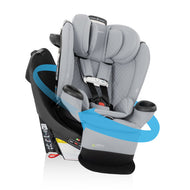
The Canadian Nuna RAVA and Nuna ROYL are not substitutes at the same child stage. The RAVA can be used rear-facing and then forward-facing. The ROYL starts as a forward-facing harnessed seat and later becomes a high-back booster. If a child still fits the RAVA rear-facing, moving to the ROYL would give up a stage Transport Canada recommends using until the rear-facing seat's limits are reached.
This comparison becomes useful only after asking one question: Is the child ready to leave rear-facing? Price, cup holders and expected years of use come later.
The stage boundary in Canadian specifications
| Mode | Nuna RAVA (Canada) | Nuna ROYL (Canada) |
|---|---|---|
| Rear-facing | 5–40 lb, up to 49 in. | Not a rear-facing seat |
| Forward-facing with built-in harness | 25–65 lb, up to 49 in. | Age 2+, 30–65 lb, up to 49 in.; installation method has its own weight limits |
| High-back booster | Not a booster | Age 4+, 40–120 lb, 38–57 in. |
| Architecture | Convertible: rear-facing to forward-facing | Combination: forward-facing harness to belt-positioning booster |
The overlap at some weights does not make the modes equivalent. A 35 lb child might be within the numerical range of all three modes shown above, but the correct stage depends on rear-facing fit, maturity, the exact seat's instructions and the vehicle installation.
Checkpoint 1: does the child still fit rear-facing?
Transport Canada advises keeping a child rear-facing until they reach the rear-facing weight or height limits of the seat. For the current Canadian RAVA page, those published maximums are 40 lb and 49 inches, with all additional manual fit rules still applying.
If the child remains within every rear-facing rule, the ROYL should not be treated as the “next version” of the RAVA. It has no rear-facing mode. The useful RAVA-versus-ROYL decision begins when the child has actually reached a transition point supported by the current RAVA manual, not when forward-facing becomes merely possible.
A minimum is not a recommendation to switch early. The RAVA's forward-facing mode begins at 25 lb, while the ROYL's harness mode begins at 30 lb and age two. Those are lower eligibility boundaries. They do not override the direction to continue rear-facing while the child fits the rear-facing mode.
Checkpoint 2: what does the next forward-facing setup require?

Once rear-facing is genuinely outgrown, both seats can provide a forward-facing five-point harness within their Canadian limits. The decision is then about which supported mode meets the child's current stage and can be installed correctly in the vehicle.
The RAVA continues as the same seat. That can be the least disruptive route when it already fits the child, the vehicle and the household. Its forward-facing range is 25–65 lb and up to 49 inches.
The ROYL begins with a harnessed forward-facing mode and adds a future high-back booster mode. In harness mode, Nuna lists UAS plus top tether for 30–40 lb and vehicle belt plus top tether for 30–65 lb.
For either seat, use the top tether in forward-facing mode as directed by the Canadian manual and confirm the vehicle's permitted seating position and anchor locations in the vehicle owner's manual.
Checkpoint 3: is a future booster part of today's purchase?
The ROYL's structural advantage is that its forward-facing harnessed stage can later convert to a high-back belt-positioning booster. The current Canadian limits for that booster mode are age four or older, 40–120 lb and 38–57 inches. All limits and fit requirements must be met at the same time.
The RAVA does not become a booster. After its forward-facing harness is outgrown, a child will need an appropriate booster if they are not yet ready for the vehicle belt alone. Buying the ROYL may consolidate those two later stages, but only if it fits well in each mode and remains suitable for the vehicle and child over time.
A future conversion is not a reason to skip today's best stage. It is reasonable to choose the RAVA for continued rear-facing now and make the booster decision later. It is also reasonable, after rear-facing is outgrown, to choose the ROYL because a harness-to-booster architecture fits the family's longer plan.
A no-shortcut decision tree
Signals that do not prove a stage change
Meeting a forward-facing minimum alone does not show that rear-facing is outgrown; compare the child's measurements and seated fit with every rear-facing requirement in the matching RAVA manual. If those rules are still met, the rear-facing stage remains available.
Likewise, reaching age four or 40 lb does not prove readiness for ROYL booster mode. The child may still fit the harness and may not yet maintain correct vehicle-belt position. Meeting the next mode's minimum does not by itself end the current mode; continue the current stage while every exact rule remains satisfied.
Test the forward-facing modes as separate products
If rear-facing is complete, install the RAVA forward-facing and the ROYL in harness mode in the same vehicle position on separate trials. For each, record:
- the installation method allowed at the child's current weight;
- top-tether routing and anchor access;
- harness height and crotch-buckle fit;
- front-seat and adjacent-passenger space;
- whether every caregiver can tighten and release the child without disturbing the installation.
The ROYL's future booster mode should be evaluated as a benefit, not assumed fit. Vehicle-belt geometry, buckle access and the child's maturity will need a new trial when conversion time arrives. The RAVA's lack of booster mode should be evaluated as a future separate purchase, not as a flaw in its present rear-facing job.
Write the reason for changing seats
Use one sentence: “We are changing because _____.” A strong answer names a reached fit limit, an installation that no longer works or a stage that is complete. “The next seat was on sale” or “the child met the next minimum” is a signal to pause and recheck.
- Check the current seat label and manual. Record the child's standing height and weight, then verify head position, harness position and every fit rule.
- If rear-facing still fits, stay in that stage. The ROYL's first mode is forward-facing, so it is not a rear-facing replacement.
- If rear-facing is outgrown, test forward-facing fit. Compare the RAVA's continuing mode with the ROYL's harness mode in the actual vehicle.
- Choose the installation method by the manual. For the ROYL, distinguish its 30–40 lb UAS-plus-tether range from its 30–65 lb vehicle-belt-plus-tether range.
- Treat booster mode as a later decision. Recheck age, size, belt fit and the child's ability to remain properly seated when that transition actually arrives.
Which seat fits which decision?
Bring the child's current measurements to the trial and name the mode before touching the vehicle. “RAVA rear-facing,” “RAVA forward-facing,” and “ROYL harness mode” are distinct setups with different instructions. If a qualified, retailer-permitted in-vehicle demonstration is available, use it; otherwise follow the exact manuals and seek a recognized child-passenger-safety resource. Keep the present restraint job ahead of future features.
Continue with or choose the RAVA when
- the child should still ride rear-facing;
- one seat covering rear-facing and forward-facing stages is the priority;
- the installed RAVA preserves acceptable space and access in the vehicle;
- the household is comfortable buying a dedicated booster later.
Consider the ROYL when
- the child has genuinely completed the rear-facing stage;
- a forward-facing harness is still required;
- the exact approved installation works in the intended vehicle;
- a later conversion to high-back booster mode is valuable.
Pause when
- the decision is being driven only by age or by a minimum weight;
- the vehicle's permitted tether anchor for that seating position has not been identified;
- the chosen installation method is not valid for the child's weight;
- the seat cannot be tested in the actual seating position.
The stage boundary decides
The Nuna RAVA protects the option to remain rear-facing; the Nuna ROYL begins after that option has ended and carries a child from a forward-facing harness toward a booster. Treat the boundary as a child-stage decision, not a model upgrade. Once that boundary is clear, compare both seats within the Nuna collection at baby enRoute and test the appropriate mode in the real vehicle.