In this article
Short answer: the Evenflo Gold Revolve360 Extend is worth considering when a rotating seat would make daily loading easier and your vehicle can accommodate a 29.6 lb all-in-one seat. Its Canadian limits cover rear-facing, forward-facing harness, and high-back booster use, but rotation does not make vehicle fit or installation automatic. Start by measuring your seating position, then follow the seat and vehicle manuals.
Check the current Evenflo Gold Revolve360 Extend colours and availability.
Use this three-question fit check
- Will it fit the vehicle? Evenflo lists the seat at 21 in. wide, 19.8 in. deep, 25.9 in. high, and 29.6 lb. Published dimensions are a screening tool, not proof of front-seat clearance or a three-across fit.
- Will you use the rotation? The shell rotates for loading, but the seat still has to be installed and used in the correct travel mode every trip.
- Do its stage limits match your plan? Compare the Canadian limits below with your child's current measurements. Move stages only when the manual requires it, not because a birthday arrives.
Follow the installation and rotation path before buying
- Choose one real seating position. Do not evaluate the seat against the vehicle in general. Open the vehicle manual to the child-restraint section for the exact rear-left, rear-centre, or rear-right position you intend to use. Confirm which belt, UAS, tether anchor, head-restraint, and front-seat rules apply there.
- Screen the physical envelope. Evenflo's assembled measurements are 21 in. wide, 19.8 in. deep, and 25.9 in. high. Compare those numbers with the door opening and neighbouring passengers, then treat the result as permission to trial - not proof of fit. A rotating shell needs swept space as well as static space.
- Plan the approved installation method. The seat arrives with its own UAS equipment; Evenflo says not to substitute another style. If the chosen method or seating position cannot follow both manuals, stop and choose a different position or seat.
- Locate the tether anchor before checkout. Tether360 is part of both rear-facing and forward-facing harness installation. A convenient door-side position is not a valid plan if the required anchor cannot be identified and used as directed.
- Trial the empty installed seat. If the store permits an in-vehicle trial, install the seat empty in the intended position exactly as the current Canadian seat manual and vehicle manual direct. Rotate the empty shell toward the door, return it to the required travel position, and repeat with the front seat and neighbouring restraint in their normal positions. Check clearance at the door trim, cupholders, front seat, and adjacent restraint.
- Check the actual child's fit only after correct installation. Once the seat is correctly installed, assess the child's harness height, head clearance, buckle position, recline, and mode eligibility under that exact current manual. Rotation may improve access, but it does not alter those fit rules.
Canadian use limits at a glance
| Mode | Published child limits | Decision note |
|---|---|---|
| Rear-facing | 4-50 lb; 17-48 in. | Transport Canada advises keeping a child rear-facing until they reach the seat's rear-facing height or weight limit. |
| Forward-facing harness | 30-65 lb; 35-49 in.; at least 2 years old | All listed conditions apply. Follow the manual's harness and head-position rules. |
| High-back booster | 40-120 lb; 44-57 in.; at least 4 years old | A child must also meet the manual's booster-readiness and belt-fit requirements. |
These rows are ceilings and entry conditions, not a schedule. For example, a child who meets the forward-facing weight but not the minimum age or height does not meet the mode requirements. Likewise, a booster-weight number does not replace the seat's readiness and belt-fit instructions. Use the first applicable limit or failed fit rule as the transition trigger.
What the rotation changes - and what it does not
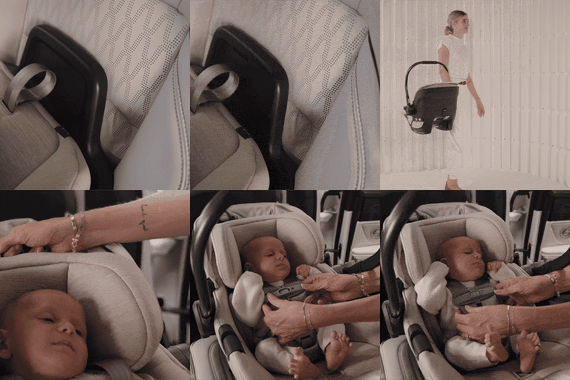
Rotation can reduce the reach needed to place a child in the shell and buckle the harness. That is a convenience decision, not a separate safety rating. The useful question is whether the shell can rotate in your actual seating position without colliding with the door frame, front seat, or neighbouring restraint.
The base is not optional: Evenflo states that the shell must be used with its base. The manufacturer also states that Tether360 is used for both rear-facing and forward-facing harness installations, and that only the UAS equipment supplied with the seat may be used. Those are installation boundaries, not optional upgrades.
How to treat SensorSafe
Evenflo describes SensorSafe as providing alerts for four conditions: a child left in the vehicle, an unbuckled chest clip while driving, an uncomfortable ambient temperature, and a child seated for an extended period. Treat those alerts as supplemental information. They do not confirm correct installation, harness fit, or readiness to change modes.
Match the seat to the caregiver and vehicle
| Real-life scenario | What favours the Revolve360 Extend | What can reverse the decision | Trial that settles it |
|---|---|---|---|
| One primary family vehicle | The 29.6 lb seat can remain installed, so rotation is available on every trip. | The shell blocks front-seat comfort or cannot rotate with the door and neighbouring seat in their normal positions. | Set every seat for its real occupant, then repeat the empty-seat rotation and return it to the manual-required travel position several times. |
| Frequent grandparent or second-car moves | One seat covers multiple child stages. | The installed weight and tether/base requirements make repeated transfers more work than owning a simpler second restraint. | Lift the seat safely, identify every anchor in both cars, and time a complete manual-led reinstall rather than only carrying the shell. |
| Caregiver with limited reach or a tall vehicle sill | Door-facing loading may reduce how far the caregiver reaches across the side of the shell. | A narrow door opening or high side bolster prevents useful rotation, so the advertised motion does not improve access. | Use the actual door opening and caregiver stance; do not judge from a display bench. |
| Three passengers or restraints across one row | No automatic advantage. | The 21 in. published width and rotation sweep may consume shared space; a successful static measurement does not prove independent buckle access. | Install every intended restraint or seat passenger together and check each independently. |
| Canadian winter routine | Turning the shell toward the door may make the harness easier for the caregiver to see while buckling. | Transport Canada says bulky winter coats and snowsuits may not work well with a child car seat. | Read and follow the current car-seat manual and manufacturer instructions for proper use; rotation does not change those harness requirements. |
Ownership trade-offs after the first week
The main ownership advantage is consolidation: one installed shell covers rear-facing, forward-facing harness, and high-back booster modes. The trade-off is that an all-in-one seat does not behave like a portable infant carrier. At 29.6 lb before the child, it is best evaluated as vehicle equipment that stays put.
Rotation also adds a daily mechanism and a required travel-position habit. Every caregiver who uses the vehicle should know how to rotate, return, and confirm the seat's required position without relying on another person's setup. If one caregiver cannot repeat that sequence correctly, the feature has not solved the household's problem.
SensorSafe adds Bluetooth-connected alerts, which can be useful to a family that wants them. It also adds a technology layer to understand and maintain. The non-negotiable restraint tasks - installation, harness fit, chest-clip position, mode choice, and supervision - remain manual-led whether or not a phone alert is available.
Stop rules that should end the shortlist
- The shell cannot complete its loading rotation and return to the required travel position with the front seat set for its real occupant.
- The intended seating position cannot use Tether360 and the selected installation method exactly as both manuals direct.
- A neighbouring passenger loses usable belt access, or another restraint can no longer be installed and used independently.
- The household expects frequent car-to-car moves but has not completed a correct installation in every vehicle.
- The decision depends on SensorSafe replacing a manual fit or installation check.
Who should shortlist it?
Shortlist it if one rotating seat across multiple stages is appealing, you are comfortable leaving a heavier seat installed, and a vehicle trial confirms clearance. Keep comparing if you frequently move a seat between cars, need a narrow three-across layout, or cannot test the rotation and front-seat clearance first.
For any Canadian car seat, check for the National Safety Mark and read both manuals before installation. A correct model choice still depends on the child, vehicle, seating position, and installation method.
Sources
- Evenflo Canada: Gold Revolve360 Extend product specifications and use limits
- Evenflo Canada: Tether360 installation FAQ
- Evenflo Canada: supplied UAS equipment FAQ
- Evenflo Canada: base-use FAQ
- Evenflo Canada: Revolve360 Extend Canadian instruction manual (July 2025)
- Transport Canada: choosing a child car seat or booster seat
- Transport Canada: rear-facing seats
- Transport Canada: winter driving and bulky clothing in child car seats