In this article
Short answer: there is no single best car seat for every Canadian family. Start with seats that are certified for Canada and match your child's current size and stage. Then confirm that each candidate can be used correctly in the exact vehicle and seating position you plan to use. Only after those checks should convenience features decide the winner.
For stage and legal requirements, use Transport Canada's child car seat guidance and check your province or territory, because age, height and weight rules can differ.
Confirm Canadian eligibility first
Before comparing fabrics, stroller compatibility or cup holders, verify all four of these points:
- Canadian certification: look for the National Safety Mark and the product information label. Transport Canada warns that a seat without the mark is not certified for use in Canada.
- Child fit: check the manufacturer's Canadian label and manual against your child's current height and weight. Do not move to the next stage just because a milestone is approaching.
- Jurisdiction: confirm the current rules where the child will travel. Provincial and territorial requirements are not identical.
- Complete instructions: use the Canadian seat manual together with the vehicle owner's manual. A product page is not a substitute for either manual.
If a candidate fails any one of these checks, remove it from the shortlist.
Know which rule controls
Four sources answer four different questions. The National Safety Mark addresses Canadian certification. Your province or territory sets the legal use requirements for the trip. The child-seat label and Canadian manual set the product's permitted child limits and installation methods. The vehicle owner's manual sets what is allowed in the intended seating position.
Do not combine the most convenient sentence from each source. A seat must work under all of them at the same time. Advice from another country, a marketplace listing, a social post or a different model does not replace the Canadian label and the two manuals for the setup in front of you.
Bring five facts to the shortlist
- the child's current height and weight;
- the province or territory where the seat will be used;
- the year, make and model of every vehicle that matters;
- the intended seating position and neighbouring passengers or child seats; and
- the routine the seat must support, including transfers between vehicles or a stroller connection.
These facts turn a broad category search into a smaller set of models that can be checked. Without them, a long comparison mostly ranks features before eligibility is known.
Fit 1: your child
Write down your child's current height and weight before shopping. Then record the permitted stage and limits from the Canadian label or manual for every candidate. Transport Canada recommends keeping a child in each stage until they reach the seat's stated height or weight limit.
For a pre-owned seat, pause before treating a low price as a win. Confirm its full history, date of manufacture, useful-life information, labels, instructions, parts and recall status using Transport Canada's pre-owned seat checks. If the history is incomplete, choose another seat.
Fit 2: your vehicle
A seat can meet Canadian standards and still be a poor match for a particular vehicle or seating position. Transport Canada's buying checklist explicitly asks whether the child car seat fits the car. For each candidate, note:
- the vehicle year, make and model;
- the seating position you intend to use;
- the installation methods permitted by both manuals;
- space needed for front passengers and neighbouring child seats;
- whether the belt path, buckle or approved anchor method remains accessible; and
- whether the retailer permits a vehicle fit check before purchase.
Do not improvise with an accessory, mat, insert or installation method unless the child-seat manufacturer permits it for that model. If you cannot achieve the installation described by both manuals in the intended position, that candidate does not pass the vehicle-fit test.
Fit 3: your daily routine
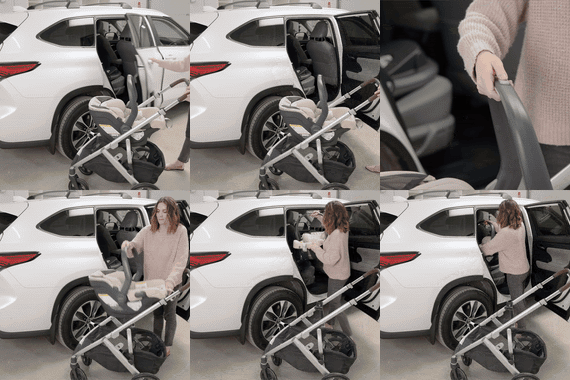
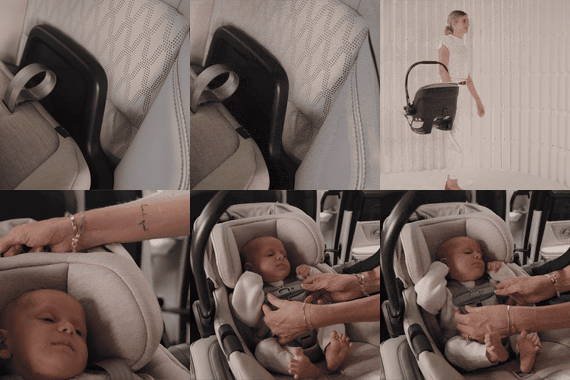
Now compare the details that affect repeated use. Does the seat stay in one car or move between vehicles? Who will buckle the child most often? Do you need an infant carrier that connects to a stroller, a convertible seat that remains installed, or a booster for a child who already meets the relevant requirements?
Convenience matters because the seat will be used on every trip, but it comes after certification, child fit and vehicle fit. Compare only features you will actually use: carrier weight, harness adjustment, cover-care instructions, storage, approved stroller connections, and whether a second vehicle needs its own compatible setup.
Check the combinations that can fail
The seat fits the child but crowds the vehicle
An infant seat may match the child's label limits yet take enough front-to-back space that the intended front passenger cannot sit as the vehicle requires. That is a vehicle-fit failure, not a reason to alter the recline or move the front seat outside its permitted position.
The seat works in the main car but not the second car
Do not assume the same seating position or installation method transfers between vehicles. Repeat the manual and space checks for each vehicle. If daily switching creates unresolved installation or storage problems, compare a separate approved setup rather than treating portability as proof of compatibility.
A feature depends on an unapproved accessory
A mat, insert, strap cover or stroller adapter belongs in the plan only when the relevant manufacturer permits that exact use. If the setup works only after adding a third-party part that is not permitted, remove the setup from the shortlist.
The pre-owned seat has an attractive price but incomplete history
Missing labels, instructions, parts or collision and ownership history prevent the buyer from completing the checks. A visual inspection cannot recover facts that are not known. Choose another seat.
Compare a short list side by side
For each candidate, record the Canadian model and manual, the child's current measurements, the intended vehicle position, the permitted installation method, the one routine advantage that matters, and any unresolved stop reason. Remove a seat as soon as one required fit cannot be confirmed; there is no benefit in carrying an ineligible option into a longer feature comparison.
Current examples can help you start the comparison, but they are not universal recommendations. An infant-seat shopper might examine the UPPAbaby Aria V2; a family comparing a seat that can remain rear-facing and later forward-facing might examine the Clek Foonf; and a booster-stage shopper might examine the UPPAbaby Alta V2. Recheck availability, the current Canadian manual and the child's eligibility when you shop.
Check the exact seat before taking it home
Confirm that the box and seat match the model and variant you compared. Locate the National Safety Mark, product information label, manufacture date, useful-life information and Canadian instructions. Check that required parts are present and inspect the selected model for current recalls or safety notices. Keep the receipt and register the seat with the manufacturer so future notices can reach you.
Stop signs before checkout
- No National Safety Mark or product information label.
- The child is outside the Canadian label's permitted limits or stage.
- The seat cannot be installed in the intended position as both manuals require.
- The setup depends on an accessory or method the manufacturer does not permit.
- A pre-owned seat has missing labels, parts, instructions or history, or is affected by a recall or the manufacturer's useful-life limit.
Once a seat passes all three fit tests, choose the option your caregivers can use consistently. Browse the car seat selection, then keep the Canadian manual with the seat and register it with the manufacturer so you can receive safety notices.