In this article
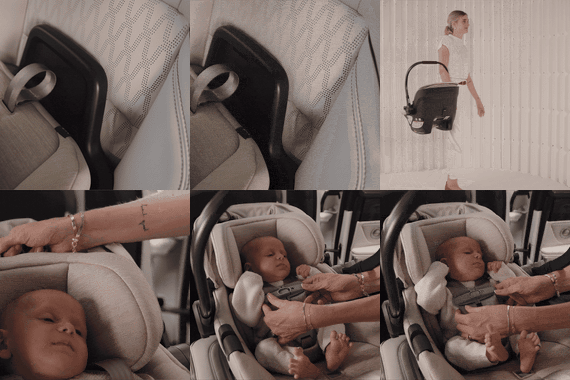
After a Canadian Nuna PIPA is outgrown, a rear-facing convertible such as the Nuna RAVA can continue the rear-facing stage; make the change according to the child's fit and the limits in the applicable seat manuals. Later steps may include the RAVA forward-facing, the ROYL forward-facing harness, and then a ROYL or AACE booster. At each stage, compare the child's current measurements with the exact seat requirements; for booster use, also verify fit for the child and vehicle.
A stage map is more reliable than a product ladder. Nuna's seats overlap at some weights and heights because minimums describe eligibility, while maximums and fit rules describe when a mode ends. The goal is to keep the child in each appropriate stage until it is genuinely outgrown.
Build the child's measurement card
Record these details before shopping or changing modes:
- current weight, measured without guessing from a recent clothing size;
- standing height;
- seated fit in the current seat, including head clearance and harness position;
- the exact model number and date label on the current Canadian seat;
- the current manual's weight, height and fit limits;
- which limit is likely to be reached first.
Where a model states an age minimum, the child must also meet its weight, height and fit requirements; age alone is not sufficient. Transport Canada recommends moving through rear-facing, forward-facing and booster stages according to the child's fit and the seat's limits.
Stage 1: know when the PIPA is actually outgrown
“PIPA” is a family name, not one shared Canadian limit. The current Canadian product pages list:
| Infant seat | Published Canadian child range | Installation architecture |
|---|---|---|
| Nuna PIPA | 4–35 lb; less than 81 cm (32 in.); top of head at least 25 mm (1 in.) below carrier top | Base included; the Canadian manual also permits carrier-only vehicle-belt installation |
| Nuna PIPA lite | 4–22 lb; less than 81 cm (32 in.); top of head at least 25 mm (1 in.) below restraint top | Must be installed with its PIPA-series base |
| Nuna PIPA urbn | 4–22 lb, 15–29 in., with at least 1 in. of head clearance | Integrated UAS or approved vehicle-belt installation; do not use with a base |
Each manual adds fit conditions beyond those headline numbers. A child must satisfy all requirements at once. Check the exact seat label and manual rather than assuming that advice for one PIPA model applies to another.
A nearing limit is a planning signal. It is wise to test the next seat before the current seat is outgrown, but the existence of a next seat is not a reason to switch early.
Stage 2: continue rear-facing in a convertible
The current Canadian Nuna RAVA is a convertible seat with a rear-facing range of 5–40 lb and up to 49 inches. Transport Canada advises keeping a child rear-facing until they reach the rear-facing weight or height limits of the seat.
The RAVA therefore fills a different job from the PIPA. It stays installed in the vehicle, so the child is transferred separately at each stop. In exchange, its rear-facing mode extends beyond the infant-carrier stage and its forward-facing mode can be used later.
Before the PIPA is outgrown, request a retailer-permitted exact-seat in-vehicle trial if available, or plan the next seat from the current manuals and a qualified fit resource. Check the approved recline, front-seat clearance, access to the buckle and anchors, and the fit of the child. A 5 lb published minimum does not guarantee that every newborn or small infant will achieve the correct fit in every setup.
Stage 3: leave rear-facing only when its limits are reached
When the child no longer fits the RAVA rear-facing according to its Canadian manual, the next stage is a forward-facing seat with a built-in harness. Two Nuna routes can be relevant:
- Continue in the RAVA: its forward-facing range is 25–65 lb and up to 49 inches.
- Move to the ROYL: its forward-facing harness mode begins at age two and 30 lb, extends to 65 lb and up to 49 inches, and later converts to a high-back booster.
These lower bounds do not recommend early forward-facing. ROYL's age and weight minimums describe eligibility for its forward-facing harness after rear-facing is complete; they are not a switch date by themselves. The top tether and approved installation method must be used as described in the exact seat and vehicle manuals.
The ROYL has a particularly important installation split: its Canadian specifications list UAS plus top tether for 30–40 lb and vehicle belt plus top tether for 30–65 lb, so its overall 65 lb harness maximum is not a lower-anchor limit.
Stage 4: use a booster after the harness stage
Transport Canada advises moving to a booster after the forward-facing child seat is outgrown and the child is at least 40 lb, while continuing to follow the booster manufacturer's requirements. A booster positions the vehicle's lap-and-shoulder belt; it does not restrain the child with an internal harness.
Nuna offers two different paths:
| Booster route | Canadian published range | Distinct use |
|---|---|---|
| ROYL high-back booster mode | Age 4+, 40–120 lb, 38–57 in. | Conversion from the same ROYL used in harness mode |
| AACE high-back mode | Age 4+, 40–110 lb, 38–60 in. | Dedicated booster that later offers a no-back mode |
| AACE no-back mode | Age 5+, 50–120 lb, 38–60 in. | Later configuration requiring suitable vehicle head support |
Booster readiness includes behaviour and vehicle fit. The lap belt should sit low over the hips, the shoulder belt should cross the middle of the shoulder, and the child must remain in that position for the whole drive. Meeting age, weight and height minimums without reliable belt position is not enough.
Stage 5: graduate from a booster by belt fit
The final transition is to the vehicle belt alone. Provincial and territorial rules vary, and legal minimums do not necessarily establish good belt fit. Confirm the current law where the child rides and use Transport Canada's belt-fit guidance.
A useful vehicle-belt check asks whether the child can sit all the way back, bend the knees comfortably at the seat edge, keep the lap belt low on the hips, keep the shoulder belt centred on the shoulder, and maintain that position for the entire trip. Fit can differ between seating positions and vehicles, so a child may still need a booster in one car after achieving good belt fit in another.
The transition trigger table
Use overlap as planning time, not permission to skip
The Nuna ranges overlap deliberately. For example, a child may meet the RAVA forward-facing minimum while still fitting the RAVA rear-facing, or meet a booster minimum while still fitting a forward-facing harness. In each case, the overlap gives the household time to research and test the next setup. It does not make both stages equally preferable.
At each overlap, ask two questions in order:
- Does the child still satisfy every rule of the current stage?
- If not, which next-stage seat and installation fit the child and vehicle now?
This order prevents an attractive next product from becoming the reason for an early transition.
Set a measurement cadence
Set a household reminder to remeasure after a noticeable growth change, when harness or head-clearance fit looks different, or whenever a current limit may be approaching. Measurements should be current enough to support the decision; a height from a medical visit months ago may no longer be useful near a limit.
Keep a simple dated record:
| Date | Weight | Standing height | Current mode | Closest manual limit | Next check |
|---|---|---|---|---|---|
| _____ | _____ | _____ | _____ | _____ | _____ |
The record supports planning but never replaces the live fit check in the seat.
Assign a manual to every hand-off
A model name in a family text thread is not enough. When another caregiver receives the child, they should receive the exact seat, matching Canadian manual, current mode and approved installation instructions. If a grandparent keeps a separate seat, record that model and its limits separately. Advice for the household's PIPA urbn should not be applied to a PIPA lite, and ROYL booster directions should not be applied while the ROYL is in harness mode.
Watch for mixed-stage purchases
A sibling, carpool or second vehicle can create pressure to move the older child so another child can use the seat. Solve each child's restraint need independently. A seat becoming useful to someone else does not change the current child's limits. Budget and vehicle planning should preserve the correct stage for both children.
| What you observe | What it means | Next action |
|---|---|---|
| The child is approaching a PIPA limit but still satisfies every rule. | Planning window | Test a rear-facing convertible; keep using the PIPA correctly until outgrown. |
| Any PIPA weight, height or manual fit limit is reached. | Infant seat is outgrown | Move to a correctly fitted rear-facing convertible. |
| The child still fits the convertible rear-facing. | Rear-facing stage continues | Do not use a forward-facing minimum as a switch date. |
| A rear-facing maximum or fit limit is reached. | Forward-facing harness decision | Test the RAVA forward-facing or an appropriate ROYL harness setup. |
| The forward-facing harness is outgrown and booster requirements are met. | Booster decision | Test ROYL booster mode or AACE belt fit with the child in the vehicle. |
| The vehicle belt fits correctly without a booster in that position. | Possible booster graduation | Confirm local law and repeat the fit test in every vehicle. |
Shopping sequence that prevents a rushed switch
Keep the old seat in service only while it remains unexpired, undamaged and fully within its instructions. Buying the next seat early does not authorize using it early, and owning the next seat does not extend the limits of the current one. Store the new restraint as its manufacturer directs until the planned in-vehicle setup is ready.
- After growth changes and before a suspected limit: remeasure the child and identify the exact current-seat rule that may be approaching.
- Test the next stage: bring the child and the primary vehicle, and use the current Canadian manual.
- Train every caregiver: each person should be able to identify the correct mode, harness or belt path, recline and installation indicators.
- Record the setup: keep the model, manual, registration and purchase information together without replacing the manual with personal notes.
- Recheck after the change: reassess fit as the child grows, after the seat is moved, and whenever a different vehicle is used.
Let fit trigger the next seat
Recheck the installed result after every transition; the new mode creates a new fit and installation question for each caregiver and vehicle.
What comes after the PIPA is not determined by age alone. It is a sequence: finish the exact infant seat correctly, continue rear-facing in a convertible such as the Nuna RAVA, use a forward-facing harness when rear-facing is complete, and move to a Nuna ROYL or Nuna AACE booster only when the child and vehicle are ready. Use the Nuna collection at baby enRoute as a product map, while the child's measurements and Canadian manuals control the timing.