In this article
Short answer: choose the UPPAbaby Aria V2 when a lighter carrier is the priority; choose the Mesa V3 when you want the higher Canadian weight limit. UPPAbaby lists the carriers at 6 lb and 9.9 lb respectively. The current Canadian manuals cap the Aria V2 at 22 lb and the Mesa V3 at 35 lb, while both list a maximum height of 32 in. Those limits matter more than a guessed number of months.
The routine chooser
| Your recurring task | Better starting point | Why |
|---|---|---|
| Carrying the carrier up stairs or over longer distances | Aria V2 | UPPAbaby lists a 6 lb carrier, 3.9 lb lighter than the listed 9.9 lb Mesa V3 carrier. |
| Keeping the same infant seat to a higher Canadian weight limit | Mesa V3 | Its Canadian manual lists 4-35 lb; the Aria V2 Canadian manual lists 4-22 lb. |
| Direct attachment to a current Vista or Cruz | Either | Both are listed for direct UPPAbaby Vista/Cruz attachment; verify the exact stroller generation in the applicable manual. |
| Trying to predict the transition month | Neither wins | Stop using either seat when the first applicable weight, height, head-position, or fit rule in its Canadian manual is reached. |
The Canadian specifications that change the decision
| Aria V2 | Mesa V3 | |
|---|---|---|
| Canadian child limits | 4-22 lb; maximum 32 in. | 4-35 lb; maximum 32 in. |
| Published carrier weight | 6 lb without canopy and infant insert | 9.9 lb |
| Published carrier width | 17 in. | 17 in. |
| Direct stroller attachment | Vista and Cruz | Vista V3/V2/2015+ and all Cruz models |
The 4 lb lower limit on both manuals is not, by itself, proof that either seat will fit every low-birth-weight or premature infant. Check the manual's harness, insert, buckle, head-position, and fit criteria for the individual child; involve the child's care team when medical needs affect transport.
Carry weight versus base weight
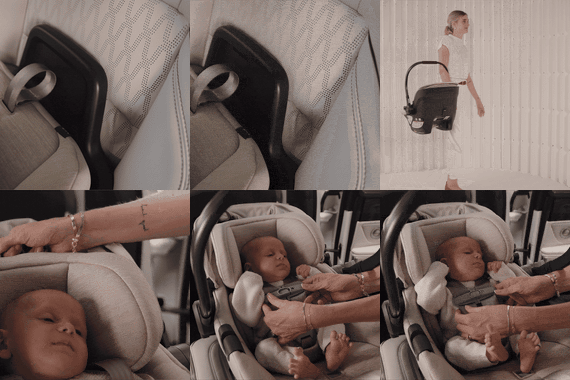
The carrier is the part you lift with the child, so the published 6 lb Aria V2 versus 9.9 lb Mesa V3 difference matters most when the carrier regularly leaves the vehicle. UPPAbaby specifies that the 6 lb Aria figure excludes the canopy and infant insert, so it should not be turned into a promise about the exact loaded weight in your configuration.
The base is a different ownership question. UPPAbaby's current product specifications list the Aria V2 base at 12.8 lb and the Mesa V3 base at 9 lb. Base weight matters when setting up or moving the base; it does not cancel the carrier-weight difference during a stair climb or walk from parking.
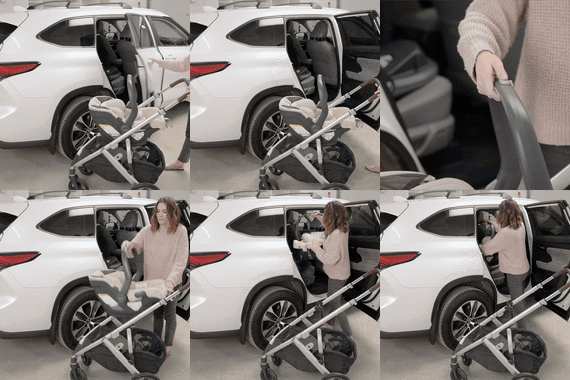
This produces a useful reversal. A family with one base permanently installed and many hand-carries may prioritize the Aria. A family that moves the base between vehicles but rarely carries the occupied carrier may notice the Mesa base difference more. Neither number proves ease for a particular caregiver, so lift the complete display setup and practise the real release-and-carry sequence.
Choose the vehicle and base routine
| Routine | Aria V2 question | Mesa V3 question | Decision check |
|---|---|---|---|
| One base in one primary car | Does the lighter carrier improve repeated stairs, parking, or hand-carrying enough to accept the 22 lb Canadian cap? | Does the 35 lb Canadian cap matter more than carrying an additional published 3.9 lb? | Install each base in the intended position and lift each configured carrier. |
| Two vehicles with a dedicated base in each | Is the exact Canadian Aria V2 base available and correct for the model? | Is the exact Mesa-compatible base the one named for Mesa V3? | Match model names and manuals; a second base adds convenience, not a separate safety result. |
| Occasional vehicle without a base | UPPAbaby lists carrier-only vehicle-belt routing, but the Canadian manual and vehicle belt must support the exact installation. | The Mesa V3 Canadian manual controls carrier-only routing and belt requirements. | Complete a correct manual-led installation in that vehicle before relying on the route. |
| Compact back seat or tall front passenger | The published 17 in. width does not establish front-to-back clearance. | The same published 17 in. width does not make the installed footprint identical. | Trial the seat at the required recline with the front seat set for its real occupant. |
| Shared row with another restraint | Neither seat has a three-across result from the published width alone. | Install and use every restraint independently; check buckle, UAS, belt, and carrier-release access. | |

Aria V2: optimize for carrying
The Aria V2's strongest measurable difference is carrier weight. A 3.9 lb difference exists before adding the child or packed accessories. That does not prove one caregiver will find it easy to carry, but it gives families with stairs, apartment hallways, or frequent hand-carrying a concrete reason to test the Aria first.
The trade-off is the Canadian 22 lb maximum, not the 30 lb figure shown in some non-Canadian material. A child can outgrow the seat by any applicable fit criterion before the published maximum, so the article cannot promise a lifespan in months.
The Aria decision can reverse earlier than expected for a fast-growing child, but growth charts still cannot predict the transition date. The practical plan is to monitor weight, standing height, and the manual's head and harness fit rules together, then budget for the next rear-facing restraint before any one criterion is reached.

Mesa V3: optimize for the higher Canadian limit
The Mesa V3 Canadian manual lists use from 4-35 lb and up to 32 in. It also specifies use of the infant insert from 4-11 lb. The higher weight ceiling may extend eligibility for some children, but height and every other manual fit rule still apply.
Do not choose a second base because it is assumed to be safer. A dedicated base can reduce repeated setup in a second vehicle, but every installation still has to follow the current car-seat and vehicle instructions.
The Mesa choice can also reverse. A higher 35 lb maximum is useful only while the child remains within the 32 in. height cap and all other fit rules. If frequent carrier lifting is already difficult, paying for a higher limit does not mean the family will want to carry the child in the seat until that limit.
Stroller use and winter clothing
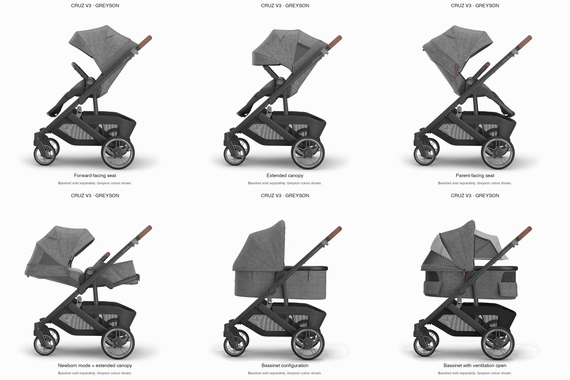
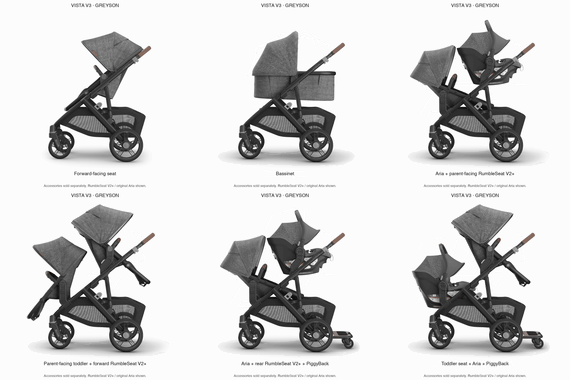
Both seats support direct attachment within the UPPAbaby Vista/Cruz ecosystem. For Ridge or Minu use, verify the exact stroller generation and adapter named by UPPAbaby before purchase. Compatibility is model-specific; matching logos are not enough.
The Mesa V3 manual says not to place a child in bulky clothing when using the restraint. Transport Canada likewise warns that bulky winter coats and snowsuits may not work well with child car seats. Follow the seat manual's clothing and harness directions rather than loosening the harness around a coat.
Counterexamples that prevent a false winner
- A smaller newborn does not automatically make Aria the winner. Both Canadian manuals begin at 4 lb, but individual harness and insert fit decides whether either seat is appropriate.
- A larger infant does not automatically make Mesa last longer. Either seat can be outgrown by height or another fit rule before the weight maximum.
- A 17 in. width does not prove three-across. Vehicle contour, belt geometry, base, handles, and independent access still matter.
- A red-to-green indicator does not install the seat by itself. Follow the full manual and vehicle instructions; do not declare an installation winner from one indicator.
- Direct Vista/Cruz attachment does not settle the car-seat choice. The carrier still has to fit the child, vehicle, and carrying routine.
Final choice
Start with Aria V2 if the lighter carrier directly improves a task you repeat and the 22 lb Canadian limit fits your expectations. Start with Mesa V3 if the 35 lb Canadian limit matters more than the additional carrier weight. Then test the chosen seat in the vehicle and confirm stroller compatibility before treating the decision as final.
Sources
- UPPAbaby Aria V2 Canadian manual, model 1002-ARI-CA
- UPPAbaby Mesa V3 Canadian manual, model 1003-MSA-CA
- UPPAbaby Aria V2 product specifications
- UPPAbaby Mesa V3 product specifications
- Transport Canada: choosing a child car seat or booster seat
- Transport Canada: winter driving and bulky clothing in car seats