In this article
The extra front wheel is not the most useful reason to choose the Thule Urban Glide 4-Wheel over the Urban Glide 3. For walking errands, the more concrete trade is a 10 kg basket instead of 7 kg, in a stroller weighing 13 kg rather than about 12 kg. Both need a 69 cm doorway according to Thule's Canadian specifications. The four-wheeler does not solve a narrow entrance.
That makes this a choice between carrying more below the seat and lifting less stroller into the car. A family walking home with groceries has a reason to favour the 4-Wheel. A family with a light changing bag and frequent car trips has a reason to prefer the Urban Glide 3.
Put the shopping load ahead of the wheel count
The Urban Glide 3 combines its 7 kg basket allowance with a zip-top cover, a rear mesh pocket and two mesh compartments. The 4-Wheel keeps that covered-storage approach but raises the basket allowance to 10 kg. The additional 3 kg is permitted load, not a promise that a particular shopping bag will fit.
If your changing bag and shopping together exceed 7 kg, the larger allowance is a practical benefit you can use on an ordinary walk. If you carry only a few small items, buying the higher allowance may add stroller weight without solving a problem. Think about the heaviest normal trip, not every hypothetical load you might carry once.
Keep the basket and total limits separate. Thule lists a 34 kg maximum stroller load and a 22 kg child maximum for both models. A higher basket rating does not increase the child limit. The safety instructions also warn that loads attached to the handle, backrest or sides affect stability, so a hanging bag is not an alternative way to obtain extra basket capacity.
Same doorway, different weight in your hands
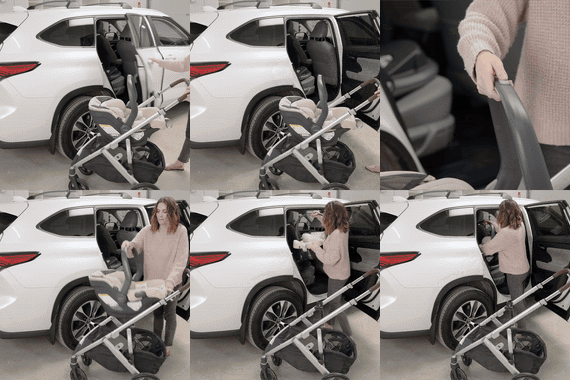
At about 12 kg, Urban Glide 3 is roughly 1 kg lighter than the 13 kg 4-Wheel. That difference matters when you lift the stroller out of a trunk repeatedly. It matters less when the stroller lives open in a ground-floor storage space and is rolled out for every trip.
The published compact folded dimensions are 88 x 58 x 31 cm for Urban Glide 3 and 88 x 58 x 28 cm for the 4-Wheel, in length, width and height order. The Urban Glide 3 and 4-Wheel manual drawings show these compact shapes with the rear wheels removed. They are not a wheels-on trunk guarantee. The 4-Wheel's listed height is 3 cm lower; its extra weight and its packed shape are different trade-offs.
Those folded figures are a starting point for trunk planning, not the open stroller's passage width. Both specifications list 69 cm for door passage. A hall, lift or storage entrance that is too narrow for one does not become suitable merely by choosing the other. Measure the clear opening at the narrowest obstruction, not the width of the door leaf.
Both models offer a one-hand fold and a self-standing folded position. That shared convenience will not decide this pair. If you must lift the stroller often, prioritize the mass and the way you can grip it; if it will occupy a shallow storage area, compare the actual folded shape in that space.
What the front end actually changes
Urban Glide 3 has one swivelling front wheel that can be locked. The 4-Wheel has two swivelling front wheels that can be locked. Both use air-filled tires and suspension, and both have an integrated twist hand brake. The 4-Wheel is not the only one with a control for slowing the stroller, and the three-wheeler is not the only one with a lockable front end.
The two layouts are worth trying around the kind of turn you actually negotiate: a shop entrance, the turn into a lift or a bend beside a parked car. Compare how the front end tracks and how much steering movement feels comfortable.
Do not buy either on the assumption that an all-terrain name or a lockable wheel grants running permission. The safety booklet linked from both Canadian product pages states that the product is not suitable for running or skating. This comparison is for walking. For a running purchase, seek a model and exact instructions that explicitly permit that activity.
The seat is more similar than the chassis suggests
Both provide an adjustable reclining seat, a built-in leg rest and a ventilated canopy. Their regular-seat instructions begin at six months; a newborn needs an appropriate separately approved configuration, not simply a reclined regular seat. Both manuals show limits of 22 kg and 111 cm, and an age range ending at four years, whichever limit comes first.
Current versions include a magnetic harness buckle, while older stock may have the earlier buckle. Confirm the version on the particular stroller being ordered; the cargo and doorway decision does not depend on treating those versions as identical. A different buckle also does not change the instructions that apply to the child or the activity.
Which daily inconvenience would you remove?
For a walking-first household carrying a heavier under-seat load, the 4-Wheel's 10 kg basket is the strongest reason to accept its additional weight. For a car-first household carrying a lighter bag, Urban Glide 3 saves roughly 1 kg at every lift while keeping the same published doorway requirement and many of the same everyday controls.
Use the stroller collection to compare another size class if 69 cm is the real obstacle. Within this pair, choosing by cargo, lifting and the exact front-wheel layout produces a clearer answer than choosing by an assumed three-wheel or four-wheel hierarchy. Check current model and colour options before ordering.