In this article
The Nuna PIPA Lite is the lighter published carrier and the direct choice for a Nuna stroller. The UPPAbaby Aria V2 gives up 0.7 lb in carrier weight but adds a Canadian baseless vehicle-belt route and direct attachment to current Vista and Cruz strollers. That installation difference matters more than the decimal on the scale when taxis, flights, grandparents' cars, or an existing UPPAbaby stroller are part of the week.
Separate carry burden from vehicle-change burden
Both current Canadian models are rear-facing infant seats rated from 4 to 22 lb. The PIPA Lite manual requires height less than 81 cm (32 in.) and at least 25 mm (1 in.) of head clearance below the restraint top; the UPPAbaby Aria V2 Canadian manual states 81.3 cm (32 in.) or less and includes its own 2.5 cm (1 in.) head-gap rule. Nuna lists the PIPA Lite carrier at 5.3 lb and UPPAbaby lists the Aria V2 at 6 lb; both published figures exclude the canopy and infant insert. Because the exclusions match, the 0.7 lb difference is a fair product-spec comparison. It still is not the load a caregiver carries once a baby and accessories are added.
| Carry and fit line | Nuna PIPA Lite | UPPAbaby Aria V2 |
|---|---|---|
| Current Canadian model scope | CF08506 family | 1002-ARI-CA |
| Rear-facing child limits | 4-22 lb; less than 81 cm (32 in); top of head at least 25 mm (1 in) below restraint top | 4-22 lb; up to 32 in |
| Published carrier weight | 5.3 lb, excluding canopy and insert | 6 lb, excluding canopy and insert |
| Published carrier dimensions | 17.5 in W x 27.3 in D x 22.5 in H | 17 in W x 25.8 in L x 23.7 in H |
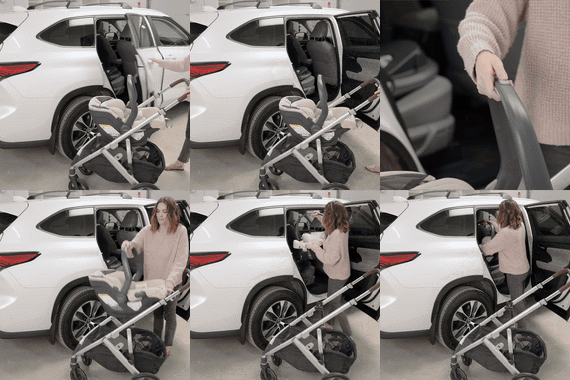
| Vehicle installation | Must be installed with its base | Base or carrier-only vehicle-belt installation |
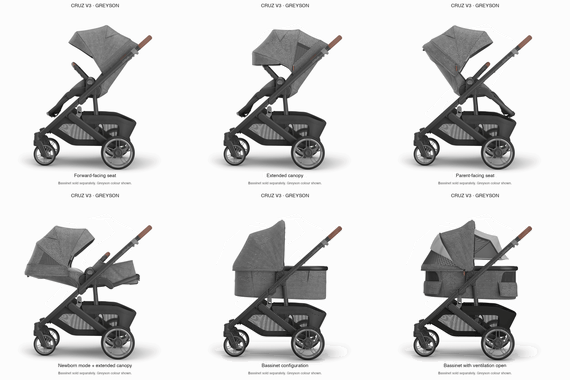
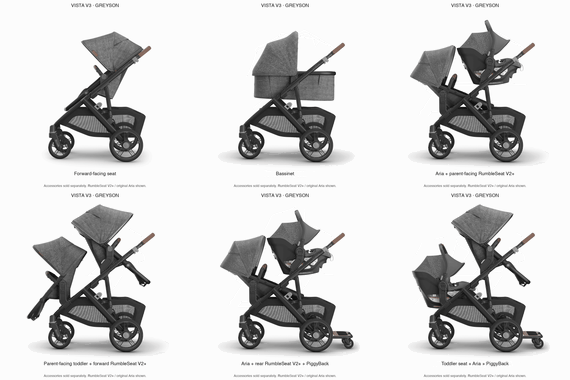
| Stroller path | All Nuna strollers | Direct Vista and Cruz connection; adapters for Minu and Ridge |
The numbers answer only part of the question. Aria V2 is 0.5 in narrower and 1.5 in shorter in the manufacturers' published exterior dimensions, while PIPA Lite is 1.2 in lower. Those are paper comparisons, not installed-clearance promises. Vehicle contours, seat angle, front-seat position, and handle instructions can change the real envelope.
Measure one stair-and-door carry circuit
Use the route that is hardest on the regular caregiver: for example, vehicle to apartment door, parkade to daycare, or curb to elevator. Record the number of lifts, doors, turns and places where the carrier must be held while another task happens. Compare the occupied carrier load, not only the empty shell: add the child's current weight to each published carrier weight, while keeping excluded canopy and insert weight visible as an unknown unless measured separately.
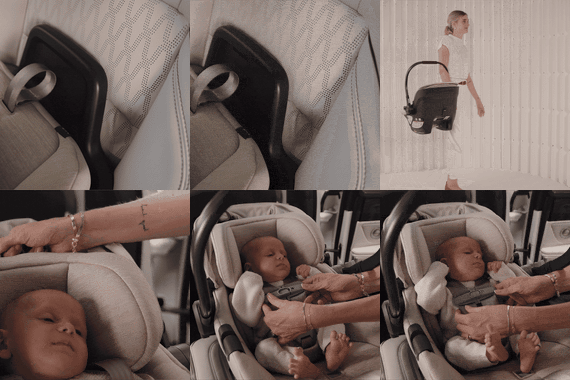
Then add the equipment that must travel with the route. PIPA Lite requires its base in every vehicle used. Aria V2 can use its base or the carrier-only vehicle-belt method in its Canadian manual. A 0.7 lb lighter carrier can lose the whole-route comparison when its required base has to be transported; a baseless option can lose when the household leaves one base installed and carries the seat up stairs several times a day.
This is a handling ledger, not an installation shortcut. Every chosen method must still follow the exact Canadian restraint manual and the vehicle manual.
The installation fork
Mostly one car: compare both bases in the intended seating position. PIPA Lite's base uses Nuna's steel-reinforced True lock base installation system. Aria V2's base lists auto-retracting UAS connectors and a vehicle-belt lockoff. Connector type does not decide fit by itself; the allowed installation that works correctly in the specific vehicle does.
Frequent car changes: Aria V2 has the practical advantage because its carrier-only belt route is an approved Canadian option. PIPA Lite remains base-only. If a second base would solve the routine, include its cost, storage, and installation checks in the comparison rather than treating it as invisible.
Air travel: verify the exact seat label, airline policy, aircraft instructions, and destination transport plan before the trip. A low carrier weight can help through an airport, while a baseless vehicle route can help after landing. Those are different parts of the same journey.
The ecosystem cost is part of the seat
The PIPA Lite connects across Nuna's stroller range. Aria V2 attaches directly to UPPAbaby Vista and Cruz strollers, while UPPAbaby identifies adapters for Minu and Ridge. If the household already owns one of those strollers, direct attachment can remove an adapter purchase and reduce one compatibility check.
For any other stroller, confirm the exact model, model year, and manufacturer-approved adapter. Do not transfer an approval from a previous seat generation or from a United States page. The manufacturers publish model-specific stroller compatibility: Nuna lists PIPA Lite with Nuna strollers, while UPPAbaby lists direct or adapter-based Aria V2 connections for named stroller families.
The Canadian stage check
Both seats have a 22 lb maximum, which is lower than the 35 lb maximum of some other infant seats. Height, weight, and fit instructions all apply; reaching any manufacturer stop rule ends use. Transport Canada says to keep a child rear-facing until the seat's height or weight limit is reached and not to rush from one stage to the next.
Before purchase, confirm that the exact seat bears Canada's National Safety Mark and that its planned vehicle position and installation are allowed by the child-seat and vehicle manuals. Install the seat only as allowed by the child-seat and vehicle manuals, and check the installation at the belt path.
Compare the equipment that stays behind
UPPAbaby publishes its Aria V2 base at 12.8 lb and 23.9 in L x 14 in W x 15.2 in H. Nuna's PIPA Lite page identifies the True lock base installation system but does not publish a base weight or complete base dimensions. Keep that unknown visible if storage space or carrying the base is part of the trip; do not fill it with a specification from another market.
For a permanent installation, base weight may matter little. For a flight followed by a rental car, it can reshape the luggage plan. PIPA Lite requires that base in the destination vehicle. Aria V2 allows the family to decide whether the base benefits the trip or whether the approved carrier-only belt route is the better documented option.
Make the lighter carrier lose once
Test the strongest counterexample to the scale result. PIPA Lite loses when its required base must be transported to the destination or cannot remain installed in every regular vehicle. Aria V2 loses when the base stays in one car, the carrier is lifted repeatedly, and its extra 0.7 lb is felt on every stair or long handoff. Write down which losing condition actually occurs in the household.
Next, count total carried pieces for the hardest trip: carrier, required base, stroller adapters and travel protection. Keep unpublished base dimensions or weights as unknown rather than borrowing a specification from another market. The winning system is the one whose full load and approved installation path both fit the same real route.
The three-line decision
- Choose PIPA Lite for the lighter published carrier, a base that stays put, and direct Nuna stroller use.
- Choose Aria V2 for an approved base-free vehicle-belt option, a Vista or Cruz stroller, or slightly smaller published width and length.
- Pause the purchase if the intended vehicle fit, stroller adapter, or full travel route has not been confirmed.
See the current Nuna PIPA Lite at baby enRoute. If the comparison has narrowed to PIPA Lite versus PIPA Urbn rather than PIPA Lite versus Aria V2, continue with the Nuna PIPA Lite vs PIPA Urbn guide. The final choice still needs an allowed installation in the intended vehicle using the current Canadian manual.