In this article
Map the next eighteen months of passengers first. Nuna DEMI Next can begin as a single, add a sibling seat, support twin-style configurations, or carry an older child on the included rider board. TRVL Dubl starts from a different premise: two seats and a self-standing fold for the family that needs that configuration now. The DEMI Next buys configuration flexibility; the TRVL Dubl buys immediate two-seat simplicity. Neither is the practical choice until its passenger map passes your door, trunk, and age-gap tests.
Draw the passenger map before comparing strollers
Write one row for each child who may ride during the next eighteen months. Record current mobility, likely nap timing, how long they tolerate walking, and whether an infant car seat or bassinet is part of the early plan. Then mark each outing with the number of seats truly required.
| Passenger pattern | DEMI Next path | TRVL Dubl path | Question to settle |
|---|---|---|---|
| One child now, second later | Start single; add sibling seat or use rider board | Carry an unused second seat from day one | How certain and how soon is the second seated rider? |
| Two seated children now | Add the correct second-seat configuration | Two seats are already integrated | Does stacked seating or side-by-side width work better on your route? |
| Baby plus walking preschooler | Included rider board may cover intermittent rides | Second seat is available whenever needed | Can the older child reliably stand when tired? |
| Infant car seat plus sibling | Map the approved upper/lower configuration | PIPA installs on the wider seat only | Where will the second child sit and what remains accessible? |
| Twins or same-stage riders | Supports double or twin paths with separately sold pieces | Two forward-facing seats with independent controls | Do you want configuration range or identical side-by-side routines? |
The width-versus-configuration trade
Nuna Canada's current TRVL dubl product page lists it at 30.5 inches wide, 6.5 inches wider than DEMI Next's published 24-inch width. The Canadian ST19800 manual separately controls passenger and configuration limits. That width difference is the first route checkpoint, not a verdict. DEMI Next keeps passengers in a tandem or stacked footprint. TRVL Dubl places them side by side, which increases width while keeping both seats immediately visible and independently adjustable.
Measure the narrowest doorway you control and the narrowest one you regularly use. Do not compare a door label with stroller width. Measure clear space with the door held at its normal angle, including the latch, frame, and your hand position. Add turning room before and after the opening. A 30.5-inch stroller may clear a generous entrance but still be difficult where the approach is diagonal.
Length complicates the story. DEMI Next is 39.5 inches long when open; Nuna Canada's current TRVL dubl product page lists it at 37.5 inches long. A narrower tandem is not necessarily shorter. In a small elevator, the choice may be between side clearance and front-to-back clearance. Tape both rectangles on the floor and stand where the caregiver would stand; do not assume the handle area disappears from the manoeuvre.
What conversion really costs in daily steps
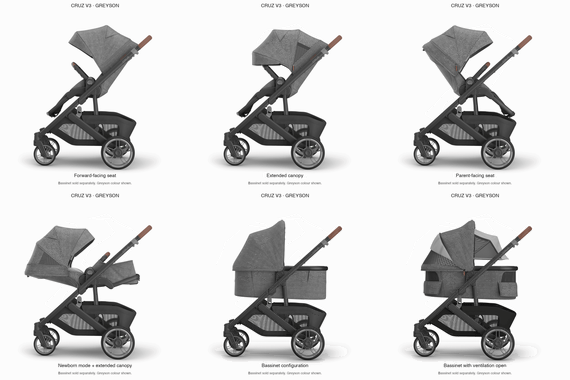
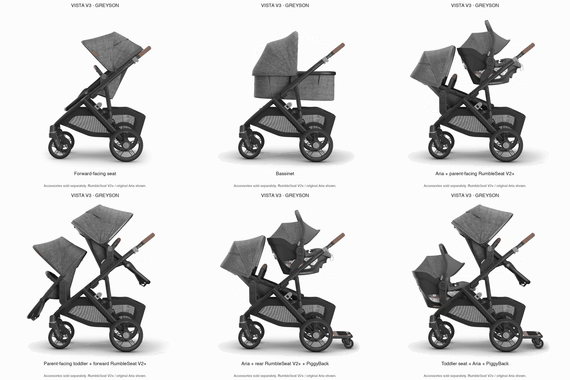
DEMI Next converts from a single to double or twin setup, supports a separately sold sibling seat, and includes a rider board that attaches to the lower seat mounts and flips into the basket when not in use. That flexibility is useful only if the household is comfortable storing, attaching, and removing the pieces required for its chosen configuration.
Make a configuration card for every routine: daycare drop-off, weekend walk, newborn appointment, and solo outing with one child. List the parts installed, the parts left at home, and what must change between trips. If you will reconfigure several times a week, rehearse those transitions as part of the purchase decision. Flexibility can prevent buying another stroller, but it can also create a parts-management job.
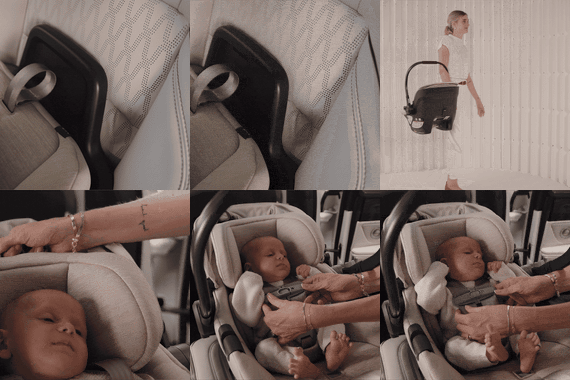
TRVL Dubl's two seats are always present. The Canadian TRVL dubl manual documents a self-standing fold. The Canadian manual says a PIPA series infant carrier can be installed on the wide seat only and must be removed before folding. That is a simpler fixed architecture, but it is not part-free. An infant-seat day still changes how one side is used.
Passenger limits and newborn modes
The TRVL Dubl Canadian manual limits each seat to 50 lb and 45 inches, with a 100 lb combined maximum for two children. The same manual describes a fully reclined carriage position and requires the calf support and fabric flaps to be set correctly; it also says the enclosure must not be used once a child can push up on hands and knees or crawl out.
DEMI Next's stroller seat is listed from newborn to 50 lb. Nuna also offers a separately sold DEMI Next bassinet for birth to 20 lb and up to 27 inches, with a stop rule when the infant begins to push up on hands and knees. The bassinet is identified by Nuna Canada as suitable for overnight sleep. Do not transfer that sleep claim to the stroller seat, sibling seat, rider board, or infant car seat.
Health Canada advises that strollers and car seats are for transport rather than routine sleep. If a baby falls asleep in one, transfer the baby to a crib, cradle, or bassinet at the destination. For any bassinet used as a sleep space, follow the exact model instructions and Canadian use limits rather than relying on the appearance of a flat surface.
Four age-gap decisions
Under two years apart, both likely to sit
TRVL Dubl has the more direct starting case when both children need seats on nearly every outing. DEMI Next becomes more practical if the family values a single-to-double path, bassinet options, or a narrower footprint enough to manage configuration changes.
Baby plus independent preschooler
DEMI Next has the more flexible starting case when one eligible child can use the rider board standing, within every board limit and operating rule, without committing to a permanent second seat. The board is not interchangeable with a seat: if the older child still naps, wanders, or cannot stand reliably for the full route, TRVL Dubl's second seat may be the more practical plan.
Twins or two children at the same riding stage
TRVL Dubl offers symmetrical day-to-day seat routines with independent reclines. DEMI Next offers more configuration possibilities, including twin-oriented setups with the appropriate separately sold components. Price and storage must include every required piece, not only the base stroller.
Uncertain second-child timing
DEMI Next avoids carrying a second full seat before it is needed and keeps rider-board and sibling-seat branches open. TRVL Dubl asks the household to accept double width immediately. The side-by-side can still be rational if two-seat use is near-term and certainty matters more than staged expansion.
The trunk-and-door rehearsal
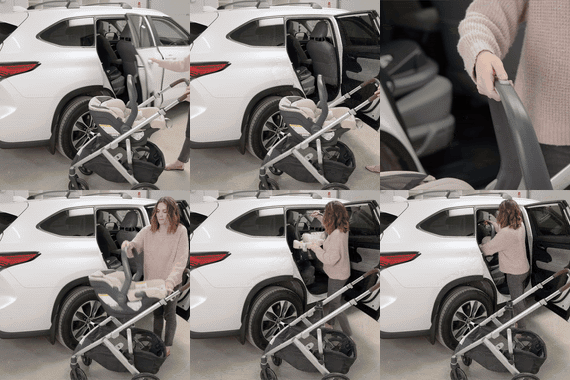
DEMI Next folds to 23.5 by 24 by 35 inches and is listed at 26 lb without its insert, canopy, and arm bar; Nuna says those omitted parts add about 3.4 lb. Use the Canadian TRVL Dubl manual for passenger, PIPA-position, and configuration limits, and measure the physical stroller before relying on a tight folded fit. The weights are close enough that folded shape may decide more than the headline number.
- Tape each folded footprint on the trunk floor and include the height limit under a parcel shelf.
- Place two common bags beside the outline; a double stroller rarely travels alone.
- Walk a 30.5-inch template through the narrowest door and corner.
- For DEMI Next, add the sibling-seat or bassinet storage plan.
- For TRVL Dubl, test whether the wide fold can be gripped and lifted without contacting the vehicle opening.
Repeat the rehearsal with the adult who will use the stroller least often. Ask that person to identify the correct passenger place, prepare the fold, and name every loose component without coaching. If the setup works only when one caregiver remembers an unwritten sequence, add a labelled storage position or simplify the planned configuration. A two-child stroller must survive real handoffs between caregivers, vehicles, and daycare routines.
Choose the chassis around the passenger calendar
DEMI Next is a family-configuration system; TRVL Dubl is a two-seat stroller. Choose DEMI Next when the route rewards narrower width and the family will genuinely use its single, sibling-seat, twin, or rider-board branches. Choose TRVL Dubl when two independent seats, a fixed side-by-side layout, and fewer reconfiguration decisions fit the current household better.
Start with the Nuna collection, then inspect the current Nuna DEMI Next with rider board and Nuna TRVL Dubl at baby enRoute. For broader layout principles, see the existing side-by-side versus tandem stroller guide.