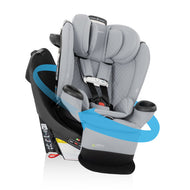
In this article
The choice is about transfer routine, not which category is universally better. An infant seat has a removable carrier. A convertible seat stays in the vehicle. Both still need Canadian certification, a suitable child range and a permitted installation in the intended vehicle position.
Start by mapping the recurring route: where the car is parked, whether the baby leaves the car in the seat, which stroller is used, who carries the seat and whether the setup moves between vehicles. The pattern usually makes the useful category clearer.
The routine difference in one table
| Repeated task | Infant carrier | Convertible from the start |
|---|---|---|
| Move baby between car and stroller | Can stay buckled when used with an approved stroller connection | Baby is unbuckled and moved; seat remains installed |
| Carry through stairs or a long parking route | Carrier, baby and permitted accessories are lifted together | Only the baby and other gear are carried |
| Use more than one vehicle | May use an additional compatible base or an allowed baseless installation | The whole seat must be installed in each vehicle, or each vehicle needs its own restraint |
| Keep one installation undisturbed | Base stays installed while carrier is removed | Complete restraint stays installed |
| Plan for later stages | A convertible seat will be needed after the infant seat is outgrown | The same shell may cover rear- and forward-facing stages within its exact limits |
First check whether either candidate fits from the first ride
Read the Canadian label and manual rather than relying on category language. Transport Canada's buying checklist asks buyers to match the child's age, weight and height to the restraint and to confirm that the seat fits the vehicle. Some convertible seats need a manufacturer-approved infant insert for smaller babies; others have a higher starting minimum. Do not infer newborn suitability from the word convertible.
The chosen seat must also achieve the recline and harness fit required for the baby. Transport Canada's guidance makes the exact child, restraint and vehicle part of the choice. If the exact seat and vehicle combination cannot reach the permitted setup, the category decision is not complete.
Choose an infant seat when the removable carrier earns its work
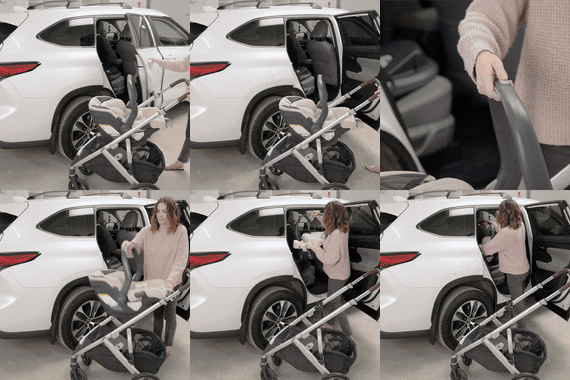
An infant seat can simplify frequent short transfers. It is most useful when the caregiver regularly moves the buckled carrier between the vehicle and an approved stroller, carries it through weather or uses a base that remains installed while the carrier comes inside.
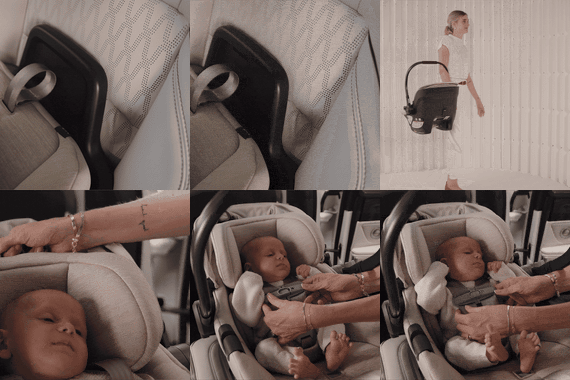
That convenience has a weight cost. Compare the carrier-only weight, then rehearse the carry path with the empty carrier before adding the baby's weight to the decision. A six-pound carrier and a nine-pound carrier may feel different on stairs, but either becomes heavier as the baby grows. Check whether the handle clears the door, neighbouring child seat and stroller connection without using a buckled baby as a handling test.
Base-free installation can matter for occasional taxis or a second vehicle only when the exact manual permits it and the caregiver can repeat the belt routing and recline. It is a separate installation method, not proof that every unfamiliar vehicle will be easy.
Choose a convertible when the seat should stay put
A convertible can be a practical first seat when the family does not need to carry the baby in the restraint and wants one installed setup to cover the rear-facing stage and later forward-facing use. It can also avoid storing an infant carrier and base after the infant stage ends.
The tradeoff is that every car-to-destination transition begins by unbuckling the baby. That may be simple for a garage-to-home route and less convenient for frequent appointments or winter stops. A convertible may also be larger or heavier to move between vehicles, so repeat the full installation in every car that matters.
Do not count future stages as savings until the present stage fits. The seat must meet the baby's current minimums, achieve the required recline and leave usable space for the front passenger and adjacent occupants.
Map the recurring routine before choosing
- Identify whether the baby will typically move directly from car to stroller.
- Measure the longest carry from the parking spot to the destination.
- List every regular vehicle and intended seating position.
- Name the caregiver who will lift or reinstall the seat most often.
- Check the exact stroller and adapter approval, if a travel-system connection matters.
- Decide where the carrier or stroller will be stored at home.
- Install the leading candidate at the required recline and check front-passenger space.
Two examples show why the routine matters
A family that parks in a garage, uses one vehicle and usually carries the baby directly indoors may gain little from moving the restraint. A newborn-compatible convertible that passes the child and vehicle checks can keep the installation undisturbed.
A caregiver who makes several short appointments each week and connects the carrier to a compatible stroller may use the removable seat on nearly every trip. For that family, carrier weight, release access and the approved stroller connection are primary comparisons after fit.
Questions to settle before checkout
- Does the exact Canadian label include the baby's current height and weight?
- Is any infant insert required, and is it included and permitted for this model?
- Can the restraint reach the required recline in the intended vehicle position?
- Can the front passenger sit according to the vehicle manual?
- Will a second vehicle use a separate seat, another approved base or a permitted baseless method?
- Can every regular caregiver complete the harness and installation steps in the manual?
Browse infant seats and convertible seats as two different routines, then let child fit and vehicle fit veto any option that does not work in the real setup.