In this article
A full-size stroller earns its footprint when it removes friction from the trip a family repeats most often. The useful question is not which model has the longest feature list. It is whether the stroller can leave its storage spot, carry the right passenger and cargo, cross the usual surfaces and return home without one difficult step dominating every outing.
Find the route bottleneck
Trace one real weekday from the front door to daycare, transit or the vehicle. Measure the narrowest doorway, elevator depth and usable trunk opening with the normal cargo still inside. Then identify the moment that takes the most effort: lifting the folded stroller, steering over damaged pavement, reaching the basket with the seat reclined, or arranging two children.
That bottleneck should lead the decision. A compact fold has limited value if the stroller is rarely put in a car. Large wheels do not solve a third-floor walk-up. A future second seat matters only if its approved passenger limits and layout match the ages your family expects.
| Repeated job | What to handle in person | Product direction to compare |
|---|---|---|
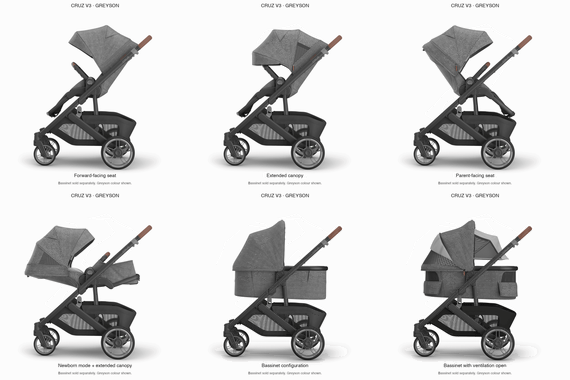
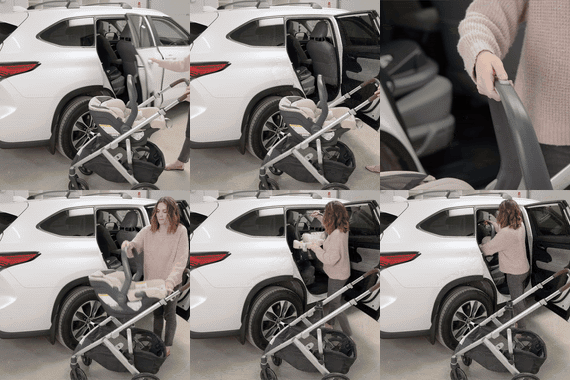
| Car-and-daycare routine | Folded shape, lifting grip, trunk clearance and basket access with the daycare bag. | A single-seat everyday chassis such as the UPPAbaby CRUZ V3. |
| Long walks and rougher routes | Steering on the actual surface, overall width, braking and the lift into storage. | An all-terrain design such as the UPPAbaby Ridge V2. |
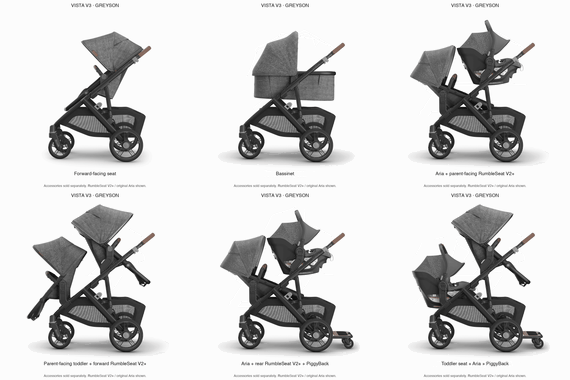
| A planned second passenger | The exact two-child layout, each seat limit, turning length and what remains accessible. | An expandable model such as the UPPAbaby VISTA V3, built in the configuration the family would actually use. |
Use numbers to expose tradeoffs, not crown a winner
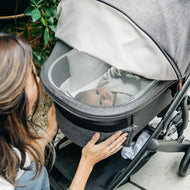
UPPAbaby lists the North American CRUZ V3 at 26.5 lb with its seat, 22.5 inches wide and 17 x 22.5 x 32.5 inches folded with the seat attached. Its current North American manual permits use from birth to 50 lb; for a newborn in the toddler seat, it specifies the most reclined position with the full harness and foot barrier. UPPAbaby also offers direct attachment for its Bassinet, Mesa and Aria on the CRUZ V3. Those routes let a family choose between a lie-flat bassinet, a direct infant-car-seat connection and the approved stroller-seat setup instead of assuming every reclined seat is newborn-ready. See the official CRUZ V3 specifications and UPPAbaby Canada attachment guidance for the exact current model.
The North American Ridge V2 is a different tool. UPPAbaby lists it at 29.2 lb and 25.6 inches wide, with a 20 lb basket. Its seat is for children from three months to 55 lb; use from birth requires an approved accessory. Jogging has a separate readiness threshold: the child must be able to hold their head up unassisted, and UPPAbaby advises consulting the child’s physician. The official Ridge V2 page keeps these limits together. A family buying for gravel paths may accept the extra width and lift. A family lifting into a compact hatchback twice a day may not.
Match the first-use setup before buying extras
Write down the child’s stage on the first outing, not only the stage six months later. If that first outing requires a bassinet, infant car seat or model-specific adapter, include it in the purchase and practise the complete connection before leaving home. Convenience accessories such as a parent organizer or snack tray can wait until the routine shows a real need.
For two-child plans, assemble both current and expected layouts. Confirm which seat goes where, whether the stroller folds with that hardware attached, how each child is lifted in, and whether groceries still fit. “Expandable” describes a product family; it does not prove that one configuration works for newborn twins, a baby and toddler, or a rider-board child.
Handle the hard step in store
Bring trunk measurements and the normal bag. Fold the stroller without a demonstration reset, lift it to approximate trunk height and set it into the measured space. Adjust the handle for each regular caregiver. With permission, place representative weight in the basket and seat, then steer a tight turn and cross a threshold. The aim is not to improvise a safety test; it is to feel the routine while following the displayed model’s instructions and limits.
Health Canada advises caregivers to use the harness and brakes, follow manufacturer instructions and avoid hanging purses or diaper bags from stroller handles because the stroller can tip. Its stroller and carriage guidance is the right baseline for every model.
Use the full-size stroller collection to see the wider category, but open the product page for every finalist. The better choice is the model whose approved first-use configuration clears the family’s hardest repeated step without creating a worse one elsewhere.