In this article
Clek Foonf vs Fllo: compare the differences that affect your vehicle
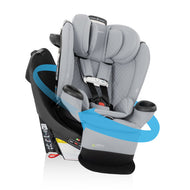
The Clek Foonf and Clek Fllo are narrow convertible car seats, but they are not interchangeable. Their child limits, installation hardware, installed length and carrying weight differ. Use those details to decide which seat to test in your vehicle rather than assuming that the heavier or more expensive model is safer.
Foonf and Fllo specifications at a glance
| Detail | Clek Foonf | Clek Fllo |
|---|---|---|
| Rear-facing child range | 14–40 lb, 25–43 in and able to sit upright alone; from 5 lb and 19 in with the compatible Infant-Thingy | 14–50 lb, 25–43 in and able to sit upright alone; from 5 lb and 19 in with the compatible Infant-Thingy |
| Forward-facing child range | 22–65 lb and 30–49 in | 22–65 lb and 30–49 in |
| Width and base width | 16.9 in wide; 13 in base | 16.9 in wide; 13 in base |
| Rear-facing installed length listed by Clek | 33 in | 32.5 in with anti-rebound bar |
| Seat weight listed by Clek | 38 lb in rear-facing configuration | 25 lb; 28 lb with anti-rebound bar |
| Forward-facing lower-anchor hardware | Rigid UAS connectors | Flexible UAS belt |
These figures come from the current Canadian Foonf specifications, Fllo specifications and Clek comparison. Always confirm the current manual for the exact seat before installation.

Difference 1: rear-facing limits
The Fllo has the higher listed rear-facing weight limit: 50 lb compared with 40 lb for the Foonf. Both list the same 43 in rear-facing standing-height limit and require the child to remain within every height, weight and fit condition in the manual. A higher weight limit does not guarantee that a particular child will remain rear-facing longer because children reach limits in different orders.
Transport Canada advises keeping a child rear-facing until the child reaches the seat's height or weight limit. Compare your child's measurements with both manuals instead of using age alone.
Difference 2: forward-facing installation hardware
Foonf has rigid UAS connectors for forward-facing installation. Fllo uses a flexible UAS belt. This distinction describes the attachment hardware; it does not make one approved installation method inherently safer than another. Either seat may also permit a vehicle-belt installation when the manual and vehicle seating position allow it.
Lower-anchor limits and vehicle rules can change which method is available as a child grows. Read the car-seat manual and vehicle manual together. For either model, Transport Canada says to attach the top tether whenever a forward-facing child seat is installed.
Difference 3: weight when you move the seat
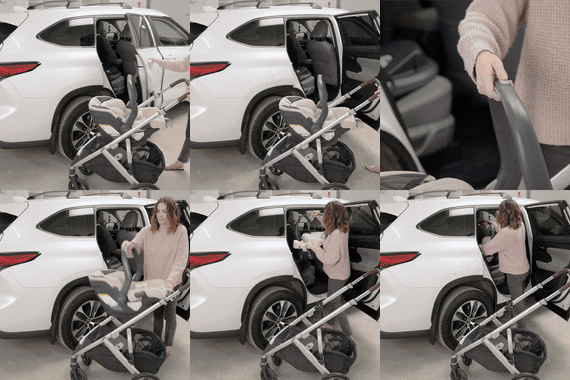
Clek lists Fllo at 25 lb, or 28 lb with its anti-rebound bar. The Foonf specification lists 38 lb in rear-facing configuration. That difference matters if the seat will regularly move between vehicles, be carried up stairs or be removed to make room for passengers. It matters much less when the seat will remain installed for long periods.
Do not choose by carrying weight alone. A lighter seat is not automatically easier to install in every vehicle, and a heavier seat is not evidence of greater crash protection.
Difference 4: front-to-back space
The published rear-facing installed lengths are close: 33 in for Foonf and 32.5 in for Fllo with its anti-rebound bar. A half-inch specification difference cannot predict front-passenger comfort because vehicle-seat shape, approved recline, head restraints and the front occupant's required seating position all affect the result.
For a useful fit check, install each candidate in the intended seating position according to both manuals. Then confirm that the child restraint has the permitted recline, the front seat remains in a safe position for its occupant, doors close normally and adjacent passengers or restraints do not interfere.

What the shared 16.9-inch width does and does not tell you
Both seats are 16.9 in at their widest point and have a 13 in base. That makes either one a reasonable candidate for a narrow seating position, but it does not prove a three-across installation will work. Door contours, belt-buckle position, vehicle-seat bolsters and the shape of neighbouring restraints determine whether each seat can be independently installed and used.
When testing more than one restraint, install each one exactly as its manual allows. Confirm that tightening or removing one seat does not loosen another and that every buckle, harness adjuster and release remains reachable. If the configuration cannot satisfy every restraint and vehicle instruction, change the seating plan or the restraint combination.
Choose based on the constraint you actually have
- Start with Fllo when the 50 lb rear-facing weight limit, lower carrying weight or flexible UAS hardware addresses a known need.
- Start with Foonf when you specifically want to test its forward-facing rigid UAS installation in a permitted seating position.
- Test both when front-to-back room or a multi-restraint arrangement is the deciding issue. The published dimensions are too close to replace a vehicle check.
The practical winner is the model that remains within your child's limits, installs correctly in the intended position and can be used properly on every trip. Compare the Clek Foonf and Clek Fllo, then verify the exact configuration against the current manual before the first ride.