In this article
The one-piece versus two-piece question is really a question about where you want the openings. A snowsuit reduces the number of jacket-to-pant gaps a caregiver has to manage. A separate jacket and snow pant let a child remove one layer, replace one piece and use the jacket on its own. Neither arrangement is automatically warmer; the better choice is the one that fits the child, the wash cycle and the day’s transitions.
This comparison uses the WeeDo UNIDO unicorn snowsuit as the one-piece route and Kidorca’s Cypress jacket-and-pant system as the two-piece route.
The one-piece route: fewer junctions
The current WeeDo UNIDO snowsuit combines jacket and pant coverage in one garment. Its exact SKU, UNIJSfpp2 for 92–104/XS, appears in WeeDo’s authorized Autumn/Winter 2023–2024 snow catalogue. That same generation specifies a waist bathroom zip, taped seams, a 10,000 mm water column, 5,000 g/m²/24h breathability, adjustable grow-system sleeves and legs, internal suspenders, snow guards, reinforced high-wear areas and an adjustable helmet-compatible hood.

The advantage is continuity. There is no jacket hem lifting away from the pant waistband when a child crawls, sleds or rolls. A caregiver has fewer pieces to match at the cubby. The trade-off appears indoors and at bathroom breaks: the upper body cannot simply be removed and left hanging while the child keeps snow pants on.
The waist-zip concept is meant to reduce how much of the suit needs to come off, but it is still worth rehearsing at home. Put on the intended base layer, open the zip, and confirm the child or caregiver can complete the sequence without the garment touching a wet floor. A clever feature is useful only if it works for that child’s reach, balance and independence.
Also ask who will wash and dry the garment after a muddy snow day. A one-piece keeps the set together, but the whole outer layer is unavailable while it is being cleaned. With separates, a family may wash the pants more often than the jacket. Follow each care label; do not assume the two Kidorca pieces or the UNIDO use the same drying settings.
The two-piece route: more combinations
The Kidorca route pairs a Cypress Winter Jacket with Cypress Padded Snow Pants. Kidorca’s current pages specify 12,000 mm waterproofing, 10,000 g/m² breathability and fully sealed seams for the jacket and exact Ombre Blue snow pants. The pants add lightweight technical insulation and adjustable, removable suspenders. The current jacket page adds fleece lining, fast-dry stretch inner cuffs and a wind guard over the zip.
Separates win on modularity. The jacket can go to school without the pants. A wet pant can be hung while the jacket is still used for errands. Different top and bottom sizes may work better for a child whose torso and leg measurements do not land in the same age band. The penalty is the waist junction: the jacket must overlap the pant through a squat and the suspenders must hold the waistband without pulling at the crotch.
Choose by the awkward moment
Most comparisons focus on the picturesque part of winter. The purchase is usually decided by less glamorous moments:
- The cubby: one suit is one item to track, but it needs enough hanging space to dry. Two pieces create more labels and clips, yet each can be positioned separately.
- The bathroom: a waist zip may simplify a one-piece stop; separates are familiar but snow-pant suspenders and jacket layers still need managing.
- The warm classroom: a separate jacket comes off immediately while snow pants remain. A one-piece requires more undressing.
- The wet afternoon: any soaked item needs time and airflow to dry. Two pieces let the family isolate the wet half; one-piece construction keeps the whole system together.
- The growth spurt: grow features can extend usable length, but they do not solve a tight torso, restricted seat or boot opening. Separates offer another sizing lever.
The fit drill
- Use the child’s current height, chest, waist, hip and inseam. Compare those measurements with the exact brand chart; age is only a label.
- Add the base layer and midlayer planned for a real snow day. Do not test over a T-shirt and assume a fleece will fit later.
- Ask the child to sit on the floor, touch their toes, climb one stair and reach overhead. Look for pulling across the seat, shoulders and crotch.
- Put on the actual boots and mittens. The pant or gaiter should cover the boot opening, and the sleeve should meet the mitten cuff without a bulky stack.
- Check the hood with normal headwear. For skiing, skating or another helmeted activity, use the correct helmet and follow its fit instructions.
Do not buy a dramatically oversized suit in the hope of two extra seasons. Excess fabric can interfere with movement, cuffs can drop over hands, and a hood can shift out of position. “Grow with me” means using the garment’s designed adjustment range, not beginning with a size that does not fit now.
A clean decision split
| If this matters most | Start here | Verify before buying |
|---|---|---|
| Reducing snow entry at the waist | UNIDO one-piece | Exact size, torso mobility, bathroom sequence |
| Using the jacket separately | Cypress two-piece | Hem overlap and suspender adjustment |
| Different top and bottom proportions | Cypress two-piece | Each piece against its own chart |
| One labelled item at daycare | UNIDO one-piece | Drying space and current stock |
Safety boundaries belong in the routine
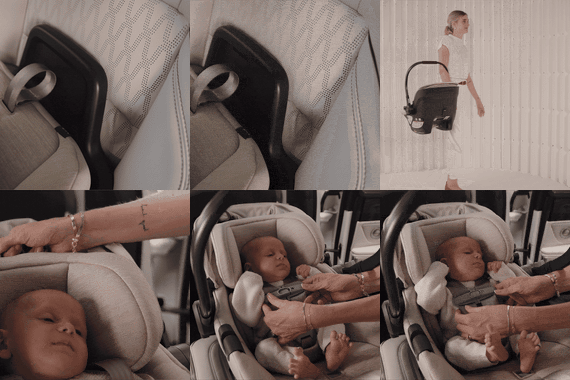
Transport Canada says bulky winter coats and snowsuits may not work well with a child car seat and directs caregivers to follow the child-seat manual. A wearable snowsuit is not automatically acceptable with a particular restraint.
For outdoor activities, Health Canada recommends the correct helmet, equipment that fits and is in good condition, supervision, suitable layers and changing wet clothing. No snowsuit removes the need to watch weather, activity level and the child’s condition.
The final gate is measured fit
UNIDO remains a useful one-piece choice only for a child who fits the exact 92–104/XS option. Cypress separates offer another route because the jacket and pants can be fitted independently. Measure both pieces, check the intended colour and size, and reject any combination that opens at the waist, pulls through the crotch or leaves a boot gap during movement.
Build the rest of the system from the Fall/Winter Edit. The right answer is not “one piece forever” or “two pieces forever”; it is the configuration that closes today’s gaps and still lets the child move.