In this article
LEAF grow belongs in an awake, supervised routine, not in a sleep plan. It offers side-to-side motion, three recline positions and two use stages, but Health Canada says babies should be moved from seated or semi-reclined products to a crib, cradle or bassinet once asleep. The useful question is where this seat helps while the child is awake and the caregiver is nearby.
Draw the wake-window map
Place the seat beside a real adult task: folding laundry, eating breakfast, or sitting on the floor for play. Mark how the child enters, how the harness is checked, how long the task lasts, and where the child goes next. A floor seat can support proximity without becoming a parking place for an entire wake window. If the map ends with sleep in the seat, redraw it with an appropriate sleep space.
Stage one ends on development, not convenience

Nuna's current Canadian manual uses the built-in restraint in Stage One and says to stop that stage as soon as the child starts trying to sit or reaches 20 lb, whichever happens first. Do not wait for both conditions, and do not extend Stage One because the child still appears comfortable. Stage Two is a separate chair mode that begins only after the child can walk.
Stage two is a chair for a walking child
For stage two, Nuna removes the built-in harness and describes use as a chair when the child is able to walk, up to 130 lb. That is a different job from the infant stage. Store the removed pieces with the manual and record the change, rather than treating conversion as a casual swap. A high upper weight does not make LEAF grow a sleep surface.
Motion is manual and finite
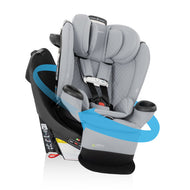
A gentle push starts the side-to-side sway; Nuna says the motion may continue unassisted for up to two minutes. The seat uses no motor, batteries or cord and can lock in a stationary position. Decide whether that short manual motion suits the household. Families seeking continuous powered motion are asking this product to do a different job. Families who value a quiet, cord-free seat may prefer the simple mechanism.
Recline changes comfort, not product category
LEAF grow has three recline positions. Recline can support an awake child's comfort, but it does not override the sleep boundary or the stage requirements. Health Canada warns that a baby's head can fall forward in seated or semi-reclined products during sleep and advises moving a sleeping baby to a crib, cradle or bassinet. Use recline within the exact manual and supervise; do not use a lower angle as permission for sleep.
Cleaning and storage are part of daily fit

Nuna lists the infant insert, seat pad and toddler seat as removable for machine washing. The seat also detaches from the base for storage or trips. Rehearse where the 28.7-by-28-inch base will sit and where the detached seat will go. At 15.4 lb, it is movable, but the broad floor footprint can still conflict with walkways. A clear home reduces the chance that it becomes a trip hazard.
Separate product fit from the use boundaries
After applying the sleep and Stage One limits above, ask a different question: does this seat solve the household's actual awake-time job? Reject it when the real need is continuous powered motion or a smaller floor footprint. This keeps the purchase decision tied to a repeated routine instead of adding a vague caution.
Who should choose it
Choose the Nuna LEAF grow when an adult wants a supervised, floor-level place for short awake periods, appreciates manual sway and has room for the base. Delay it when floor space is tight, the desired job is sleep, or a portable powered seat is the actual priority. If the real need is a contained play area rather than sway, use the SENA Aire home-and-away guide to compare that different job. For a direct motion, portability and footprint decision, use the LEAF Grow and Bouncer Bliss comparison. The strongest purchase is one with a named awake task and a clear exit routine; current Nuna home-gear availability is collected on the Nuna page.
Test the floor-space counterexample
Mark the LEAF grow footprint near the sofa, table and route to the kitchen, then add the arc of an adult bending to place and lift the child. If the only open location is beside cords, heaters, stairs or busy foot traffic, the room does not support the plan. A movable seat can still be the wrong shape for a narrow apartment or a home with several children using the same path.
Keep stage conversion and handoff together
Keep a short card with the seat: current stage, harness requirement, permitted awake activities, sleep transfer rule, recline check and manual location. When Stage One ends, retrieve the current manual and inspect the seat. Convert to Stage Two only after the child can walk; Nuna specifies that Stage Two uses the seat pad alone and does not require the harness. Store the removed components together. Update the card and every caregiver so no one returns to the infant configuration from memory.