In this article
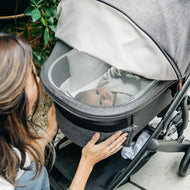
The SENA Aire makes the strongest case when one portable frame must cover supervised play, its included bassinet stage and occasional moves between rooms or destinations. It is less convincing as a substitute for every sleep space. Nuna Canada says only the bassinet may be used for sleeping or napping, while Health Canada says playpens are not recommended for unsupervised sleep. Start with the job, then apply the exact stage and sleep boundary.
Put each proposed job on the switchboard
Write down the actual repeats: morning play beside a caregiver, a bassinet setup in another room, weekends at grandparents, or air travel. A playard can be portable without being effortless for every trip. The current Canadian SENA Aire is listed at 22 lb without the bassinet and folds to 13 by 11 by 31.5 inches, so stair count, vehicle space and how often it moves all matter. If it stays open most days, room footprint and cleaning matter more than carry weight.
Home base: useful when visibility and containment solve a real problem
At home, the SENA Aire can create a defined supervised play area that moves closer to the adult task. Nuna lists mesh sides, floor and mattress, removable ventilated mattress panels, a machine-washable zip-off mattress design and a one-hand fold. Those features support a routine, but they do not remove the need to supervise, check setup and respect the child limits. Health Canada advises locking the sides, checking the floor pad and mesh, and keeping the playpen away from cords and other hazards.
Away setup: count the complete trip, not only the fold

For travel, rehearse the route from storage to final setup. Will the folded frame share a small trunk with a stroller? Is there a safe, flat location away from windows, blinds and electrical cords? Who will check that the frame is fully opened and the correct attachment is installed? The included carry bag helps contain the frame, but a good travel decision includes loading, unloading, setup, inspection and laundry. If those steps feel disproportionate for one short visit, a fixed sleep space at the destination may be simpler.
The Canadian sleep line changes the recommendation
Nuna Canada's SENA Aire product page states that only the bassinet is for sleep or naps, not the playard. Health Canada's playpen safety guidance says playpens are not recommended for unsupervised sleep and identifies bassinet attachments as a separate category with their own setup and milestone rules. Health Canada also says a change table is not a sleep surface. That means ‘playard’ cannot be treated as one sleep permission across every configuration.
Stage exits are stop signs, not suggestions
Nuna lists the bassinet for babies unable to push up on hands and knees, up to 15 lb. The playard is listed for a child unable to climb out unassisted, up to 30 lb and under 35 inches. Health Canada gives an additional bassinet boundary: stop when the baby can roll over or reaches the attachment limit, whichever comes first. Use the earliest applicable limit in the exact manual and government guidance. A calendar estimate cannot replace what the child can do today.
An untimed footprint and route rehearsal
Mark a rectangle about 41.3 by 29.5 inches where the frame would stand. Walk the folded footprint through the narrowest doorway and to the vehicle. Name the storage location for the bassinet components and sheet. Then decide who will verify the setup after every move. If the intended use is unsupervised sleep in the playard configuration, pause. If it solves several repeated supervised tasks with one known setup, it has a clearer role.
What to buy with it, and what can wait
The SENA Aire includes a carry bag and an organic cotton sheet according to Nuna Canada, so do not automatically duplicate the sheet on day one. A spare fitted sheet may help only after you know the laundry cycle. The changer, waterproof mattress cover and insect net each solve narrower problems and deserve their own compatibility check. See the current SENA Aire at baby enRoute and add accessories after the routine proves the need.
Decision: home, away or neither
Choose it mainly for home when a movable supervised play zone and easy-to-clean components will be used every week. Choose it for occasional travel when the folded size, 22 lb listed weight and setup checks fit the route. Treat the bassinet as a stage-limited attachment, not a permanent reason to keep the system. Skip or delay it when a fixed crib already solves sleep, floor space is scarce, or portability would be used only in theory.
Run three counterexamples before deciding
A playard can look flexible while solving no urgent problem. First counterexample: the family already has a safe crib at home and a compliant bassinet at grandparents, so the SENA Aire would move rarely and duplicate floor space. Second: the intended trip involves stairs, a compact car and enough luggage that the folded frame becomes the item left behind. Third: the desired job is overnight unsupervised sleep in the playard configuration, which conflicts with the Canadian boundary described above. Any one of these can reverse an otherwise positive feature list.
Plan ownership after the first month
If the SENA Aire stays, assign responsibility for checks before use, after moving the frame and whenever the manual requires them. Check mesh, rail coverings, mattress pad, fasteners and the label; confirm the manual remains with the frame. Keep the carry bag and bassinet parts together rather than distributing them across closets. Record the child's current weight and developmental milestones near the instructions without turning the note into a substitute for observation. The system remains useful only while every configuration is complete, correctly assembled and appropriate for the child.
Score the primary route
Write the next three likely uses with dates and locations. For home use, score visibility, clear floor area, cleanup and frequency. For travel, score folded fit, carry distance, destination setup, the correct sleep configuration and the return job of cleaning, drying and storage. Name one primary route rather than averaging the scores. If the same complete routine appears several times and the sleep boundary remains clear, the product has a defined job; if it serves only one hypothetical event, wait.
The overlooked exit plan
Decide what happens when the bassinet stage ends and when the child approaches the playard limits. Will the frame continue as a supervised play zone, move to a second home, or be stored? Keep every part and label needed for that later use. Planning the exit avoids holding a large product for a function that ended months earlier and prevents an older configuration from being recreated without the correct components or current instructions.