In this article
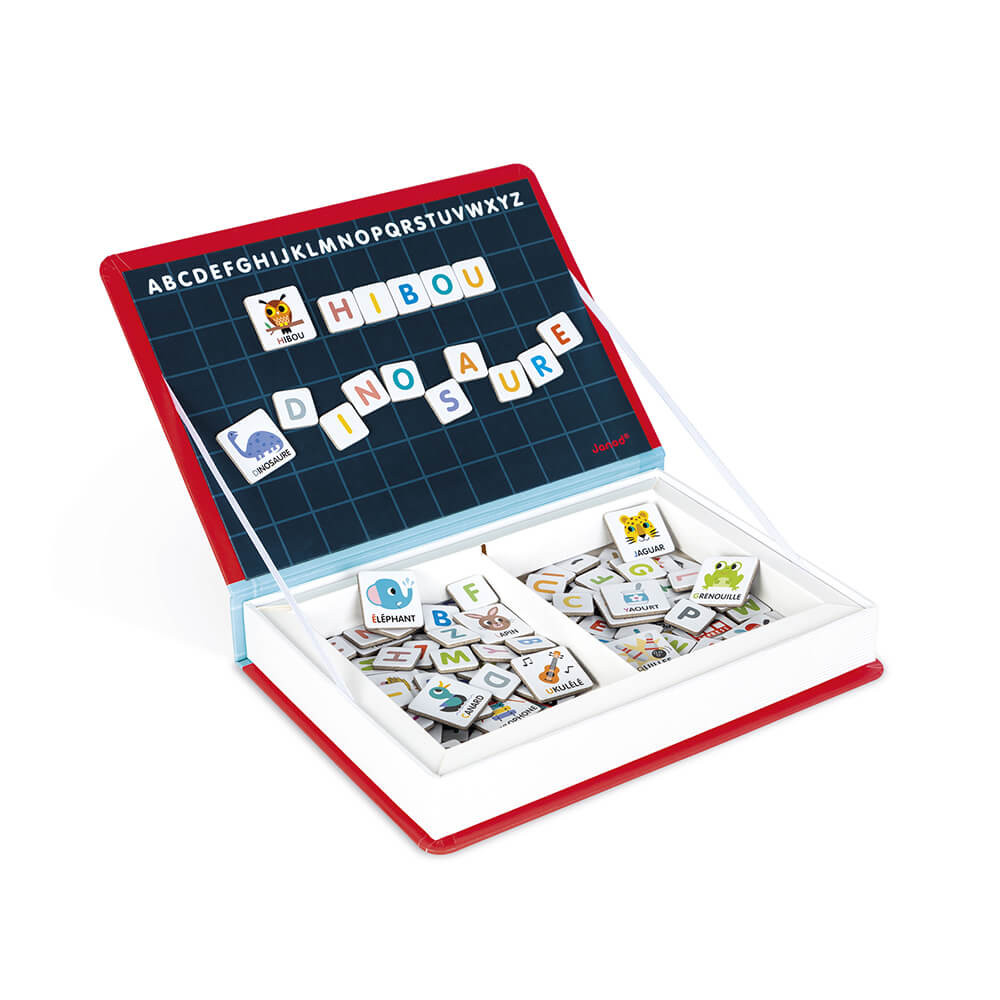
A Janod Alphabet Magneti'book gives you two things to play with: a picture to name and a printed word to build. In a bilingual home, those need not be the same task. You can talk about an owl in English, then arrange HIBOU to match its French label. What the chosen edition supplies is the written model and the letters, not a rule about which language your family may speak.
The English Alphabet book, J02712, pairs illustrated word magnets with separate letters. Janod describes the activity as reproducing the word on the picture magnet. The French Alphabet book, J02711, supplies French prompts and includes accented letter magnets.
Neither local edition can currently be ordered from baby enRoute. The activities below remain useful for families who already own one or for comparing the formats if an edition returns.
The word examples below come from Janod's current product photographs. Older boxes may have different picture words.
1. Name the picture, then choose whether to spell
Take one picture magnet and name what it shows before taking out the letters. With the French owl tile, an English-speaking adult might say "owl", then introduce the printed French word, HIBOU. The child can point to the picture or repeat a familiar name without being asked to spell it immediately.
When you move to letter-building, leave that picture magnet on the board and copy its printed word. For HIBOU, place H, then I, B, O and U beside the model. That keeps the two activities clear: the conversation can use either language, while the visible label tells you which spelling you are arranging.
Janod also shows a JAGUAR picture magnet in both editions. It is a useful shared example because the written word is the same, unlike owl and hibou. It does not mean the two boxes contain a complete set of paired translations. One book is enough for naming pictures in two languages; what the other edition would add is its own set of printed spelling prompts.
2. Build one short word, then change the size of the task
In the French examples, HIBOU has five letters and DINOSAURE has nine. Start with the shorter pictured word and arrange it beside its label. Once it is complete, return those letters to the tray, select DINOSAURE and build the longer word. You are changing the number of letters to find and put in order, while keeping the same picture-and-word format.
The English photographs offer the same kind of choice: ROBOT has five letters and WATERMELON has ten. A longer word can be a shared arrangement, with the adult finding some letters while the child places others. There is no need to finish several words at once or turn the whole tray into an exercise.
This matters when comparing an edition for siblings or planning how to revisit a book already owned. The language label does not set a single difficulty level. A familiar short word, an unfamiliar short word and a longer word ask for different amounts of help. The prompt language sets the model; the word length varies the task within it.
3. Copy the accent as part of the letter
The French picture tiles shown by Janod include ÉLÉPHANT and UKULÉLÉ. Choose one accented word and leave its small printed label visible. When finding its letters, compare the mark above the letter as well as the letter shape. An ordinary E and an É do not reproduce the same printed model.
For ÉLÉPHANT, begin with the accented É, then continue along the word. An adult can find that first tile and let the child place it, or the child can search while the adult points to the mark on the label. The point of this small activity is concrete: make the large magnetic word agree with the little printed one, accents included.
This is the clearest practical distinction of the French edition for French written-word play. Its included accented letters serve a task that simply talking in French over an English picture does not address. You can still enjoy bilingual conversation with the English book; its printed words remain English models.
The prompts define the fit
If either edition returns, its prompts define the decision: French supports activities around French labels and accented letters, while English supplies the English spellings shown with its pictures. For shared bilingual play, naming can cross languages, but a second book adds value only when you want a second set of printed word models. Browse the Janod collection for magnetic play available now.
Both books are listed at 19 by 4 by 26 cm. Both carry Janod's warning that they are not suitable for children under three because of small parts. Their format is the same; the worthwhile choice is which written prompts and letter set you want to use together.