In this article
A 9 lb stroller changes the moment you lift it into a trunk or carry it home. That is the strongest reason to consider the Evenflo Hummingbird alongside the UPPAbaby Minu V3. Evenflo publishes a 9 lb product weight; UPPAbaby lists the Minu V3 at 16.7 lb. The difference is 7.7 lb before adding your child's belongings, substantial enough to make carrying weight a real buying priority.
The lighter stroller still has a reclining seat, a canopy, front-wheel suspension and a basket. Minu V3's case rests on what you gain for the extra weight: a shoulder-carry option, more seat adjustment and twice the published basket allowance. Child stage can settle the choice before any of those details: Hummingbird requires a child who can sit unassisted, while Minu V3 has a documented from-birth configuration.
What 9 lb gives you after the wheels stop rolling
Evenflo's Canadian Hummingbird specifications describe a carbon-fibre stroller with a one-handed compact fold and an integrated carry handle. Its appeal is the low weight of the stroller itself, not a long list of accessories you need to remove before each lift. For a family already happy with a larger stroller at home, Hummingbird offers a distinctly lighter option for car outings, visits and trips with a sitting child.
The Minu V3's 16.7 lb specification puts it in a different carrying category within this pair. If the reason for buying another stroller is that the current one feels heavy whenever it leaves the ground, Hummingbird addresses that problem more directly. An extra 7.7 lb is not a small trim difference between otherwise similar purchases.
The advantage is less decisive when the stroller rolls out of a ground-floor home and stays open through most of the outing. On those days, the seat and basket are doing more work than the carry handle. That is where Minu V3's extra equipment becomes easier to justify, particularly when this purchase must serve as the main stroller rather than a lighter companion.
A lighter handle carry or a heavier shoulder carry?
Hummingbird's integrated handle gives you a direct way to pick up the folded stroller. Minu V3 instead provides an integrated carry strap that is accessible when folded, so the stroller can go over a shoulder. The practical distinction is where the load sits: Hummingbird reduces the weight in your hand; Minu V3 offers a way to free that hand.
For short transfers between a car and storage, the lower hand-carried weight is a strong benefit. For a longer walk with the stroller folded, the shoulder option may be more useful, provided 16.7 lb is manageable for the person carrying it. A strap does not erase the weight difference, and the lighter stroller does not automatically solve the need for a free hand. These are two different advantages, not two versions of the same carrying system.
Both manufacturers describe one-handed folding; UPPAbaby also specifies one-handed unfolding and an upright standing fold. Those features help during transitions, but they do not turn either stroller into a seat for carrying a child up stairs. Both manuals prohibit taking an occupied stroller on stairs or escalators. Compare the carry arrangements with the stroller empty.
Hummingbird keeps the essentials; Minu adds adjustment
The Hummingbird is more than a light frame with a fixed upright seat. Its Canadian product page includes a reclining seat, a three-panel UPF 50+ canopy and mesh at the seat back for ventilation. Those are useful everyday features when the stroller will handle a meal out, an afternoon visit or a longer walk between stops.
Recline operation has a specific limitation worth knowing before buying: the Hummingbird instructions say not to raise or recline the seat with the child in it. Set the angle with the seat empty. That matters if your usual routine involves changing the seat position after your child has settled.
Minu V3 adds a three-position leg rest, a padded integrated insert and a deeply reclining seat, as described in its Canadian seat features. The adjustable leg rest gives you a separate choice about lower-leg support instead of relying on the backrest alone. For a main stroller used through different seated activities, that broader adjustment is a tangible reason to accept more carrying weight.
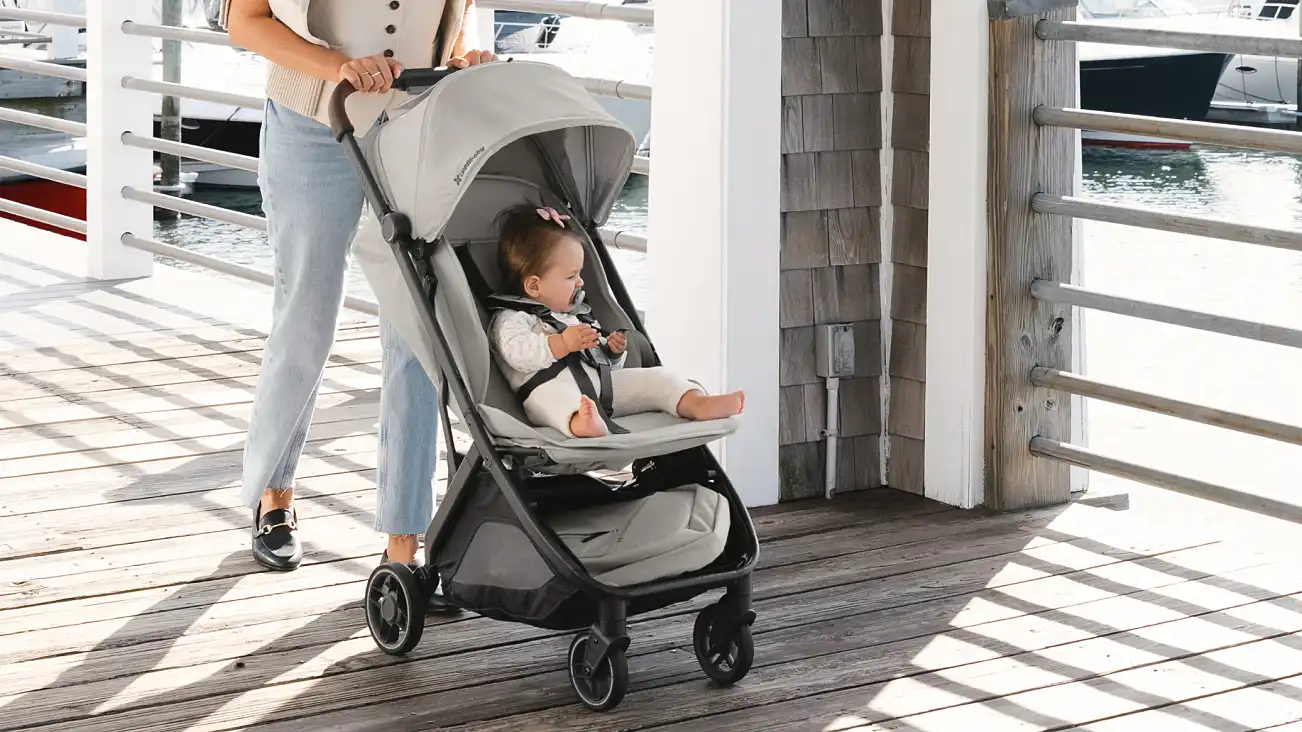
Hummingbird also includes a cup holder, shown in the parts list of its current instructions. Minu V3's Canadian page offers its cup holder as an additional accessory. This is a small point in Hummingbird's favour for a buyer who wants that convenience without another purchase, although it should not outweigh the seat or carrying decision.
The strongest reason to carry more stroller: carry less elsewhere
Hummingbird's main basket has a 10 lb / 4.5 kg limit. Minu V3's North American instructions allow 20 lb / 9.1 kg. That is twice the permitted basket load, not a promise that its physical basket holds twice the volume.
If your outing bag is light and you are not shopping on foot, Hummingbird's allowance may cover what you need. Minu V3 becomes the more useful choice when a substantial changing bag and extra supplies regularly travel underneath the seat. It gives you more room in the weight allowance before something has to stay behind or be carried separately. A bag's shape still needs to fit the opening; a higher limit is useful only if the items can actually be loaded.
Wheel equipment also differs. Evenflo specifies front-wheel suspension; UPPAbaby describes all-wheel suspension with independent rear suspension. For a buyer keeping one compact stroller open through longer daily outings, Minu V3 offers the more extensive suspension arrangement alongside its larger basket allowance. Hummingbird's lower weight remains its advantage for the repeated lift. Neither description establishes how the two will feel on a particular rough route.
The child-stage difference is bigger than the weight difference
Hummingbird's manual requires independent sitting and says it is not recommended for newborns. Its maximums are 55 lb and 40 inches. Minu V3's North American manual permits use from birth, with maximums of 50 lb and 40 inches. Hummingbird's higher weight ceiling therefore does not mean it covers more stages: both have the same height ceiling, and Hummingbird starts later.
For Minu V3, the early-stage instructions specify the most reclined position and rear crotch-buckle slot until the baby has strong head and neck control and can sit with bent knees. The complete five-point harness is required. This is a defined seat setup, not permission to put a newborn into any recline position. For a purchase needed before independent sitting, Minu V3 is the relevant option in this pair; Hummingbird is a later-stage lightweight choice.
When Minu's added equipment earns its price
As of September 17, 2026, the listed prices are $399.99 CAD for Hummingbird and $599.99 CAD for Minu V3; prices may change. For a child who already sits independently, Hummingbird makes a persuasive second-stroller purchase: you spend less and remove 7.7 lb from each empty-stroller lift while keeping recline, shade and basic storage.
The extra spending on Minu V3 is easier to defend when it is buying your main compact stroller: the 20 lb basket limit, adjustable leg rest and shoulder strap address different parts of the day, and the from-birth setup may meet an immediate need. When neither early-stage use nor the extra carrying and seating equipment is important, Hummingbird's lower weight is the clearer gain. To compare other balances of portability and daily use, browse the lightweight travel stroller collection.