In this article
Short answer: buy the UPPAbaby Ridge V2 if you are shopping new. Keep an original Ridge that still fits your family unless the V2's self-standing fold, adjustable handlebar, controllable seat ventilation, or reflective details solve a problem you feel every week. The V2 is the current new-purchase path, not a reason to replace a working stroller by default.
Start on the right side of the decision
| Your situation | Starting answer | What could reverse it |
|---|---|---|
| Buying a Ridge for the first time | Choose Ridge V2, the current model sold by baby enRoute. | A different stroller category may fit better if your routine is mostly stairs, transit, or a very small trunk. |
| You own an original Ridge and it works | Keep it. | Upgrade only if a current V2 feature removes a repeated handling or storage problem. |
| You are comparing a used original Ridge with a new V2 | Compare condition, remaining support, included parts, and total cost before features. | A low used price loses its advantage if worn brakes, missing parts, or uncertain maintenance need attention. |
| You want a stroller mainly for jogging | Either generation requires its exact manual and a route-specific safety check. | Do not use a feature comparison as running-readiness advice. |
Test current V2 features against the original Ridge you own
UPPAbaby Canada's current Ridge V2 page lists an adjustable multi-position handlebar, a one-hand fold that self-stands, controllable seat ventilation panels, and reflective details on the frame and wheels. Official current information confirms these V2 features, but it does not establish that each one is exclusive to V2. Compare them directly with the original stroller you own before assigning upgrade value.
UPPAbaby's official manuals index exposes separate Ridge and Ridge V2 manuals. Existing owners can match the exact original model and its controls before deciding whether a current V2 feature changes their routine. Treat the decision as a household-fit choice, not a manufacturer recommendation to replace a working Ridge.
- The current handlebar never settles into a comfortable position: test the V2's adjustable positions with every regular pusher and compare them with the original stroller in front of you.
- The folded stroller must stand in a hall, mudroom, or garage: test whether the V2's self-standing fold removes a repeated storage problem.
- Warm-weather airflow is a recurring concern: check whether the V2's controllable seat ventilation is useful on the routes and in the conditions you actually use.
- Early or late routes are common: V2 lists reflective details, though visibility still depends on route, lighting, clothing, and local conditions.
If none of those conditions describes your week, the upgrade case is weak. A current generation can offer useful features without making a working original stroller obsolete.

The current V2 planning numbers
| Planning point | Ridge V2 published specification | Why it matters |
|---|---|---|
| Stroller weight | 29.2 lb | Lift the display stroller into the height of your real cargo opening; the current V2 is not a lightweight travel stroller. |
| Open dimensions | 46.3 in. L x 25.6 in. W x 43 in. H | Check elevators, gates, and the tightest turn on the normal route. |
| Folded dimensions | 19.5 in. L x 25.6 in. W x 36 in. H | Measure the trunk or storage location before assuming a standing fold solves total space. |
| Basket capacity | 20 lb | Useful for a covered weekly load, but it should not substitute for a real packing test. |
| Toddler-seat range | From 3 months to 55 lb | From-birth use requires an approved accessory; the stroller seat itself is not the newborn setup. |
UPPAbaby Canada currently lists Ridge V2 at 29.2 lb, so do not treat this update as a weight-saving change. Use the published number for planning, then rehearse the real lift into your vehicle.
Run the two-lap test before buying
Lap 1: the route
- Map one normal week: sidewalks, gravel, park paths, hills, curb cuts, and winter maintenance.
- Mark how often the front wheel would be locked for running versus left swivelling for walking.
- List what normally goes in the basket and whether the covered 20 lb capacity is enough.
- Test handlebar comfort for every regular pusher rather than choosing from a height label.
Lap 2: the transitions
- Measure the narrowest doorway and cargo opening.
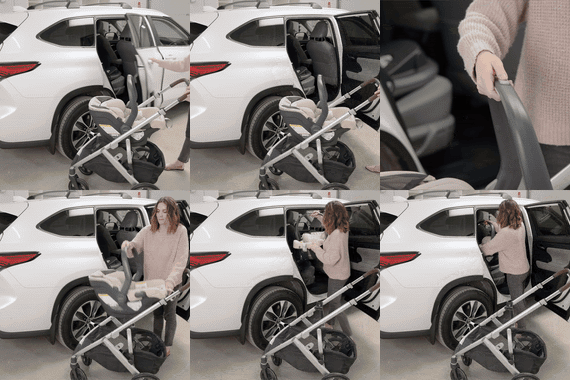
- Rehearse the fold, lift, and set-down sequence without assistance.
- Choose the exact parking spot at home and confirm whether a self-standing fold actually saves space there.
- Price any required newborn adapter or PiggyBack separately; compatibility does not mean the accessory is included.
This test protects against two opposite mistakes: buying V2 for an occasional trail that never happens, or dismissing a standing fold that would improve every weekday transition.
Accessory carry-over needs an exact-name check
UPPAbaby lists Ridge V2 compatibility with its Bassinet, Aria and Mesa infant car seats through Ridge-specific adapters, plus the Ridge PiggyBack. Do not turn that ecosystem statement into a promise that every original Ridge or third-party accessory transfers. Match the accessory name, stroller generation, and current compatibility instructions before relying on it.
For exact newborn connection options and required parts, use the Ridge V2 newborn adapter guide before building the receipt.
The jogging boundary
The current Ridge V2 manual recommends waiting until a child is at least 6 months old for running or off-road use, requires the child to hold their head up unassisted, directs caregivers to consult a physician about readiness, and says to lock the front wheel before running, jogging, or walking fast. Follow the manual for the exact stroller and child; this comparison does not establish individual readiness.
Check the stroller category before the generation
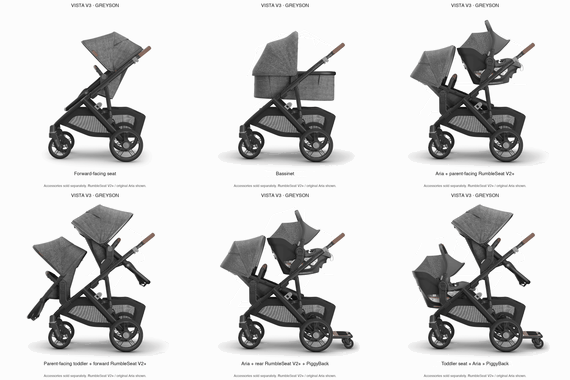
Ridge V2 is a performance jogging stroller, so the original-versus-V2 question matters only after that category fits the household. If most trips involve stairs, frequent transit transfers, air travel, or carrying the folded stroller for long distances, repeat the lift and storage tests before accepting the extra capability and size. If the real choice is a jogger versus an expandable everyday stroller, compare Ridge V2 and Vista V3 instead of using a generation upgrade to answer a category question.
Existing Ridge owners should also separate stroller condition from generation. Check the frame, wheels, tires, brake, harness, folding action and every included part against the original manual. A sound stroller that fits the route can be the better keep decision; a damaged or incomplete stroller needs manufacturer-led assessment rather than an upgrade score.
Use a friction threshold, not a feature count
Write each current V2 feature that could improve your routine on one line, followed by how often it changes a real task. A self-standing fold used twice daily carries more decision weight than ventilation adjusted on one annual trip. Require at least one repeated, measurable improvement before replacing a working original Ridge. This rule also exposes the opposite case: if every regular pusher struggles with the old handlebar position or the stroller falls into a busy storage path after every fold, the V2 change has a clear job to do.
Keep or upgrade: the call
Choose Ridge V2 as a new purchase when a performance jogger matches the real weekly route and the 29.2 lb stroller fits the vehicle and storage plan. Keep an original Ridge when it remains in good condition and the V2's fold, handlebar, ventilation, and visibility details do not remove a recurring friction. A worthwhile upgrade solves a problem you can name before you spend.