In this article
Start with two separate measurements: what the infant carrier weighs in your hand and how much room the installed seat needs in the vehicle. A light carrier can still require substantial front-to-back space, while a narrow base does not prove that the carrier will clear the front seat at the required recline.
Compare only Canadian-certified seats that fit the child's current height and weight. Then use the Canadian restraint manual and vehicle manual to check the intended seating position. Transport Canada does not rate, rank or endorse individual seats, so feature lists are not a substitute for child and vehicle fit.
Make two shortlists, not one score
| Question | What to record | What it does not prove |
|---|---|---|
| Will it fit the child? | Canadian height and weight range, newborn insert rules and any head-clearance limit | Vehicle fit |
| Can the caregiver carry it? | Carrier-only weight, handle position and the real route from car to home | Installed size |
| Will it fit the vehicle? | Base and carrier width, front-to-back space at the allowed recline and front-passenger position | Fit in another vehicle |
| Will transfers help? | Approved stroller connection, number of stairs and frequency of short stops | That the carrier should be used as a sleep space outside travel |
Child fit comes before carry weight
Write down the baby's current weight and length, then check the label and manual for the exact Canadian model. Transport Canada's buying checklist asks shoppers to compare the child's age, weight and height with the restraint. A model name shared with a US seat does not establish Canadian limits.
For example, UPPAbaby's Canadian Aria V2 specifications list the Aria V2 for children from 4 to 22 pounds and up to 32 inches, whichever limit comes first. Clek's Canadian Liing specifications list the Liing from 4 to 35 pounds and up to 32 inches. The higher number does not make one seat a better fit for a particular newborn; the harness, required insert, recline and clearance rules still have to work for that child.
Compare the weight you will actually lift
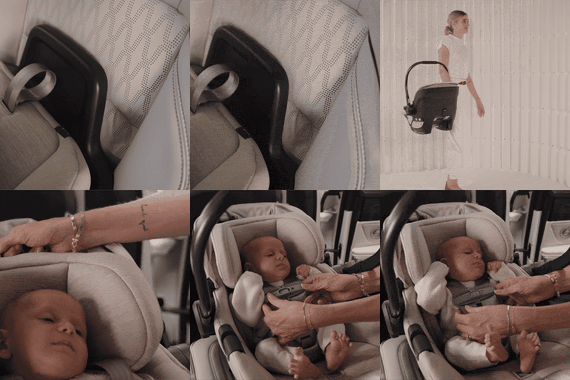
Manufacturer carrier weights are useful when they state what has been removed. UPPAbaby lists the Aria V2 carrier at 6 pounds without its canopy and insert. Clek lists the Liing carrier at 9 pounds with the newborn insert removed. Once the baby, canopy and permitted accessories are added, the carried load is greater.
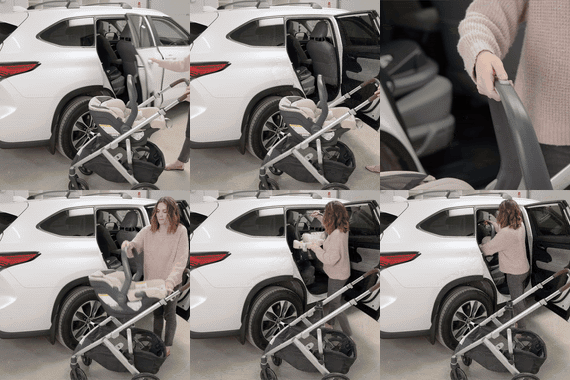
Map the actual transfer rather than choosing the smallest catalog number. A family parking beside an elevator may carry the seat only a few metres. A caregiver climbing two flights of stairs or lifting the carrier into a high vehicle may feel the difference every day. Try the handle clearance and lifting path without twisting around a door frame or neighbouring seat.
If the carrier will usually stay clicked into the base, low carrier weight may be less important than easy harness access or a setup that leaves enough room for the front passenger. If the carrier will often connect to a stroller, verify the exact stroller and adapter combination with both manufacturers.
Installed geometry is a different test
Width is only one dimension. UPPAbaby lists the Aria V2 at 17 inches wide. Clek lists Liing at 16.9 inches wide, with a 13.2-inch-wide base. Those figures help with side-by-side planning, but neither states how the seat will fit front to back in a particular vehicle.
Install each candidate at the recline required for the child's size. Put the front seat in a position permitted by the vehicle manual, then check whether the passenger can sit as the vehicle manufacturer intends. Confirm whether the child-restraint manual allows contact with the front seat; do not assume that touching or a gap is universally required.
Repeat the installation in every vehicle that matters. A base that fits a family SUV may crowd a compact second car, and a centre position may have different belt, lower-anchor or floor-support rules from an outboard position.
Base installation and baseless use are separate routines
An infant seat may allow installation with a base, without a base, or both. That flexibility matters only when the caregiver can follow the correct belt path, recline and locking instructions in the vehicle being used. A rideshare plan should be practised with the exact carrier; it should not be inferred from the presence of a handle.
A load leg also depends on the exact vehicle position and manual instructions. Check the vehicle floor and storage-compartment rules before treating the feature as usable. If either manual prohibits the setup, choose another seating position or another seat.
Complete a vehicle-fit check
- Find the National Safety Mark and Canadian model label.
- Confirm the child's measurements are within the label and manual limits.
- Install the base or carrier in the exact seating position you plan to use.
- Set the recline for the child's size and check the permitted installation method.
- Move the front seat only within the vehicle manufacturer's instructions.
- Check adjacent buckle access, another child seat and the carrier release path.
- Have each regular caregiver lift, buckle and remove the carrier without changing the installation.
Decide from the repeated task
Choose the lighter carrier when carrying is frequent and the seat also passes the child and vehicle checks. Choose the better-installed fit when the carrier will mostly remain in the car. When both matter, compare them as two vetoes: a carrier that is manageable but does not fit the vehicle is out, and a seat that fits the vehicle but cannot be handled through the daily route needs a different transfer plan.
Use the infant car seat selection to build the shortlist, then verify the current Canadian manual for the exact model before purchase.