In this article
If you want glass but worry about a bottle slipping out of wet hands at 3 a.m., Pigeon's new silicone-coated glass bottle is worth the extra $10 to $13 per bottle. If your bottles mostly stay at home and you're careful with them, Pigeon's plain glass bottle is the better value. For daycare, travel and a baby who's starting to hold the bottle, PPSU is the practical choice.
All three are Pigeon wide-neck bottles with the same nipple, so you don't have to pick just one. If you're deciding between glass and plastic bottles in general, the same trade-offs apply to most brands: glass is heavier and easier to keep looking new, PPSU plastic is lighter and safer to drop.
The three side by side
| Silicone-coated glass | Glass | PPSU | |
|---|---|---|---|
| What touches the milk | Glass | Glass | PPSU plastic |
| Outside feel | Soft, grippy silicone | Smooth glass | Smooth, light plastic |
| Weight | Heaviest (glass plus a silicone layer) | Heavy | Lightest |
| If it's dropped | Better protected, but it's still glass | Can break | Won't shatter |
| Price per 8 oz bottle | $39.98 (2-pack $79.95) | $29.99, or $26.66 in a 3-pack | $28.99 |
| Price per 5 oz bottle | $37.48 (2-pack $74.95) | $26.99, or $25.00 in a 3-pack | $25.99 |
| Best for | Glass at home, with less worry | Glass at home, lowest cost | Daycare, travel, self-feeding |
Prices are in CAD and were current when we wrote this.
What the silicone coating does, and what it doesn't
The coated bottle is glass on the inside with a silicone layer on the outside. Pigeon says the coating adds grip and impact protection. In practice that means two things: it's easier to hold when your hands are wet from washing or warming, and it's better protected from everyday knocks against the counter or sink.
It doesn't make glass unbreakable. A drop onto tile can still break it, so keep treating it like a glass bottle. The coating also adds weight rather than taking any away, so it's the heaviest of the three.
If the main reason you're considering glass is that milk only touches glass, the plain and coated bottles are the same on the inside. You're paying for the outside.
See the 8 oz silicone-coated glass 2-pack or the 5 oz 2-pack.
Plain glass: the value pick for home
Pigeon's plain glass bottle gives you the same glass interior for less, especially in the 3-pack. Glass doesn't scratch the way plastic can, and it's easy to see whether it's clean.
It's a good fit if your bottles live on the counter and in the steriliser, you feed mostly at home, and you're not regularly carrying bottles in a diaper bag. The trade-off is the weight and the drop risk.
See the 8 oz glass bottle or the 5 oz glass bottle.
PPSU: for daycare, travel and little hands
PPSU is a heat-resistant plastic that's much lighter than glass and won't shatter. That makes it the easier choice when a bottle goes in a bag, on a plane or to daycare.
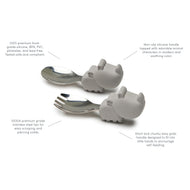
It also makes sense once your baby starts reaching for the bottle. A full glass bottle is heavy for a baby to hold. Pigeon's bottle handles are made for the 8 oz PPSU bottle and give small hands something to grip. Whatever bottle you use, stay with your baby while they feed and don't prop the bottle.
Plastic does show wear over time. Replace a PPSU bottle if it turns cloudy, discoloured or scratched.
Before you buy a full set for daycare, ask the centre about its bottle rules. Policies vary, and some centres don't accept glass.
See the 8 oz PPSU bottle or the 5 oz PPSU bottle.
The same nipple fits all three
This is the most useful thing to know before you buy. The coated glass, plain glass and PPSU bottles all take the same Pigeon wide-neck nipple. Your baby gets the same feel whichever bottle you grab, and you can mix materials without starting over.
Pigeon nipples come in five flow stages:
- SS: 0 months and up
- S: 1 month and up
- M: 3 months and up
- L: 6 months and up
- LL: 9 months and up
Watch which nipple comes in the box. The 5 oz bottles come with an SS nipple, and the 8 oz bottles come with an M (3 months and up). If you're buying 8 oz bottles for a newborn, add a pack of SS or S Pigeon nipples so the flow isn't too fast. Ages are a guide. Your baby's feeding cues matter more than the number on the nipple.
Pigeon recommends replacing nipples at least every two months and rotating two or more so each one wears more slowly. Replace one sooner if it feels soft or sticky, or if it's torn.
A setup that works for a lot of families
Many families end up with a mix: two or three glass bottles at home, and one or two PPSU bottles for the diaper bag, the car or daycare. Because the nipples match, your baby doesn't have to adjust, and one set of spare nipples covers everything.
If you want glass at home but someone in the house is nervous about breakage, put the coated glass bottles in that spot instead.
Comparing other brands too?
If you haven't settled on Pigeon, our Hegen vs Pigeon vs Dr. Brown's comparison looks at how the three brands differ. If you're starting from scratch with a newborn, see our guide to the Pigeon Newborn Feeding Gift Set.
Want to feel the difference between coated and plain glass before you choose? Call our Richmond, Burnaby or Ottawa store ahead of your visit and we'll let you know which Pigeon bottles we have on hand that day. You can also browse the full Pigeon range or all bottle feeding products.