In this article
The milestone of starting solid foods marks a messy, exciting, and significant shift in family routine. At baby enRoute, we help parents navigate the Nursing & Feeding aisle by focusing on the three pillars of this phase: Preparation, Consumption, and Cleanup.
With options from Beaba, Marcus & Marcus, and Bumkins, the right toolkit depends on your approach to mealtime. Here are the decision dimensions to consider.
Dimension 1: The Food Source Strategy
Before the spoon hits the mouth, the food must be prepared.
The Homemade Chef
For families committed to making their own purées, the friction point is often the time it takes to steam and blend. Beaba addresses this with their all-in-one stations. Parents choose this route when they want to control ingredients and textures without dirtying every pot in the kitchen. The trade-off is counter space, but the gain is workflow efficiency.
The Batch Prepper
We also see families who prefer to cook once and eat for a week. These parents often pair food makers with storage solutions, viewing food prep as a Sunday activity rather than a daily chore.
Dimension 2: The Independent Eater
How the child interacts with food changes rapidly from 6 to 12 months.
The Grip Factor
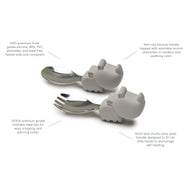
Utensils need to fit the hand. Marcus & Marcus designs are frequently selected for their ergonomic "palm grasp" shape. Families focusing on baby-led weaning often prioritize these shorter, chunkier handles because they align with a toddler's natural motor skills, reducing the frustration of getting food to mouth.
The Material Safety
Silicone is the material of choice here. Parents gravitate toward it for its softness, ensuring that if a child chews on the spoon (which they will), it won't damage developing gums or teeth.
Dimension 3: The Mess Management
Accepting that mess will happen is the first step; managing it is the second.
The Coverage Level
Bumkins offers a spectrum of protection. For light snacks, a standard bib suffices. But for spaghetti nights or sensory play, families often opt for sleeved bibs. The decision here is about laundry tolerance: do you want to wash a full outfit after dinner, or just rinse a bib?
The Quick Turnaround
Fast-drying fabrics are a key logistical advantage. We observe that parents with multiple children or frequent meal schedules prefer the thin, waterproof fabric of Bumkins because it can be rinsed and ready again for the next meal, unlike heavy cloth bibs that stay damp.
Retailer Insight: The "System" Approach
We often see parents register for these items as a cohesive system. A common pattern is pairing the "prep" tool (Beaba) with the "eating" tool (Marcus & Marcus). Families realize that having the right ecosystem of gear can make the transition to solids feel less like a chaotic experiment and more like a managed routine.
Summary: Defining Your Toolkit
Every family finds their own rhythm.
- Consider Beaba if: You value the control of homemade food but need to save time on cooking mechanics.
- Consider Marcus & Marcus if: You want to encourage self-feeding with tools designed for small hands.
- Consider Bumkins if: Your priority is minimizing laundry and protecting clothing from aggressive spills.
We invite you to visit our shelves in Richmond, Burnaby, or Ottawa. Holding the utensils and testing the bib fabrics can help you visualize how these tools will work at your dinner table.
Quick FAQ: General Selection
Q: When should I buy these items?
A: Families often purchase these a month or two before the planned start of solids to be ready when the child shows interest.
Q: Can I mix and match brands?
A: Absolutely. Most families curate a mix of bibs and utensils from different brands to suit different meals and locations (home vs. restaurant).
Related baby enRoute reading
- Bc Babycare Long Sleeve Bib in Canada: A Practical Guide for Outdoor Meals and Messes
- B.box Silicone Bib in Canada: A Practical Guide for Outdoor Meals and Messes
- The Ultimate 2025 Holiday Gift Guide: Best Christmas Gifts for Babies & Toddlers
Product details can change: Check linked product pages for current colours, pricing, availability, and compatibility. Follow manufacturer instructions and official safety guidance when those apply.