In this article
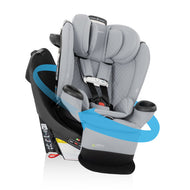
Short answer: the Clek Foonf and Diono Radian 3R are both marketed for space-conscious installations, but a width claim does not prove that three seats will fit in a specific Canadian vehicle. Clek publishes a 16.9-inch Foonf seat width. Diono publishes a 129.5 cm minimum interior width between fixed structures for a three-Radian setup. Those are different measurements. Child mode, adjacent-seat shape, belt geometry, buckle access and the vehicle and car-seat manuals still control the result.
There is also a current purchase boundary: baby enRoute has sellable Clek Foonf variants but no Diono Radian car seat. For Clek-only configuration ideas, use the Clek 3-across guide. For single-seat progression, use the dedicated Foonf guide.
Compare the exact Canadian models
| Planning point | Clek Foonf | Diono Radian 3R |
|---|---|---|
| Current baby enRoute path | Sellable variants are available | No Radian car seat is listed; a Radian cover is not a seat purchase path |
| Space number published by manufacturer | 16.9 in seat width; 13 in base width | At least 129.5 cm between fixed interior structures for three Radians |
| Rear-facing range | 14-40 lb, 25-43 in and able to sit upright alone; Infant-Thingy can extend use from 5 lb and 19 in under its instructions | Manufacturer product page states rear facing to 50 lb and 44.1 in |
| Forward-facing harness maximum | 65 lb and 49 in | 65 lb; consult the exact Canadian label and manual for the minimum because the current product page gives inconsistent minimum figures |
| Booster mode | No | Manufacturer markets booster use to 120 lb, subject to the exact label and manual |
| Rear-facing front-to-back planning | Clek publishes 33 in | Diono publishes approximately 76-91.4 cm depending on vehicle and approved setup |
| Moving and storage | 38 lb rear facing; 33 lb forward facing; does not fold | Folds for transport; product weight and exact configuration should be checked on the Canadian label/manual |
These planning boundaries do not establish crash outcomes or a “safest” winner in a particular vehicle.
Why three-across math fails
Adding three advertised seat widths ignores where each shell flares, where the base lands, whether two seats can puzzle beside one another, and whether an adult can reach the buckle for a booster. Clek also notes that moving from lower anchors to a seat-belt installation can shift where a seat sits and that many vehicles do not provide lower anchors in every rear seating position.
Diono's 129.5 cm figure is a useful rejection screen for three Radians, not a universal approval. It measures between fixed structures for that named configuration. It does not certify a mixed row of one Radian, one Foonf and another seat.
Three rows that can reverse the answer
Three harnessed seats
A row of harnessed seats avoids an adult reaching between shells to buckle a booster on every trip, but the shells still have to install independently in approved seating positions. Three copies of the same narrow model can fail if the vehicle's centre position, belt geometry or head restraints do not permit the required installations.
Two harnessed seats and one booster
The booster changes the daily-use test. The child must be able to route and buckle the belt correctly without moving a neighbouring installed seat. A mathematically narrow row that blocks the buckle is not a working row. Radian's eventual booster mode is therefore not automatically an advantage in a tight configuration; the exact belt path and access matter.
A mixed Foonf, Radian and third seat
Neither Clek's shell width nor Diono's three-Radian interior-width figure certifies this mixed row. The third seat's base, widest point and required recline can change the result. Test the complete set in the intended directions and positions, not a two-seat sample with empty space where the third restraint will go.
Front-to-back space can end the plan first
Three-across discussions often focus on side-to-side width, but a rear-facing restraint also occupies front-to-back space. Clek publishes 33 inches for rear-facing Foonf, while Diono publishes a range of approximately 76-91.4 cm for Radian 3R depending on the vehicle and approved setup. Check whether the front seat can remain in an allowed, usable position without touching or bracing unless both manuals permit it. A row that fits laterally can still be impractical for the front passenger.
Moving the seat changes ownership value
Foonf's published weight is 38 lb rear facing and 33 lb forward facing, and it does not fold. That can suit a seat that remains installed in one vehicle, but it adds work for frequent transfers. Radian's fold can matter for storage or transport, yet folding does not remove the need to verify a Canadian model, complete installation and usable row at the destination. Decide whether the seat is primarily permanent, occasionally moved between family vehicles or intended for travel before treating portability as a tie-breaker.
Use this fit worksheet before checkout
- Name all three children and modes: rear-facing harness, forward-facing harness or booster. Do not plan from ages alone.
- Name all three exact Canadian seats: record model, manufacture date and the National Safety Mark.
- Choose the proposed seating positions: read the vehicle owner's manual for prohibited positions, air-bag warnings, belts, head restraints and lower-anchor locations.
- Record the manufacturer's space number: Foonf width or the Radian three-seat interior-width screen is only a starting input.
- Check each manual's approved installation: never assume lower anchors are required or available in the centre.
- Install and verify each seat independently: confirm that installing or removing one does not disturb another and that required buckles remain usable.
- Get qualified help for unresolved fit: a Canadian Child Passenger Safety Technician can evaluate the exact children, seats and vehicle; the final installation must still follow both manuals.
Bring a complete fit record
Before a store fit check or technician appointment, bring the vehicle year, make and model, photos of all three rear seating positions, the vehicle manual, each child's current measurements and the exact names of all three restraints. Record which seats are already owned and which are candidates. If one child will soon change modes, test both the current row and the near-term row; buying for a configuration that lasts only a few weeks can create another replacement.
Also plan the handoff from demonstration to daily use. Every regular caregiver should know which seating position belongs to which child, which installation method is approved, how the harness or belt is routed and what must be checked after a seat is removed. A successful one-time arrangement is not useful if it cannot be reproduced without disturbing the neighbouring restraints.
Plan the next mode before buying three seats
Write down the first likely change in the row: a rear-facing child moving forward facing under the exact limits, a harnessed child moving to booster mode, or a seat reaching expiry. Then repeat the fit plan for that future mode. Booster access can become harder even when the shell gets no wider, while a forward-facing installation may use a different approved method or seating-position rule. The useful purchase is the one that fits now without creating an obvious near-term dead end.
A vehicle change resets the calculation. Keep the exact Canadian manuals and model records with the seats, but do not carry an old vehicle's approved layout into a different row. Even another trim level can change the usable seating geometry. Recheck seating positions, belts, lower anchors, head restraints and front-seat clearance from the beginning.
Which path makes sense?
Choose Foonf as the current baby enRoute path
Foonf is the actionable choice when its exact rear- or forward-facing range fits the child, its 16.9-inch shell works in a verified row, and a heavy non-folding seat suits the household. Its current availability is a commercial advantage, not proof of vehicle fit.
Keep Radian 3R in the comparison for a specific reason
Radian 3R belongs on the shortlist when folding, its published rear-facing maximum or eventual booster mode solves a defined need and a current Canadian purchase route can be verified. Existing owners should use the exact Canadian label and manual. The current Diono product page contains inconsistent forward-facing minimum figures, so use the exact Canadian label and manual instead of choosing one number from the page.
Stop the comparison when the row is still theoretical
Do not buy three seats from a spreadsheet alone. Transport Canada directs caregivers to follow the exact child-seat and vehicle manuals, and its Canadian purchase guidance requires the National Safety Mark. A three-across layout is complete only when every seat can be used correctly in the real vehicle for the real children.