


Short answer: a stroller rain cover is not universal because it must match the exact stroller and configuration, attach at the intended points, preserve the maker's required canopy position and openings, stay away from the child's face, and be removed under conditions the instructions exclude. Buy from the model name outward, not from a visual guess that the clear shell looks large enough.
A cover also creates work after the rain: it must be removed, cleaned as directed, dried open, folded without damaging clear panels, and stored where it can be found before the next shower. Compatibility includes that whole cycle.
For a broader view of which add-ons earn space in a stroller setup, see Stroller Accessories That Actually Get Used. This guide goes deeper on one accessory only: matching a rain cover to the exact model and managing fit, visibility, weather limits, drying, and storage.
Build the identity chain
- Record stroller brand, exact model, generation, manufacture date, and current seat or bassinet configuration.
- Read the stroller manual's accessory and weather sections.
- Find a cover whose official compatibility statement names that model and configuration.
- Keep the cover instructions with the stroller manual.
- Verify every attachment point on the actual frame before travel.
- Repeat when the seat direction or stroller configuration changes.
The physical ability to stretch a cover over a canopy is not compatibility evidence. A loose panel can reach a wheel, a tight panel can distort an opening, and a mismatched lower edge can leave no stable attachment point.

Compare two model-named examples
The Bugaboo Butterfly 2 Rain Cover is named for the Butterfly 2. Treat that exact product identity as the starting point and verify the current Bugaboo instructions rather than extending it to an earlier stroller by appearance.
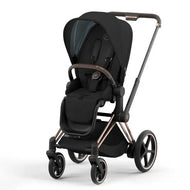
The Cybex Coya Rain Cover is currently listed for the Cybex Coya stroller and described as a transparent cover. Its named fit does not authorize use on another compact Cybex model.
The rain-cover collection owns current commercial choices, while the stroller-accessories collection helps locate other model-specific items. Keep each accessory's owner model visible in storage.

Read the weather limits, not just the word rain
Bugaboo's Canadian warning booklet says its rain cover should not touch the child's face, the child should be monitored frequently, and the cover should not be used for prolonged periods. It also says not to use the cover indoors or outside when it is not raining and warns against leaving a child under it in sunny weather because of overheating risk.
The same booklet says not to use the rain cover on a product other than one recommended by the manufacturer. These instructions are for the covered Bugaboo products and do not automatically become Cybex instructions. Read the manual supplied for the exact cover in use.
Run the dry-fit visibility audit
Install the cover without a child present, exactly as directed. Check every fastener, lower edge, zipper or opening, and the maker's required canopy position. Move the handle and permitted seat adjustments. Confirm that no clear panel reaches the child's face area and that the adult can see the seating area from normal walking positions.
Health Canada says to follow manufacturer instructions for extra stroller items and accessories, stay close to supervise a child in the stroller, and check the stroller for damage. A dry fit should therefore end with a complete stroller condition check, not only a photograph of the cover.
Plan the remove-and-dry sequence
- Choose where the wet cover can be removed without dripping into the stroller seat.
- Shake or wipe water only as its instructions permit.
- Open every fold and attachment area for drying.
- Inspect clear panels for cuts, clouding, or changed seams.
- Keep the cover open until all surfaces and its storage pouch are dry.
- Fold along the intended lines without placing heavy items on top.
A clear panel that is difficult to see through, a torn opening, or a fastener that no longer holds changes the use condition. Stop and obtain the maker's advice rather than adding tape, cutting new ventilation holes, or tying the cover to the frame.
Pack for a forecast change
Store the dry cover in a known stroller-basket position without exceeding the basket instructions. Keep it separate from sharp toys, wet cloths, and food residue. Practise installing it before a trip so rain does not become the first time the attachment order is discovered.
When conditions shift to sun, indoors, or a weather condition excluded by the manual, remove the cover promptly as directed. A cover should not remain installed merely because folding it again is inconvenient.
Time installation without rushing the fit
Practise from the stored state with the stroller empty. Record how long it takes to identify the front, unfold clear panels, set the canopy position, attach every point, and complete the face-area and visibility checks. Repeat until the order is familiar, but never shorten the sequence by skipping a fastener or condition check.
Then practise removal into a wet-item area. The useful time includes keeping water away from the seat, opening the cover to dry, and repacking only when dry. An accessory that installs quickly but takes over a hallway for drying may still be right; the household simply needs a designated place.
Check the full viewing triangle
View the covered seating area from behind the handle, from each side, and from the front while the stroller is stationary. Clear material can reflect lights or collect droplets, so transparency in a product image is not the same as visibility in rain. Use the cover's intended openings and positions only.
Plan frequent observation points along the route and remove the cover under conditions excluded by its manual. Do not use a phone camera, mirror, or window as a substitute for direct supervision.
Keep model identity on the pouch
Label the storage pouch with the exact stroller model and cover product name. In a household with several strollers, similar clear covers can be difficult to distinguish after unfolding. A model label prevents a visually plausible but unauthorized swap at the door.
Add the front orientation and attachment order to the label only if those notes restate the current manufacturer instructions accurately. Keep the original manual as the controlling source. Replace the label when the stroller, cover, or instructions change instead of layering new notes over old ones.
Before lending or selling the stroller, reunite the cover, pouch, and instructions and confirm the model identity again. An unlabelled clear cover should not be included as a guessed accessory merely because it was stored nearby.
Questions shoppers actually ask
Are compact-stroller rain covers universal?
No. Verify exact model and generation, configuration, attachment points, and current manufacturer instructions.
Can I make extra air holes?
Do not modify the cover. Use only its designed openings and contact the manufacturer if ventilation or fit is uncertain.
Can the cover stay on when rain stops?
Follow the exact manual. The cited Bugaboo booklet says not to use its cover outside when it is not raining and not to use it indoors.
Can I fold a wet cover into its pouch?
Dry the cover and pouch as instructed before closed storage. Water can remain in folds and attachment seams.
Sources checked
- Health Canada: Stroller and carriage safety, page dated November 3, 2025. Accessed August 4, 2026.
- Bugaboo: Canadian generic warning booklet. Accessed August 4, 2026.
- baby enRoute: Cybex Coya Rain Cover. Accessed August 4, 2026.